Why Companies Are Choosing Remote Recruitment
Remote recruitment lets employers post job openings, review applications, interview candidates, administer tests, and complete parts of the hiring process online. It is often linked to remote jobs, but can also be used to hire for hybrid and office-based roles.
Companies are using remote recruitment because it lets them reach more candidates, makes scheduling interviews easier, and helps hiring teams in different places work together. But it also raises new concerns about candidate information, identity verification, online tests, accessibility, and platform safety.
A successful remote recruitment process, therefore, needs more than just video call software. Employers need a clear hiring plan, the right technology, proper security measures, and regular communication with candidates from a remote Location.
Traditional recruitment often limits employers to candidates who live nearby or can travel for multiple interviews. Remote recruitment removes this location limit.
A company can interview candidates from different cities, regions, or countries without asking them to travel during the early stages. This may be especially useful when recruiting for:
- Specialist positions with a limited local talent pool
- Remote and hybrid roles
- International assignments
- Multiple offices or project locations
- Contract and freelance work
- Senior positions requiring a wider executive search
A wider search does not automatically mean it will find better candidates. Recruiters still need to clearly define the job, choose the right ways to find candidates, and check practical details such as work hours, relocation, job type, and work permits—a well-defined search rather than compensating for an unclear job description.
Online Hiring Can Reduce Scheduling and Administrative Delays
Setting up an in-person interview may need meeting rooms, travel plans, and managing several schedules. Virtual interviews can help address some of these practical problems, especially when hiring managers are in different locations.
Online scheduling, automatic reminders, and shared candidate records can also reduce repetitive paperwork. Recruiters can keep applications, interview notes, tests, and messages in one system instead of using separate spreadsheets and emails.
The time saved depends on how the process is set up. Putting a slow recruitment process online will not fix extra approval steps, late feedback, or unclear roles.
Before launching new software, employers should establish:
- Who reviews each application?
- Who can move candidates between stages?
- Which interviewers provide feedback
- How quickly decisions should be recorded
- Which documents must be collected?
- When candidates should receive an update
Technology works best when these tasks are already clear.
Virtual Interviews Can Support a More Consistent Evaluation Process
Remote recruitment allows employers to use the same interview style across different locations. But just having a set format does not make judging candidates fair or accurate.
A structured interview uses predetermined, job-related questions and consistent scoring criteria. Candidates are asked comparable questions, and interviewers assess their responses against the same standards. The US Office of Personnel Management notes that standardized interviews give candidates equal opportunities to provide information and support more accurate and consistent assessment. CIPD guidance also recommends standardized interviews and objective evaluation criteria to reduce the influence of personal bias.
Hiring teams should prepare:
- Questions connected to the responsibilities of the role
- Clear indicators of strong, acceptable and weak responses
- A consistent interview sequence
- Independent scoring before panel discussion
- Written reasons for selection and rejection decisions
Remote interviews can make it easier to follow this structure with different teams. They should not turn into casual talks where each interviewer asks random questions.
Candidate Experience Depends on More Than Convenient Technology
Remote recruitment can make interviews easier to attend, but it can also exclude candidates with poor internet, the wrong devices, disabilities, or limited experience with the chosen platform.
Employers should tell candidates in advance:
- Which platform will be used?
- Whether an account or software installation is required
- How long the interview or assessment will take
- Who will attend
- Whether the session will be recorded?
- What documents or materials are needed
- Whom to contact if a technical problem occurs
Candidates should also have a fair chance to ask for changes. This might include extra time, captions, a phone option, tests that work with a keyboard, or a different interview time. HR teams should write down all requests, review them quickly to decide what is fair and needed, and record the results and actions taken. Clear communication with the candidate about the decision and any plans is important to ensure fairness and meet accessibility rules.
The CIPD advises employers to explain the technology and assessment process in advance and to ask candidates whether they require reasonable adjustments proactively.
A technical failure should not automatically count against a candidate. Recruiters need a backup arrangement. A technical problem should not count against a candidate. Recruiters need a backup plan, like calling by phone again or rescheduling the part of the interview that was affected. Information breaches occur during remote recruitment. For technical failures, recruiters should:
– Document the nature of the problem and its impact on the candidate’s experience.
– Notify the candidate promptly and describe the steps being taken to resolve the issue.
– Offer other arrangements, such as a different interview platform or rescheduled time.
To prevent potential data leaks, HR should restrict access to affected systems.
– Report the incident to the organization’s data protection or IT team without delay.
– Inform candidates if their information may be at risk, in line with legal obligations.
– Record all actions taken and review the incident to strengthen future processes.
Having a clear plan helps teams respond fast, reduce stress for candidates, and handle incidents fairly and safely.
Protect Candidate Data from the First Application
Recruitment involves personal information such as names, contact details, work history, qualifications, salary information, interview notes, and references. Later steps may include ID documents, health info, background check results, or bank details.
Remote recruitment can increase the number of systems that handle this information. Candidate data may move among a job site, an application system, email, a testing service, a video interview platform, and a background check company.
Employers should first find out:lected
- Why each item is needed
- Which system stores it
- Who can access it
- Whether it is shared with another provider
- How long it will be retained
- How it will be removed or anonymized
Data protection rules differ between countries. Employers must know which laws apply to their company, candidates, and data use instead of assuming one global policy is enough.
The UK Information Commissioner’s Office, for example, states that recruitment data protection applies from finding candidates through to deleting their information. Its guidance also recognizes that recruitment can include sensitive information about health, diversity and criminal convictions. To achieve compliance, HR teams should take practical steps, such as issuing explicit privacy notices to candidates and explaining how their information will be used and their rights under relevant laws. Employers should manage consent appropriately, making sure it is sought only when necessary and documented where required. Data retention policies should be set so that candidate information is stored only for as long as needed and safely deleted or de-identified when no longer necessary. Regular reviews of these policies help sustain compliance as laws evolve. ICO recruitment guidance
A privacy notice must explain the purpose of collection, the applicable legal basis, recipients of the information, retention period and relevant candidate rights. Consent should not be treated as the automatic legal basis for every recruitment activity.
Collect Only the Information Needed at Each Stage
Employers do not need all candidate documents at the start. Asking for passports, ID numbers, bank details, or detailed background info before shortlisting candidates creates unnecessary risk.
A safer staged approach would be:
- Collect contact details, work history, and role-related application information.
- Request assessment material only from candidates progressing to the relevant stage.
- Conduct references or background checks when there is a genuine role-related need.
- Collect payroll and banking information only after a legitimate offer and through an approved onboarding process.
Data retention also needs care. Keeping every rejected application forever “for future jobs” may break rules about limiting data use and storage. The ICO advises organizations to set clear retention times and delete or anonymize personal data when it is no longer needed. ICO storage-limitation guidance
Recruiters should tell candidates whether their details will be retained for future jobs and provide a way to object or have their data removed when needed.
Evaluate Recruitment Platforms Before Moving Candidate Data
A recruitment platform may hold thousands of resumes, interview notes, and candidate messages. Employers should check its security and privacy features before uploading real data.
Important questions include:
- Is data encrypted during transmission and while stored?
- Does the system support multi-factor authentication?
- Can access be limited according to each user’s role?
- Are recruiter actions recorded in audit records?
- Where is the data hosted?
- Which subcontractors or third-party services can access it?
- How are backups protected?
- What is the procedure for reporting a security incident?
- Can candidate records be exported and permanently deleted?
- Does the provider undergo independent security testing or certification?
- What happens to the data when the contract ends?
Access should follow the idea of least privilege. Recruiters, hiring managers, vendors, and administrators should get only the permissions they need for their tasks. NIST defines least privilege as limiting access to the minimum needed for assigned work. NIST guidance
User access should be checked when employees change jobs or leave the company. An inactive recruiter account can still be a security risk if it keeps access to candidate records.
Secure Video Interviews and Document Sharing
Recruiters should use company-approved interview platforms rather than personal accounts or hastily chosen unfamiliar apps.
Suitable controls may include:
- Unique interview links
- Waiting rooms or controlled admission
- Meeting passwords where appropriate
- Restricted screen-sharing permissions
- Updated software and operating systems
- Encrypted communication
- Approved devices for recruiters
- A clear policy for recording and storing interviews
The availability of a recording is not enough; just because recording is possible does not mean it should be used. Employers should record an interview only for a clear and valid reason, tell the candidate beforehand, and explain who can see the recording, how it will be used, and when it will be deleted. The recording should be shared through a secure candidate portal or an approved file-transfer system. Standard email attachments and publicly accessible links offer limited control over who can open, download, retain, or forward the information.
NIST recommends securing all components included in remote access, including client devices, communications, and the systems being accessed. It also advises organizations to develop security policies based on the threats relevant to their environment. NIST remote-access security guide
Confirm Identities Without Making the Process Intrusive: two related identity risks. Employers need to confirm that they are interviewing the genuine candidate, while candidates need to confirm that they are communicating with a legitimate employer.
Checking a candidate’s identity should match the job and hiring stage. A company can reasonably verify identity, qualifications, or work history before hiring, but asking for multiple ID documents in the first interview is rarely necessary.
Background checks should match the job’s responsibilities. Financial, criminal, or credit checks should not be done on every applicant just because a screening service exists. Employers must consider local laws, relevance, fairness, and the sensitivity of the information.
Companies should also make it easy for candidates to verify the recruitment process. Messages should come from recognized corporate accounts, vacancies should appear on an official careers page where possible, and interview invitations should clearly identify the recruiter and company.
The US Federal Trade Commission warns that scammers may impersonate recognized employers, arrange convincing virtual interviews, and request financial or identity information before a genuine hiring process has occurred. FTC guidance: Employers can reduce this risk by publishing recruitment contact information, explaining their hiring process and making clear that candidates will never be charged a fee.
Automated Recruitment Tools Require Human Monitoring
Remote recruitment platforms may use automation to parse resumes, recommend candidates, schedule interviews, or assist with screening. These functions can reduce manual work, but they can also reproduce poor criteria at greater scale.
Before using an automated tool, employers should determine:
- What data the tool uses
- Which factors influence its recommendations
- Whether candidates are informed about its use
- How its results have been tested
- Whether outcomes differ across candidate groups
- How a recruiter can review or challenge a recommendation
- Whether the tool collects information that is unnecessary for the hiring decision
In 2024, the ICO raised concerns following an audit of AI recruitment providers. Its findings included excessive data collection, indefinite retention and the inference of characteristics such as gender and ethnicity from candidates’ names. The regulator called for transparent privacy information, defined retention periods and regular checks for discrimination. ICO findings on AI recruitment tools
An automated score should inform a qualified recruiter rather than replace accountable decision-making. Employers remain responsible for the selection process even when a third-party system produces the recommendation. To preserve fairness and accountability, HR teams should conduct scheduled audits of automated tools, monitor outcomes for potential bias, and secure transparency about how these systems operate. Documenting oversight practices and openly communicating them help build trust in the recruitment process and ensure that any automated decisions can be reviewed and challenged when needed.
Measure Whether Remote Recruitment Is Producing Better Decisions
Time-to-hire alone does not show whether remote recruitment is working. A fast process can still produce unsuitable shortlists, high candidate withdrawal, or weak hiring decisions.
A more useful review should consider:
- Time taken to schedule interviews.
- Candidate withdrawal at each stage
- Completion rates for online assessments
- Technical problems and requests for alternative setups
- Interview-to-offer ratio
- Offer acceptance
- Quality and consistency of interviewer feedback
- Candidate complaints
- Access-control or data-handling incidents
- Early retention and performance, interpreted carefully.
Hiring teams should review these measures by role, location and recruitment channel. A process that works well for high-volume customer-service hiring may be unsuitable for an executive, clinical or security-sensitive appointment.
Candidate feedback can also reveal problems that internal reports overlook, such as confusing instructions, repeated requests for the same information or long periods without communication.
Using TrackTalents for a Remote Recruitment Workflow
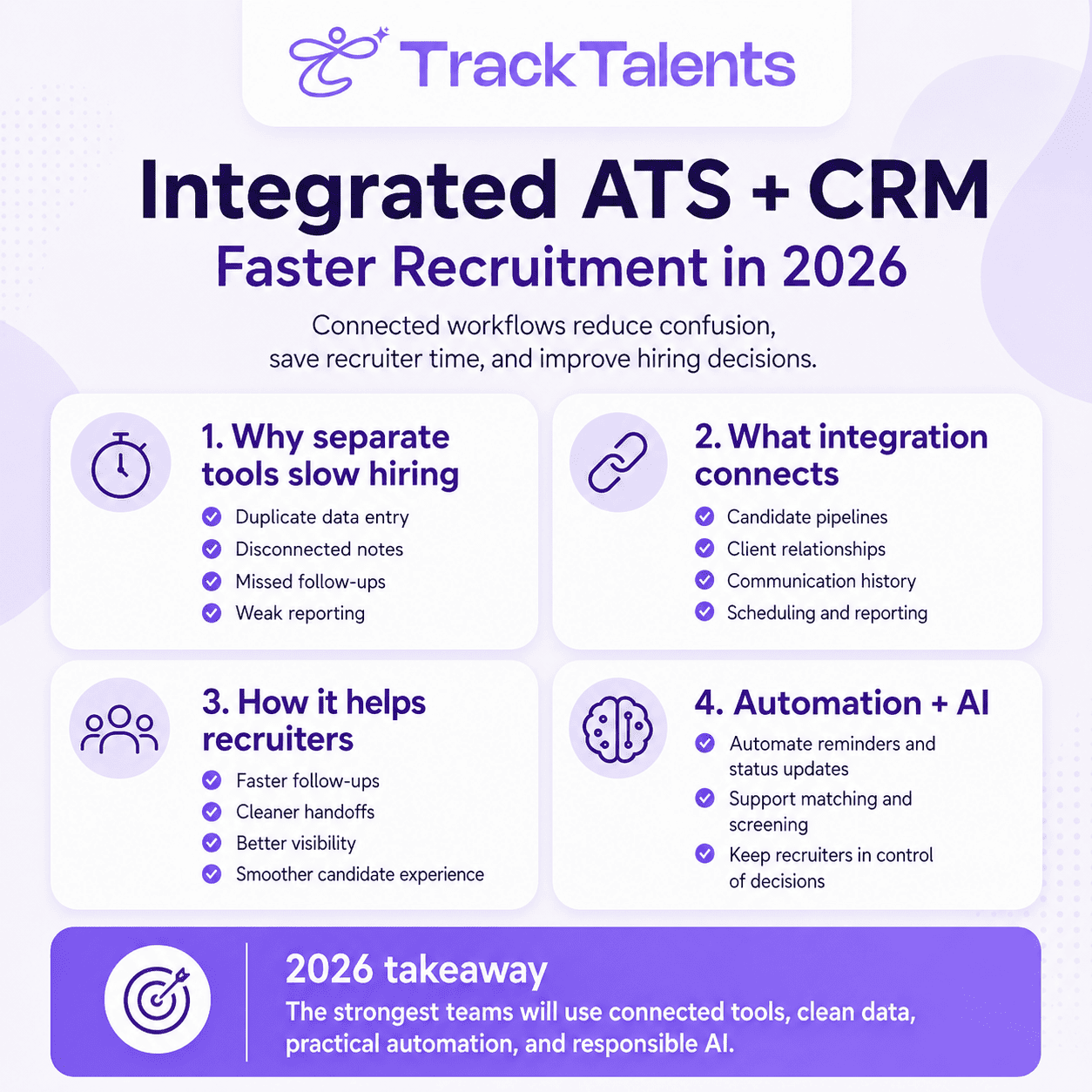
An applicant tracking system can provide one controlled place for job records, resumes, interview schedules, notes and candidate communication.
According to its official features page, TrackTalents provides job and resume management, centralized candidate records, interview scheduling, communication tracking, custom workflows, onboarding tools, secure cloud storage and authenticated access. Its pricing page also lists recruiter activity logs, integrated calendars and vendor management among the available functions.
These capabilities can enable remote recruitment by reducing the need to distribute candidate information across individual inboxes and spreadsheets. However, employers should still verify the platform’s security arrangements against their own requirements. A broad statement about encryption or secure authentication does not replace questions about encryption standards, multi-factor authentication, access permissions, hosting locations, incident reporting and data deletion.
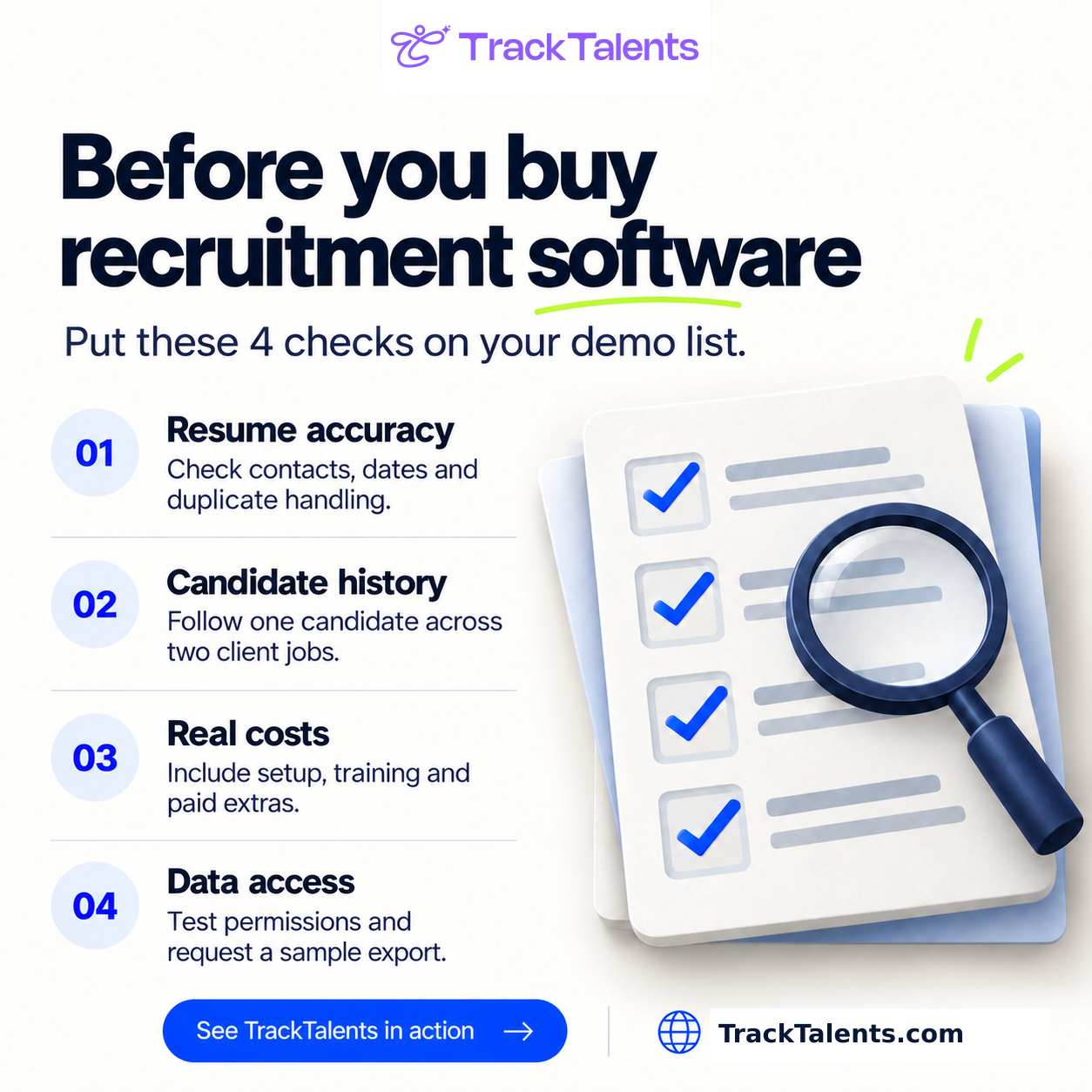
HR teams can use a checklist to evaluate recruitment platforms. A sample evaluation checklist might include:
– Does the platform use strong encryption for data during transit and at rest?
– Is multi-factor authentication available for all users?
– Can access be restricted so users only see information relevant to their roles?
– Where is candidate data stored, and are there data residency or privacy considerations?
– Are there clear logs of user access and actions within the system?
– How does the platform handle data backups and restoration?
– Can candidate data be safely deleted or exported on request?
– What is the incident response process for data breaches?
– Does the provider undergo independent security inspections or certifications?
– Are third-party vendors involved, and are their access controls clear?
Customizing this checklist to reflect company needs and local legal requirements can help ensure recruitment platforms meet both compliance and security expectations.
TrackTalents currently offers a 14-day free trial. Employers evaluating the system can use the trial to test workflows, permissions, interview scheduling, and reporting with dummy candidate records before importing personal data.
Remote Recruitment Works Best as a Controlled Hiring Process
Companies are choosing remote recruitment because it can extend their geographical reach, make scheduling easier and give distributed hiring teams a shared process. Those advantages depend on how the system is implemented.
Employers should define the role before selecting technology, evaluate candidates against consistent criteria, provide accessible alternatives and collect only the personal information required at each stage. Recruitment platforms also have to be examined for access control, encryption, retention, audit records and incident response.
Remote recruitment should make hiring more organized without making it less personal, fair or secure. The strongest approach unites convenient technology with clear responsibility and informed human decision.