
Applicant Tracking System Benefits for Recruiters and Hiring Teams
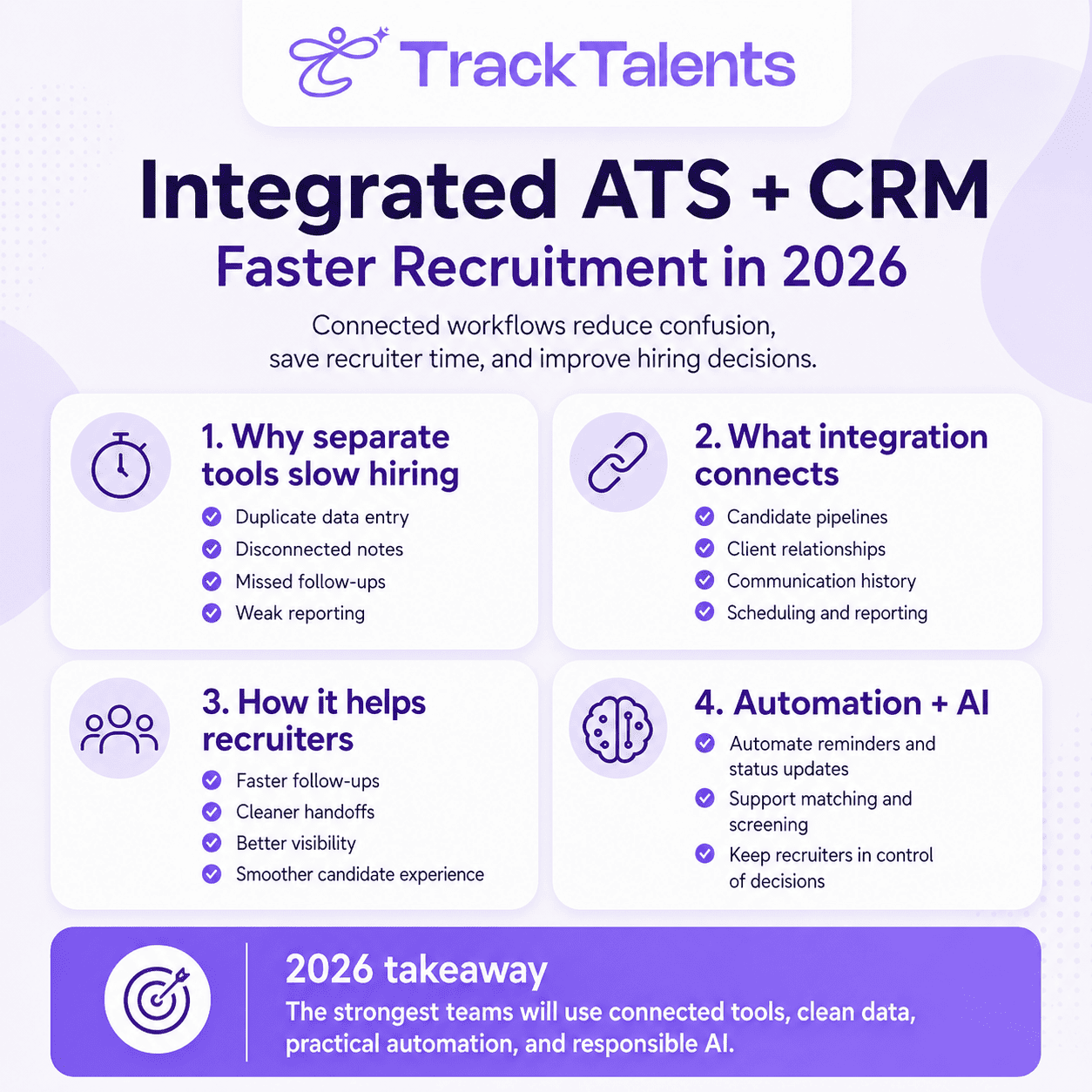
An applicant tracking system, commonly known as an ATS, helps employers organize recruitment from the moment a vacancy is approved until a candidate is hired. It can publish job openings, receive applications, store resumes, track candidates through different stages, and keep communication connected to the relevant job.
These functions are valuable when recruiters are managing several vacancies or receiving more applications than they can handle through email and spreadsheets. However, an ATS does not automatically identify the right person, remove bias or correct a poorly designed hiring process. Its value depends on the quality of the job requirements, screening criteria, workflows and decisions created by the hiring team.
The most useful applicant tracking system benefits come from better organization, clearer responsibility and easier access to reliable recruitment information.
An ATS Brings the Hiring Process into One System
Without an ATS, candidate information often becomes scattered across email accounts, spreadsheets, shared drives and individual recruiter notes. A hiring manager may have one version of a resume, while the recruiter works from another. Interview feedback may arrive late or remain buried in an email thread.
An ATS creates a central record for each vacancy and candidate. Depending on the platform, that record may contain:
- The original application and resume
- Contact details and work history
- Screening notes
- Interview schedules
- Assessment results
- Communication history
- Hiring-manager feedback
- Offer and rejection status
- Consent and data-retention information
Centralization does not simply make records easier to find. It also reduces uncertainty about which information is current, who has reviewed the application, and what should happen next.
For larger organizations and staffing agencies, this is especially important because recruiters, hiring managers, clients, and vendors may all contribute to the same hiring process.
Job Posting Becomes Easier to Coordinate
Publishing a vacancy separately on several job boards takes time and increases the chance of inconsistent job titles, descriptions or closing dates. An ATS with suitable job-board integrations can allow recruiters to create a vacancy once and distribute it across selected channels.
This can reduce repetitive posting work, but “one-click job posting” should not be interpreted as automatic access to every job board. The available integrations, supported countries, account requirements and posting charges vary between ATS providers and job sites.
Before relying on this function, employers should confirm:
- Which free and paid job boards are supported
- Whether existing employer accounts can be connected
- How edits to a vacancy are updated across platforms
- Whether applications return directly to the ATS
- How duplicate candidates are handled
- Whether each source is tracked accurately
- What happens when a vacancy is closed
Recruiters should also review the final advertisement on each platform. Formatting, salary fields, screening questions, and location settings may appear differently after publication.
The practical advantage is not simply wider exposure. It is the ability to control multiple advertising channels from a single job record and compare which sources produce relevant candidates.
Resume Management Decreases Manual Searching
Recruiters handling a great number of applications need a reliable way to store, classify, and retrieve resumes. Most modern ATS platforms parse resumes by extracting details such as contact information, job titles, experience, education, and skills into searchable fields.
Parsing can speed up initial review because recruiters do not have to open every document to locate basic information. It also supports searches across previous applications when a similar vacancy becomes available.
However, resume parsing is not always exact. Complex layouts, tables, graphics, unusual section headings, and poorly formatted files can cause information to be extracted incorrectly. Recruiters should therefore review the actual resume before making a decision based on parsed data.
Search criteria also call for careful judgment. A recruiter who searches only for one exact job title may overlook a qualified candidate whose employer used a different title for comparable work. Similar problems arise when searches depend heavily on exact keywords, uninterrupted employment or specific educational institutions.
The CIPD warns that automated sifting criteria can introduce bias, particularly when employers search for subjective keywords or use factors such as work gaps and postcode without checking whether they are relevant to the position.
An ATS should help recruiters locate possible candidates. It should not turn narrow search terms into unquestioned hiring rules.
Clear Workflows Prevent Candidates from Being Overlooked
Recruitment usually includes several stages: application review, screening, interviews, assessments, approvals, references,, and offers. When these stages are handled informally, candidates may remain in the wrong status or wait for an update because nobody is certain who owns the next action.
A configurable ATS workflow allows the organization to define each stage and assign responsibilities. For example, a candidate may move through:
- Application received
- Initial review
- Recruiter screening
- Hiring-manager review
- First interview
- Technical or skills assessment
- Final interview
- Reference or background check
- Offer
- Hired or closed
The workflow should reflect the actual recruitment process rather than force every vacancy through unnecessary stages. High-volume entry-level hiring may require a different structure from executive, clinical or technical recruitment.
Status labels also need precise meanings. “Shortlisted,” “under review” and “selected” can mean different things to different recruiters. Clear definitions make reporting more reliable and prevent candidates from receiving the wrong message.
Hiring Teams Can Work from the Same Information
Recruitment decisions often slow down when hiring managers receive resumes through email and return feedback in different formats. Some provide detailed comments, while others send a brief “yes” or “no” without giving the reason.
An ATS can give authorized users access to the same candidate record and provide a designated place for interview notes, ratings, and recommendations. This supports better collaboration, particularly when team members work in different offices or time zones.
The software should not allow unstructured comments to replace proper evaluation. Hiring teams still need:
- Role-related assessment criteria
- Consistent interview questions
- Agreed scoring standards
- Defined approval responsibilities
- Written reasons for important decisions
- Appropriate restrictions on confidential notes
The CIPD recommends structured, clear selection methods so that candidates can be assessed on their ability to perform the role rather than on personal impressions.
A shared platform supports this discipline, but the employer must establish the standards used within it.
Candidate Communication Becomes More Consistent
Applicants often judge an employer by the lucidity and timing of its communication. Long silences, duplicate interview invitations, and generic rejection messages can make the recruitment process seem disorganized.
An ATS may allow recruiters to create templates for:
- Application acknowledgements
- Requests for further information
- Interview invitations
- Assessment instructions
- Reminders
- Status updates
- Rejection messages
- Offer-related communication
Templates save time, but they should not make every message impersonal. Candidates reaching an interview or assessment stage may require more specific communication than people who did not meet the initial requirements.
Before activating automated messages, recruiters should test when each message is sent, check that the wording matches the candidate’s stage, and ensure the system does not send duplicate or contradictory updates.
A good candidate experience does not come from sending more emails. It comes from providing the right information at the right stage and giving candidates a practical way to ask questions.
Previous Applications Can Become a Usable Talent Database
A strong candidate may miss out simply because someone else was more closely aligned with a particular role. By retaining suitable profiles in an ATS, recruiters can revisit these candidates when a relevant vacancy becomes available.
This can reduce the need to restart every search. Recruiters may be able to identify candidates who:
- Reached a previous interview stage
- Possess a difficult-to-find technical skill.
- Were unavailable when first contacted
- Applied for a closely related position
- Worked with the organization as a contractor
- Previously expressed interest in future vacancies.
A stored resume does not remain useful forever. Contact information, employment status, skills and career interests can change. Recruiters should verify whether the candidate is still interested and whether the information remains accurate.
Organizations should have a clear and legally compliant policy for retaining candidate information. Candidates must know whether their Profile will it be considered for future vacancies, how long the information will remain on file, and how they can request access, correction, or deletion where applicable.
The UK Information Commissioner’s Office provides an ATS recruitment analytics case study that shows how candidate records may contain direct identifiers, demographic information, assessment results, and hiring outcomes. This example also demonstrates the need for retention limits, restricted access and additional protection once recruitment data is used for analysis.
A talent database is valuable only when its information is current, relevant, and maintained responsibly.
Recruitment Analytics Can Expose Delays and Weak Sources
An ATS can record activity at each stage of recruitment and generate reports. Depending on the system and data quality, hiring teams may be able to measure:
- Applications received by source
- Qualified candidates by source
- Time spent at each hiring stage
- Interview-to-offer ratio
- Offer acceptance
- Candidate withdrawal
- Recruiter activity
- Vacancy ageing
- Reasons for rejection
- Hiring-manager response time
These reports can reveal operational problems. For example, a company may discover that one job board produces many applications but very few qualified candidates. Another report may show that candidates wait several days for feedback from the hiring manager after an interview.
Analytics do not automatically explain every result. A high application count does not prove that a source is effective, and a short time-to-hire does not confirm that the organization made a sound appointment.
Recruitment data becomes meaningful only when it is read in the proper context. Compare similar roles, ensure information is recorded consistently, and look beyond unusual figures to understand what caused them.
Automation Should Support Recruiters Without Replacing Judgment
Automation can handle routine actions such as acknowledgments, reminders, interview scheduling, and status notifications. It may also help extract resume information or highlight applications that meet defined requirements.
These features can reduce administrative work, but they should not be described as a replacement for professional screening. A system cannot determine the relevance of every career transition, employment gap, transferable skill, or unconventional background without appropriate context.
Before automating a hiring action, employers should ask:
- Is the rule directly connected to the job?
- Could it exclude suitable candidates for an irrelevant reason?
- Can a recruiter review or override the result?
- Is the candidate told when automation affects the process?
- Are outcomes checked for possible bias?
- Is the underlying information accurate?
Automation works best when it removes repetitive work while leaving accountable decisions with trained people.
Candidate Data Requires Defined Security and Retention Controls
An ATS may contain resumes, contact details, salary information, interview notes, identification records, and background-check results. Employers should evaluate how the platform protects this information before importing live candidate data.
Important controls include:
- Encryption in transmission and storage
- Secure authentication
- Multi-factor authentication if available
- Role-specific access permissions
- Activity and audit records
- Backup and recovery procedures
- Data export and deletion controls
- Retention settings
- Incident-notification procedures
- Restrictions on third-party and vendor access
Organizations should also remove access when recruiters, managers, or vendors leave or change responsibilities. An unused account can remain a security concern if it still provides access to candidate records.
Security is not exclusively the software provider’s responsibility. Employers must configure permissions properly, train users, and avoid downloading candidate information onto uncontrolled personal devices.
TrackTalents Brings Recruitment Activities into One Workflow
TrackTalents is an applicant tracking system designed for recruiters, staffing agencies and hiring teams. According to the company’s official features page, the platform includes resume parsing and bulk resume upload, job management, job posting, candidate and contact management, email tracking, interview scheduling, custom workflows and onboarding functions.
These features address several common recruitment problems.
Job and Resume Management
TrackTalents allows users to create or import job requirements and connect resumes, interview details and notes to the relevant job record. Its website states that jobs can be posted to multiple free job boards and synchronized with an integrated career portal.
Recruiters should confirm which external job boards are available in their location and within their subscription before planning their advertising workflow.
Candidate and Business Relationship Records
The platform’s CRM functions connect candidates, contacts, vendors and jobs. This can be useful for staffing agencies that must track both candidate activity and client requirements rather than manage applications for only one employer.
Communication and Interview Scheduling
TrackTalents lists bulk email templates, email activity tracking, and multi-person interview scheduling among its communication features. Keeping these communications connected to the candidate record can reduce the need to search through individual recruiter inboxes.
Workflows and Activity Visibility
The TrackTalents pricing page lists customizable workflows, job pipelines, recruiter activity logs, integrated calendars, user management, and vendor management. These functions can help managers see where applicants are waiting and which activities have been completed.
Security and Cloud Access
The company describes secure cloud storage and authenticated access on its features page. Employers considering the product should still request technical details on encryption, access controls, backups, hosting, incident response, and data deletion to confirm that the platform meets their internal and legal requirements.
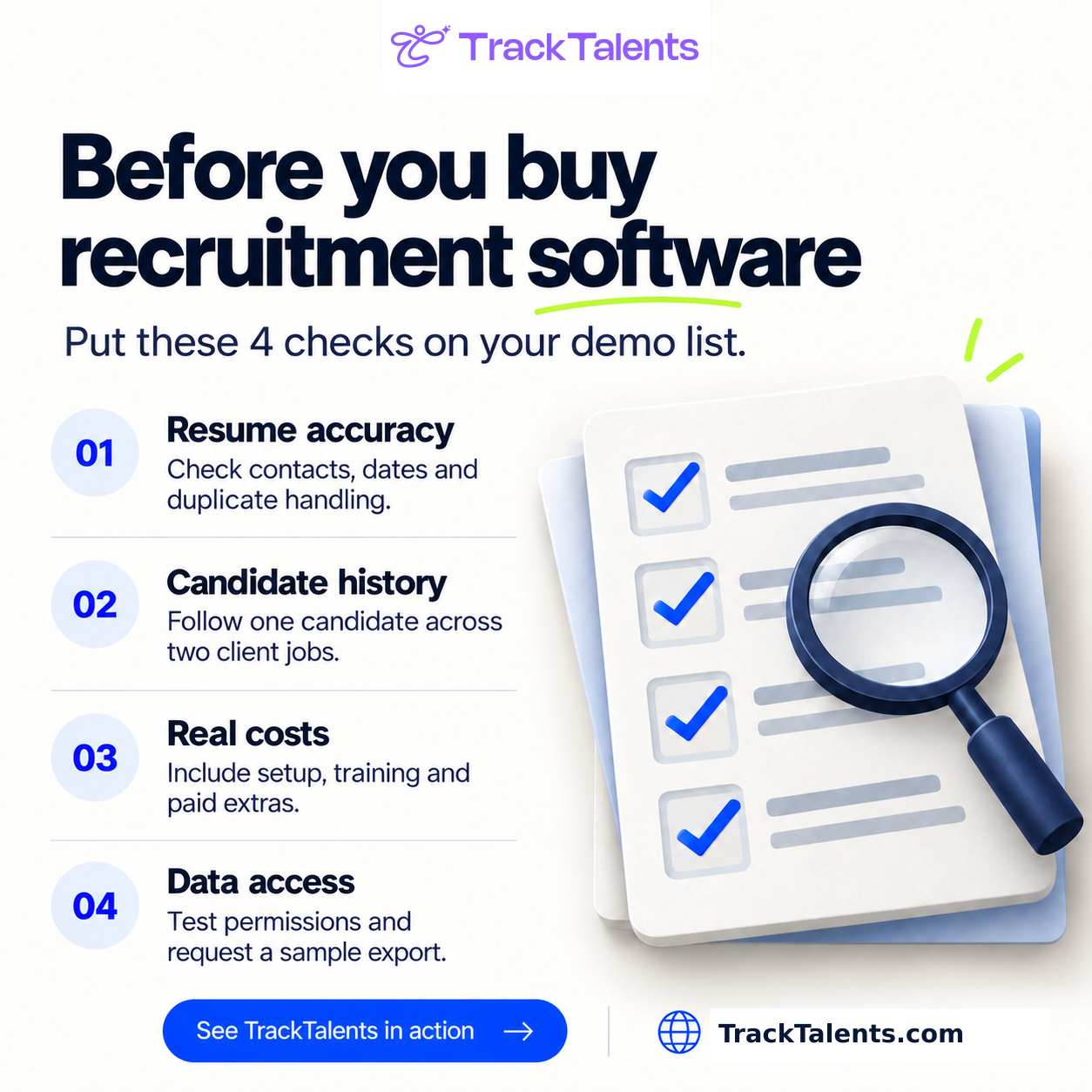
Test the System with a Realistic Hiring Scenario
A product demonstration can show features, but it may not reveal how the system behaves during everyday recruitment. Employers should test an ATS with a realistic vacancy and dummy candidate information before importing live records.
During the test, ask recruiters and hiring managers to complete the full process:
- Create and approve a job.
- Publish it through the required channels.
- Upload resumes in different formats.
- Search for candidates using realistic criteria.
- Assign applications to a hiring manager.
- Record interview feedback
- Schedule an interview
- Send candidate communication
- Move candidates through each stage.
- Generate a recruitment report.
- Restrict and remove user access.
- Export or delete a candidate record
The test should identify which steps become easier, where users become confused, and whether the workflow reflects the organization’s real hiring process.
TrackTalents currently advertises a 14-day free trial. Hiring teams can use this period to assess relevant features without placing genuine candidate information into the system before security, contractual and privacy checks are complete.
Choose an ATS That Makes Hiring Easier to Control
The strongest benefit of an applicant tracking system is not simply faster resume screening. It is the ability to bring jobs, candidates, communication, decisions and recruitment data into a process that the organization can understand and manage.
An ATS can reduce repeated posting, organize applications, support teamwork, and reveal delays. It cannot, on its own, correct vague job requirements, unsuitable screening rules, slow decision-making, or poor candidate communication.
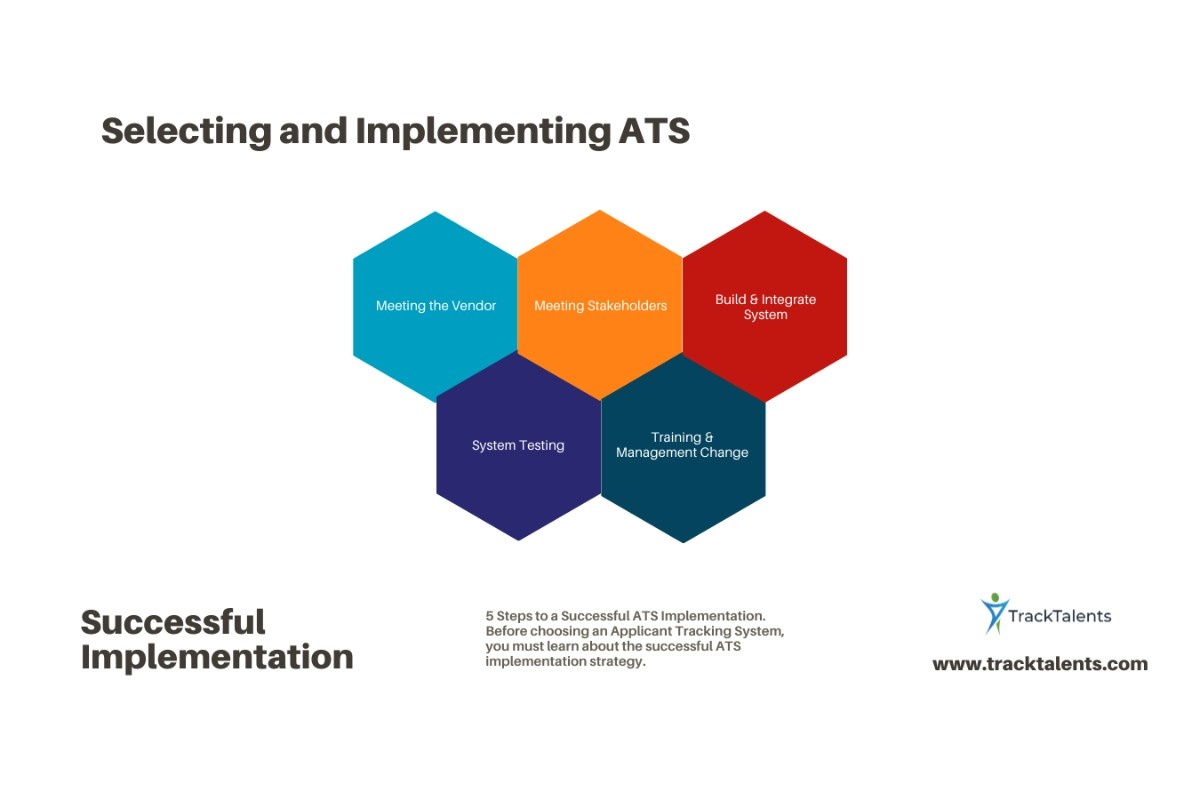
Before selecting a platform, employers should define their recruitment process, detect recurring problems, and test whether the software addresses them in practice. TrackTalents offers several features relevant to staffing agencies and hiring teams. Still, it should be assessed for sustainability through a realistic trial, verified integrations, and a careful review of security, reporting, and user access.
The right ATS should give recruiters more time for well-informed conversations and sound hiring decisions while making the administrative work easier to track.