
High-volume hiring looks simple from the outside. More jobs. More resumes. More recruiters. More interviews. Inside a staffing agency or large HR team, it is much more complex.
A staffing agency may handle several clients at the same time. Each client may have different rules, job stages, contacts, approval steps, rates, and reporting needs. An enterprise HR team may work with many departments, hiring managers, vendors, background check providers, regional regulations, and leadership dashboards.
A basic applicant tracking system can store resumes and move candidates across stages. But at scale, that is not enough. The right ATS for staffing agencies and HR enterprises should help teams manage volume, protect candidate data, track client activity, reuse past resumes, automate routine tasks, and clearly report on hiring performance.
This is where platforms such as TrackTalents, Lever, Pinpoint, and other recruitment systems are judged differently. The question is not just “Can this tool track applicants?” The better question is, “Can this system keep hiring organized when pressure rises?”
Why Staffing Agencies and HR Enterprises Need a Stronger ATS
Recruitment is changing quickly. Gartner has identified high-volume recruiting going AI-first as one of the major talent acquisition trends shaping. Gartner also points to recruiter skills shifting toward more complex work and AI changing how organizations assess talent.
SHRM’s Talent Trends research also shows why hiring systems need to become more strategic. More than 3 in 4 HR professionals, or 77%, reported difficulty hiring for roles that require new skills.
That means recruitment teams need more than a digital filing system. They need a platform that supports faster sourcing, better matching, structured workflows, cleaner reporting, and stronger collaboration.
For staffing agencies, the ATS must support both candidates and clients.
For HR enterprises, the ATS must support scale, security, consistency, and leadership visibility.
TrackTalents for Staffing Agencies and HR Teams
TrackTalents positions itself as a customizable and intelligent ATS designed for recruiters, staffing agencies, and HR teams. Its official website highlights features such as job postings, job board integration, branded career site, resume management, bulk mailing, customizable workflow, integrated calendar, recruiter activity logs, job pipeline, permissions control, vendor management, HR module, mail merge, and user management.
This makes TrackTalents relevant to agencies and HR teams that need practical control over recruitment workflows, rather than just resume storage.
For a staffing agency, useful ATS features include:
- Client-wise job tracking
- Resume database search
- Candidate pipeline visibility
- Recruiter activity tracking
- Bulk communication
- Job board integration
- Vendor management
- Permission control
- Calendar integration
- Reporting by job, recruiter, and pipeline stage
For an HR enterprise, the same system can support job approvals, internal hiring workflows, vendor coordination, role-based access, candidate tracking, and hiring reports.
The value is not in having many features on a page. The value is whether recruiters can use those features every day without returning to spreadsheets.
How ATS Requirements Change at Scale
A small company may use a simple hiring flow:
- Post a job.
- Receive applications.
- Screen resumes.
- Interview candidates.
- Select one person.
- Close the role.
That process can work for a small team.
A staffing agency or enterprise hiring team works differently. Several roles may be open at the same time. Candidates may be submitted to different clients or departments. Recruiters may be working from different locations. Hiring managers may delay feedback. Vendors may be involved. Background checks, offer approvals, and onboarding may happen through separate tools.
At this level, the ATS must do more than “track applicants.”
It must help the team manage:
- Multiple jobs
- Multiple recruiters
- Multiple clients or departments
- Candidate ownership
- Submission history
- Interview schedules
- Feedback status
- Vendor activity
- Compliance records
- Source tracking
- Performance reports
When these details are not handled inside the ATS, recruiters start building side systems. That is when spreadsheets, email folders, and personal notes return.
What Staffing Agencies Need From an ATS
A staffing agency ATS must support the full recruitment business, not only the candidate pipeline.
Agency recruiters manage relationships on both sides. They work with candidates and clients. They need to know who was contacted, who was submitted, who gave feedback, which client received the profile, and what happened next.
A strong staffing agency ATS should help manage:
- Candidate records
- Client records
- Job orders
- Resume submissions
- Interview feedback
- Follow-ups
- Candidate ownership
- Client communication
- Recruiter activity
- Revenue-sensitive hiring activity
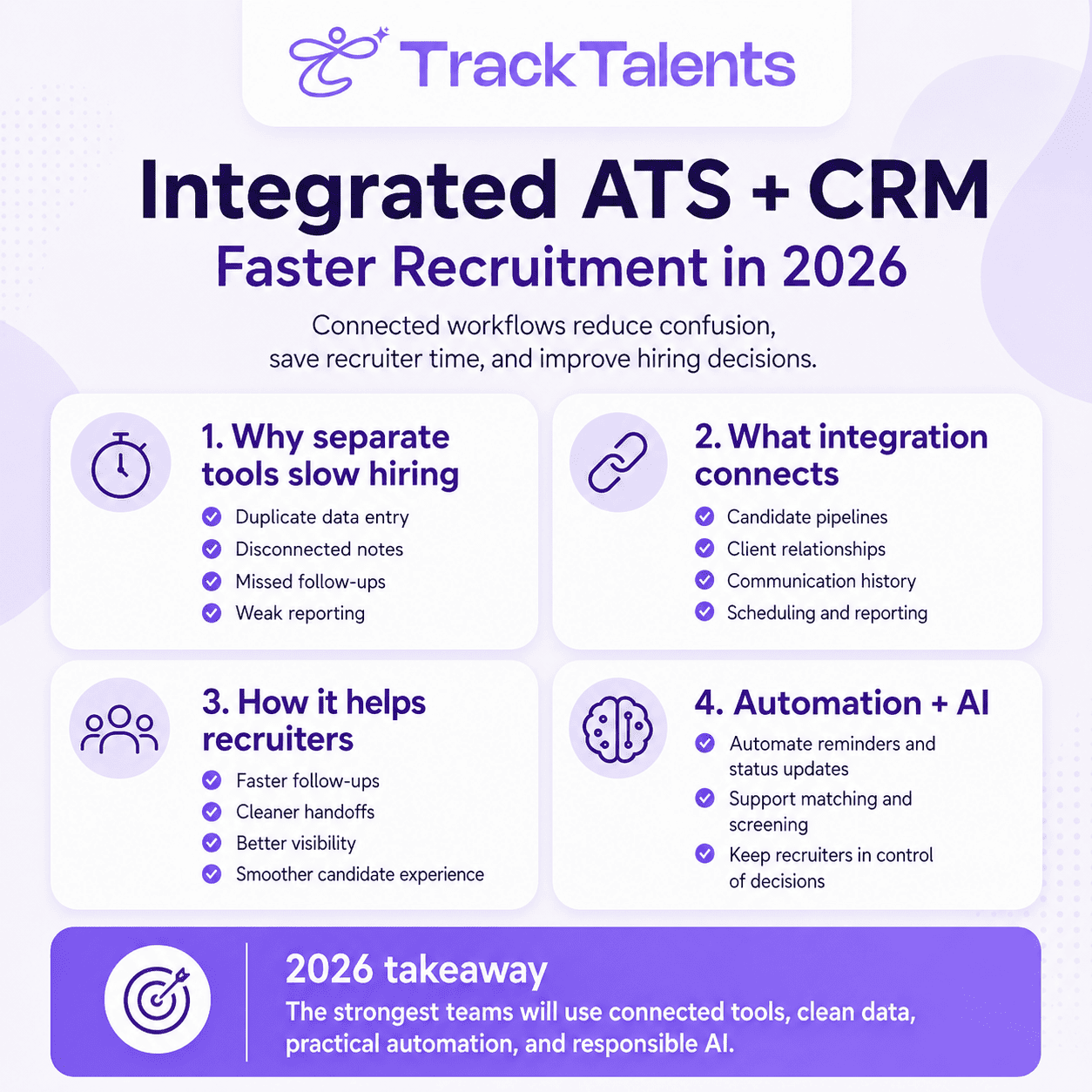
This is why many agency-focused platforms combine ATS and CRM features.
Lever, for example, describes itself as a modern ATS and recruiting CRM that helps companies attract, nurture, and hire talent. It states that its platform combines candidate relationship management, automation, analytics, and collaborative hiring tools.
For agencies, this ATS-plus-CRM structure matters. Recruiters do not only wait for applicants. They source candidates, build pipelines, manage client conversations, and protect relationship history.
Why Multi-Client Workflow Control Matters
Multi-client workflow control is one of the most important features in an ATS for staffing agencies.
Different clients may have different hiring stages. One client may need a recruiter screen, a technical interview, a client interview, a document check, and offer approval. Another client may require skill testing, a background check, and a panel review.
If every client is forced into the same hiring process, recruiters start using manual notes outside the system.
A strong Recruitment Software should allow teams to manage:
- Client-specific pipelines
- Job-specific workflows
- Different interview stages
- Client-wise permissions
- Candidate submission rules
- Feedback tracking
- Communication history
- Recruiter ownership
- Vendor access where needed
This helps protect trust. In agency recruiting, it is important to know who submitted a candidate, when the profile was shared, which client reviewed it, and what the outcome was.
Without a clear submission history, disputes can happen. With clear tracking, recruiters, clients, and managers can see the process more clearly.
Keep the Resume Database Active
For staffing agencies and enterprises, the resume database should not become a storage folder. It should work as a live hiring asset.
Many teams already have strong candidates in their database. But when the ATS search is weak or records are not updated, recruiters start sourcing from scratch for every new role.
A Hiring Software should help recruiters:
- Search past applicants
- Find candidates by skills, location, experience, and availability
- Review previous submissions
- Check past interview notes
- Re-engage older candidates
- Match candidates to new roles
- Build talent pools
- Avoid duplicate records
Pinpoint’s high-volume hiring highlights automation for screening, scheduling, communication, talent pipelines, and source-of-hire reporting. It also focuses on giving teams one shared view across every role, location, and hiring stage. This is the right direction for high-volume hiring. Recruiters should not restart sourcing every time demand returns. They should be able to use the candidate data they already have.
Enterprise Hiring needs are different
Enterprise HR teams may not manage external clients like staffing agencies, but their hiring process can be just as complex.
Large organizations often involve:
- Recruiters
- Hiring managers
- HR operations
- Department heads
- Procurement teams
- Legal teams
- Background-check partners
- Regional HR leaders
- Finance approvers
- Onboarding teams
- External vendors
For enterprises, the ATS must work as a coordination layer.
Enterprise teams need:
- Custom workflows
- Approval controls
- Role-based permissions
- Regional hiring rules
- Hiring manager access
- Vendor management
- Audit trails
- HRIS integration
- Compliance support
- Reporting dashboards
- Data security
- Candidate experience tools
Lever positions its ATS as a platform that combines candidate management and analytics, with tools for automation, collaborative hiring, and workforce planning. This type of feature set is important for enterprise teams that need visibility into hiring across roles, teams, and locations.
Integration Is Part of ATS Scalability
Large recruitment teams should be able to work inside one tool
They may use:
- Calendar
- Job boards
- Video interview tools
- Assessment platforms
- Background-check systems
- HRIS
- Onboarding tools
- Payroll systems
- CRM software
- Vendor platforms
- Reporting tools
If the ATS does not integrate well with these systems, recruiters must re-enter the same data repeatedly. This slows hiring and increases errors.
Checkr is a good example here. It is not an ATS. It is a background-check platform. But its partner page shows why integrations matter, listing connections with ATS, HR, onboarding, and HRIS systems. Checkr also states that its API can integrate with applicant tracking systems or HRIS platforms to reduce duplicated work for recruiters and candidates.
That is the standard ATS buyers should expect. The recruitment platform should reduce handoffs, not create more admin work.
Priority ATS Features for Staffing Agencies
Staffing agencies should look for features that support client service, recruiter productivity, and candidate reuse.
Key features include:
Client and Job Order Management
The ATS should help recruiters manage client accounts, open jobs, job ownership, and client-specific rules.
Candidate Ownership Tracking
Recruiters should know who sourced the candidate, who last contacted them, and where the candidate has been submitted.
Resume Database Search
The system should make it easy to search for past candidates by skills, role, experience, location, and availability.
Submission History
Every client submission should be recorded with date, recruiter name, client name, job title, and status.
Bulk Communication
Recruiters should be able to contact candidate groups without losing personalization or tracking.
Workflow Customization
Different clients should have different hiring stages where needed.
Recruiter Activity Reports
Leaders should be able to see activity, submissions, interviews, closures, and pipeline health.
Vendor and Permission Control
Agencies working with vendors need clear access rules to protect candidate and client information.
ATS Features HR Enterprises Should Prioritize
Enterprise HR teams need stronger control, security, and reporting.
Important features include:
Role-Based Access
Each user should see only what they need. This helps protect candidate data and internal hiring details.
Approval Workflows
The ATS should manage job approvals, offer approvals, and hiring manager sign-offs.
Hiring Manager Collaboration
Managers should be able to review candidates, submit feedback, and track interview stages without extra effort.
Compliance and Audit Trails
The system should record who reviewed candidates, who changed the status, and how decisions progressed.
HRIS and Onboarding Integration
Candidate data should move smoothly from hiring to employee records where needed.
Reporting for Leadership
Leaders should see time-to-hire, source quality, pipeline health, offer acceptance, recruiter workload, and hiring trends.
Regional Flexibility
Global enterprises may need different workflows, privacy rules, languages, and approval structures by location.
How AI Is Changing ATS Expectations
AI is becoming a bigger part of recruiting. But buyers should look for AI that supports recruiters, not replace human judgment.
Useful AI features may include:
- Resume parsing
- Candidate matching
- Job Description Support
- Search recommendations
- Candidate rediscovery
- Interview scheduling assistance
- Pipeline insights
- Duplicate profile detection
- Reporting support
Gartner’s talent acquisition outlook points to high-volume recruiting becoming AI-first and AI reshaping how organizations assess talent.
This does not mean every AI feature is useful. Staffing agencies and enterprises should ask vendors to explain how matching works, what data is used, whether recruiters can override results, and how decisions are recorded.
A strong ATS should make recruiters faster and better informed. It should not turn hiring into a black box.
ATS Comparison for Staffing Agencies and HR Enterprises
| Platform or Tool | Best-Fit Use Case | What to Review Carefully |
| TrackTalents | Staffing agencies, recruiters, and HR teams needing ATS workflows, resume management, bulk mailing, recruiter logs, vendor management, and permissions | Test client-wise workflows, resume search, reports, integrations, and daily recruiter usability |
| Lever | Growing and enterprise teams needing ATS plus CRM, automation, analytics, and collaborative hiring | Review pricing fit, CRM depth, enterprise controls, and workflow flexibility |
| Pinpoint | In-house teams handling high-volume hiring across roles, locations, and stages | Test automation, screening workflows, candidate communication, and reporting depth |
| Checkr | Background checks and screening integration, not ATS replacement | Use it to evaluate how well the ATS connects with background-check and HR systems |
This comparison matters because each platform or tool solves a different problem. A staffing agency should not choose software only because it looks popular. An enterprise should not choose a platform only because it has many features.
The right ATS should fit the hiring model.
How to Choose the Right ATS for Scale
Before buying or replacing an ATS, staffing agencies and enterprises should run a real workflow test.
For Staffing Agencies
Test whether the system can:
- Create different client workflows
- Track candidate ownership
- Record submission history
- Search old resumes quickly
- Manage client feedback
- Support bulk outreach
- Show recruiter productivity
- Protect client and candidate data
- Handle vendors or partner access
- Report open jobs, submissions, interviews, and closures
For HR Enterprises
Test whether the system can:
- Manage complex approvals
- Support hiring manager feedback
- Integrate with HRIS and onboarding tools
- Control access by role
- Support regional workflows
- Track compliance records
- Generate leadership reports
- Manage vendor activity
- Keep candidate communication consistent
- Scale across departments and locations
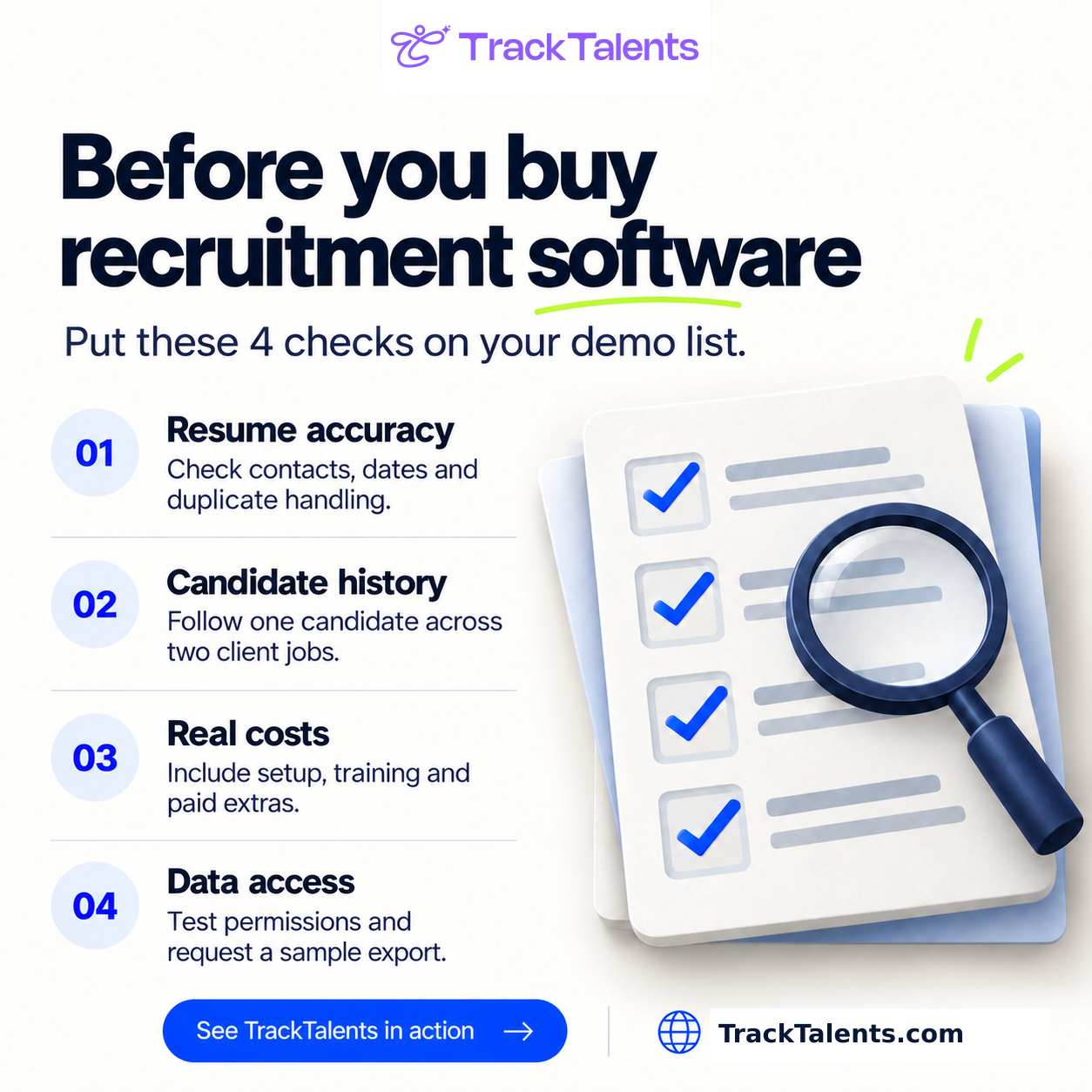
A demo should not only show features. It should show how hiring work moves from one step to the next.
Final Thoughts
The best ATS for staffing agencies and HR enterprises is the one that remains useful when hiring pressure increases.
For staffing agencies, that means multi-client workflows, candidate ownership, submission tracking, active resume database search, client communication, recruiter activity visibility, and vendor control.
For HR enterprises, it means scalable workflows, permissions, integrations, hiring manager collaboration, compliance support, data security, and leadership reporting.
TrackTalents is a strong option for recruiters, staffing agencies, and HR teams seeking practical ATS features built around hiring execution. Lever and Pinpoint also show how the ATS market is moving toward CRM, automation, analytics, and high-volume hiring support. Checkr shows why integration with background checks and HR systems matters.
At scale, recruitment software affects more than speed. It affects control, trust, compliance, relationships, and hiring quality. A strong ATS should help teams manage all of the recruitment and onboarding with greater clarity and ease of use.