Recruiter incentives influence placement numbers and improve quality as well. They affect which vacancies receive attention, how carefully candidates are screened, whether recruiters share information, how clients are handled, and significant revenue increases for the Staffing agency.
The strongest recruiter incentive plans reward commercially valuable outcomes without encouraging recruiters to sacrifice candidate quality or client trust. They also recognize that sources, delivery recruiters, account managers, and team leaders contribute in different ways.
There is no commission formula that suits every staffing business. A permanent placement agency, a contract staffing company, an executive search firm, and a recruitment process outsourcing team earn revenue differently. Their incentive plans should reflect those differences.
Start with How the Agency Earns Revenue
Before selecting commission rates, leaders need to understand what creates revenue, cost, and risk in their recruitment model.
Permanent staffing
Permanent recruitment agencies usually earn a fee when a candidate is successfully placed. The fee may be fixed or calculated as a percentage of the candidate’s annual salary.
An incentive plan may therefore be linked to:
- Placement fees
- Collected revenue
- Completion of the replacement period
- Quarterly billing thresholds
- Gross margin where delivery costs vary
Paying commission as soon as a candidate accepts an offer may create a cash-flow problem if the candidate never joins or the client pays much later. Many agencies therefore connect at least part of the payout to joining, invoice collection, or completion of a defined guarantee period.
Contract staffing
Contract staffing produces continuing revenue rather than a single placement fee. The agency may receive a bill rate from the client while paying the contractor a lower rate and covering statutory, payroll, or employment costs.
Suitable measures may include:
- Collected gross margin
- Contractor hours billed
- Contractor retention
- Timesheet completion
- Payroll and compliance accuracy
- Headcount growth within existing accounts
A recruiter who places a contractor but has no influence over payroll cost, client pricing, or collections should not carry full responsibility for net profit.
Executive search
Retained search firms may receive fees at agreed stages, such as assignment commencement, shortlist presentation, and successful appointment.
Incentives can follow the same milestones, provided the recruiter has contributed meaningfully to each stage. Paying the full amount only at final placement may undervalue months of research and candidate engagement on a retained assignment.
RPO and internal recruitment
Recruiters working in RPO or corporate talent acquisition may not generate placement fees. Their variable pay is more likely to reflect:
- Roles filled
- Service-level performance
- Hiring-manager satisfaction
- Candidate experience
- Offer acceptance
- Critical-role delivery
- Recruitment-process accuracy
- Quality-of-hire measures where reliable post-hire data is available
The incentive structure has to align with the recruiter’s actual responsibilities rather than copy a staffing-agency commission plan.
Pay Recruiters for Results They Can Influence
Recruiters should understand how their work affects their earnings.
WorldatWork recommends that incentive measures be controllable, measurable, and aligned with enterprise goals. Employees should be able to understand what is expected and how their actions influence the result.
Before linking a metric to recruiter pay, ask:
- Can the recruiter influence the outcome?
- Is the information reliable enough to measure?
- Can the calculation be explained easily?
- Does the metric support the agency’s business model?
- Could the measure encourage unwanted behavior?
- Does another team control an important part of the outcome?
For example, a recruiter may be able to control candidate screening, communication, and submission quality. The same recruiter may have no authority over client pricing, invoice approval, or debt collection.
Paying that person entirely on net profit would introduce factors outside their control.
A 360-degree recruiter who develops clients, negotiates terms, sources candidates, and manages delivery has more influence over revenue and margin. A more extensive commercial incentive may be appropriate for that role.
Role influence should also affect the balance between base salary and variable pay. WorldatWork notes that there is no fixed formula for deciding pay mix. The organization’s compensation philosophy, market practice and the employee’s influence over results all affect the decision.
Junior recruiters generally need greater salary stability as they develop screening, sourcing, and client management skills. Experienced recruiters with direct commercial responsibility may accept a larger variable component in return for greater earning potential.
Choose Between Revenue, Margin, and Profit Carefully
Recruitment agencies commonly use revenue, gross margin, or profit as the financial basis for incentives. Each method stimulates different decisions.
| Incentive basis | Suitable when | Main risk |
| Placement fee or revenue | Recruiters influence placements but do not control most costs | Large fees may receive attention even when delivery risk is high |
| Collected revenue | Cash flow and client payment are important | Recruiters may wait for payment delays they cannot control |
| Gross margin | Recruiters influence pricing, pay rates or delivery costs | Disputes arise when the margin calculation is unclear |
| Net profit | Senior leaders influence revenue and operating costs | Recruiters may be penalized for overheads outside their control |
| Fixed placement bonus | Roles and fees are relatively consistent | The plan may not recognize differences in placement value or difficulty |
Revenue-based commission
Revenue-based plans are usually easy to explain. A recruiter receives a percentage of the placement fee or a fixed amount after an agreed event.
This model works well when recruiters do not control wider operating costs. However, revenue alone does not reflect contractor pay, discounts, replacement risk, vendor costs, or poor client payment behavior.
Gross-margin incentives
Gross-margin plans can encourage better commercial decisions when recruiters or account managers influence bill rates, pay rates, and discounts.
The agency must clearly define the calculation. For contract staffing, this may involve:
- Client bill rate
- Contractor pay rate
- Employer taxes or statutory contributions
- Benefits
- Vendor charges
- Payroll costs
- Other directly attributable employment costs
Recruiters should be qualified to verify the figures used. A margin plan loses credibility when employees cannot reproduce or understand the calculation.
Profit-based incentives
Profit may be an appropriate measure for branch managers, directors, and senior commercial leaders who determine both income and expenditure.
It is less suitable for delivery recruiters when deductions include rent, corporate salaries, marketing costs, software subscriptions, or bad debt they cannot control.
The rule should be simple: the wider the financial measure, the greater the employee’s authority over the factors behind it.
Do Not Reward Activity That Fails to Prove Quality
Recruitment teams need activity, but activity is not always a useful basis for incentive pay.
Paying recruiters for calls, emails, résumé searches, or candidate submissions may increase those numbers without improving hiring outcomes.
A recruiter can make 80 calls without holding a useful conversation. A sourcer can add 100 profiles that do not meet the vacancy requirements. A delivery recruiter can submit 20 candidates who never receive an interview.
These figures may help managers diagnose effort, workload, or training needs. They should not automatically determine commission.
More meaningful measures include:
- Qualified candidates accepted for client review
- Submission-to-interview conversion
- Interview-to-offer conversion
- Offer acceptance
- Candidate joining
- Completion of the guarantee period
- Contractor retention
- Collected revenue
- Repeat business
- Accurate candidate and client records
Even these measures need context.
A low submission-to-interview ratio may indicate weak screening. It may also result from an unclear job description, changing client requirements, or slow feedback. Metrics should support management judgment rather than replace it.
The plan should also avoid encouraging recruiters to reject difficult work. If easy, high-fee roles yield the largest payouts, recruiters may neglect specialist vacancies, new clients, or jobs that require longer development.
Hard-to-fill roles may need separate recognition based on scarcity, urgency, location, complexity, or expected time to deliver.
Give Each Recruitment Role a Fair Share
A successful placement may involve several people.
A business development executive may win the account. An account manager may qualify the vacancy. A sourcer may identify the candidate. A recruiter may screen candidates and guide them through interviews. A compliance coordinator may complete onboarding.
Paying only the person who closes the placement can make other contributors feel invisible. Paying everyone without defined rules creates disputes.
Sourcers
Sourcers should be rewarded for producing usable candidates, not lists of names.
Possible measures include:
- Candidate meets the agreed essential criteria
- Candidate responds and confirms interest
- Candidate passes recruiter screening
- Candidate is accepted for client submission
- Candidate reaches the interview
- Sourced candidate joins
- Verified talent pools are developed for recurring roles
The agency should define what “qualified” means. Without clear criteria, a shortlist bonus can become another volume target.
Delivery recruiters
Delivery recruiters commonly influence the quality of screening, candidate preparation, communication, and process completion.
Their incentives may include:
- Successful placements
- Offer acceptance
- Joining rate
- Retention through the guarantee period
- Collected placement revenue
- Submission quality
- Candidate-record accuracy
Business development executives
Business development incentives should reward commercially useful accounts, not simply signed agreements or unqualified job orders.
Suitable measures may include:
- New-client revenue
- Collected fees
- Gross margin
- Qualified vacancies
- First successful placement
- Repeat assignments
- Account expansion
A client that releases many vacancies but never interviews or hires can consume considerable recruiter time without producing value.
Account managers
Account managers influence client communication, vacancy quality, feedback speed, pricing discipline, and repeat business.
Their performance may be linked to:
- Client revenue and margin
- Client retention
- Repeat vacancies
- Feedback turnaround
- Fill ratio
- Invoice collection
- Client satisfaction
- Quality of vacancy information
Team leaders and branch managers
Leaders influence staffing, workload allocation, coaching, delivery standards, and branch profitability. Their incentives should go beyond their personal placements.
Appropriate measures may include:
- Team revenue
- Gross margin
- Branch profit
- Fill rate
- Client retention
- Contractor retention
- Data quality
- Individual recruiter development
- Team target achievement
The right arrangement depends on how work is divided. The contribution split should be decided before candidate submission, not after the fee has been earned.
Decide When Commission Is Earned
A placement can pass through several commercial stages:
- Candidate submission
- Client interview
- Offer
- Offer acceptance
- Candidate joining
- Invoice raised
- Client payment
- Guarantee or replacement period completed
The incentive policy must state which event creates eligibility and which event releases payment.
For permanent recruitment, possible approaches include:
- Partial payment at joining and the balance after collection
- Payment after the client settles the invoice
- Payment after both collection and guarantee-period completion
- Monthly commission with later adjustment for fall-offs
- Quarterly payment after revenue and quality checks
Contract staffing incentives may be calculated monthly or quarterly using the collected gross margin from active contractors.
Retained-search incentives may follow the client’s billing milestones.
No approach is automatically correct. The agency must balance recruiter motivation, cash flow, and replacement risk.
Delayed client payment
If the commission depends on the revenue collected, the plan should explain what happens when a client pays late.
Questions to settle include:
- Does the recruiter wait until collection?
- Is payment released after a maximum period?
- What happens when finance fails to invoice promptly?
- Is the recruiter penalized for a credit-control problem?
- Does commission remain payable after the recruiter leaves?
These decisions should be written into the plan and checked against applicable employment and contract law.
Candidate fall-offs and replacement periods
The policy should explain what happens when a candidate:
- Accepts but does not join
- Leaves during the guarantee period
- Is dismissed during the guarantee period
- Is replaced without an additional fee
- Moves to another role with the same client
A clawback should not be automatic in all failed placements. Leaders should examine why the placement failed.
A recruiter should not necessarily lose commission when the client changes the role, creates a hostile work environment, or violates the agreed terms. A clawback may be more reasonable when avoidable screening gaps, inaccurate information, or poor candidate management contributed to the failure.
Shared placements
Ownership rules should cover:
- Who introduced the client
- Who received or qualified for the vacancy
- Who sourced the candidate
- Who completed screening
- Who managed the client
- Who handled the offer and joining
- How contributions were recorded
- Who approved exceptions
An illustrative split might award 40% to business development, 40% to delivery, and 20% to sourcing. That is not a universal recommendation. The percentages should reflect the agency’s operating model.
Balance Individual Commission With Team Rewards
Individual commission gives recruiters a direct connection between effort and earnings. It can also create silos.
Recruiters may hold candidates, avoid helping colleagues, or give precedence to their own vacancies even when another role is more urgent.
Team bonuses can reward shared outcomes such as:
- Quarterly branch revenue
- Gross-margin target
- Client satisfaction
- Fill ratio
- Contractor retention
- Guarantee-period success
- Data accuracy
- Teamwide compliance
WorldatWork notes that choosing individual or team measurement levels communicates the organization’s intended culture and changes how employees behave.
A purely team-based model has its own problem. Strong performers may feel that their effort is subsidizing colleagues who contribute less.
A hybrid plan is often more practical:
- Individual commission for directly attributable placements
- Role-based splits for shared contributions
- Team bonus for collective revenue and quality
- Leadership bonus for branch or company performance
The weighting should reflect how dependent recruiters are on one another. A specialist search team sharing candidates’ and clients’ needs requires more collective recognition than recruiters operating on independent desks.
Include Candidate and Client Quality
A placement is not automatically a good placement.
A candidate may join after being misinformed about salary, location, working hours, or responsibilities. The agency may earn a fee, but the candidate could resign quickly, and the client may lose trust.
Quality checks can be built into the plan without making it unmanageable.
Possible candidate measures include:
- Offer acceptance
- Joining rate
- Withdrawal reasons
- Guarantee-period completion
- Contractor retention
- Candidate communication completed on time
- Accuracy of salary and role information
- Candidate complaints
Client measures may include:
- Interview-to-offer conversion
- Repeat business
- Vacancy feedback speed
- Replacement requests
- Client complaints
- Retention of placed candidates
- Collected revenue
- Gross margin
These measures should act as quality gates rather than creating dozens of small bonuses.
For example, a recruiter may earn standard commission when the candidate joins, with the full payout released after the guarantee period. A recurring pattern of preventable fall-offs may trigger a quality review before further accelerators are paid.
Candidate or client surveys can provide useful context, but incentive pay should not depend heavily on one subjective rating. Scores can be affected by decisions outside the recruiter’s control.
Use Recruitment Software to Prevent Commission Disputes
An incentive plan depends on reliable records.
Agencies need to know:
- Who created the candidate record
- When the candidate was contacted
- Which recruiter screened the candidate
- When the profile was submitted
- Which vacancy was it submitted against
- Who managed the client
- When interviews and offers occurred
- Whether the candidate joined
- Whether the invoice was paid
- Whether the guarantee period was completed
Spreadsheets and private email records make this difficult to verify. They also allow different teams to maintain conflicting versions of the same placement.
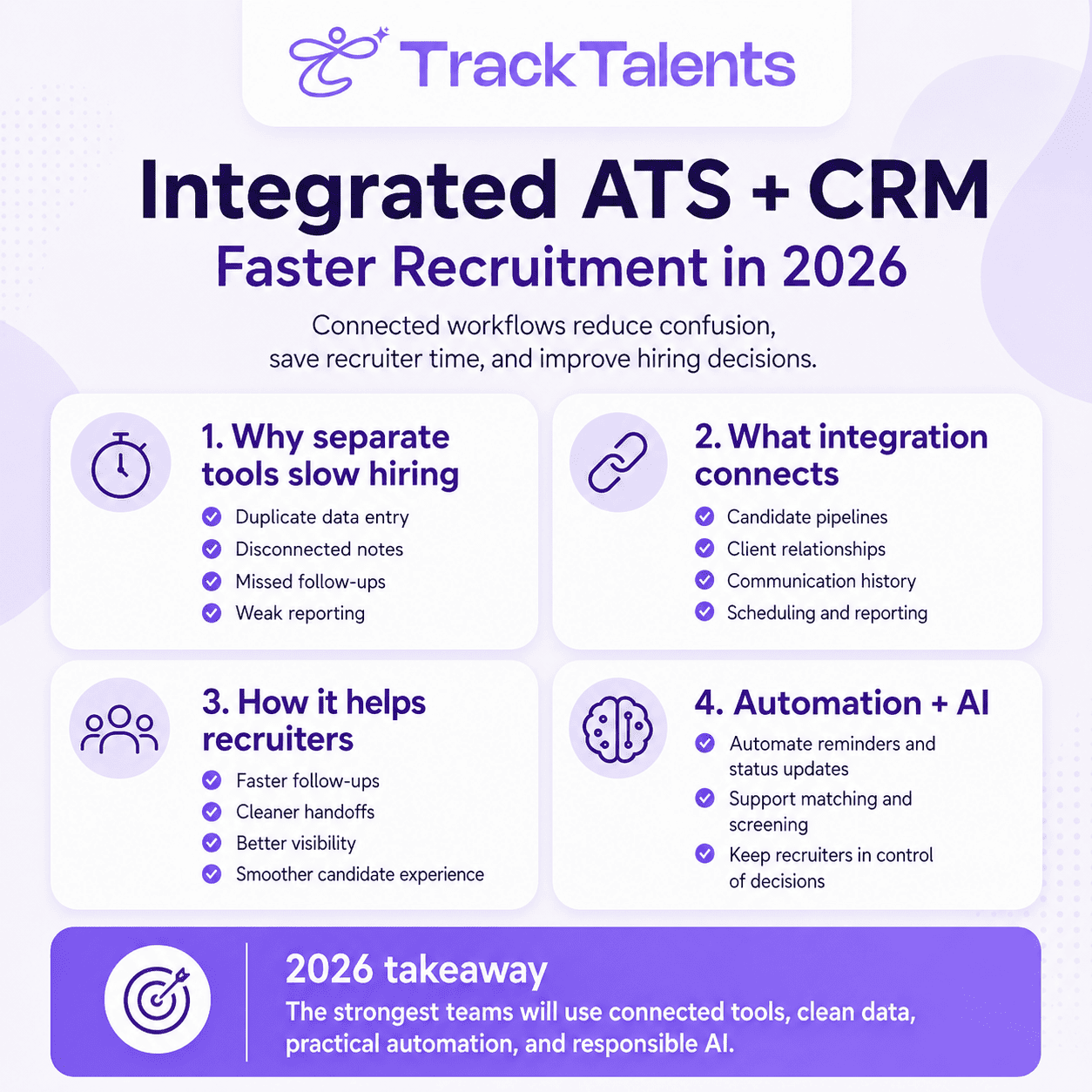
An ATS or recruitment CRM should provide the operational evidence used to administer the plan. It should not decide the compensation policy.
TrackTalents, for example, lists candidate and contact management, recruiter activity logs, job pipelines, customizable workflows, an integrated calendar, and vendor management among its available functions. Its website also describes integrations with Outlook, Office 365, and Chrome. These capabilities can help agencies track candidate movement and recruiter activity within a single workflow.
Before relying on any platform for incentive administration, the agency should define:
- Mandatory fields
- Candidate ownership rules
- Vacancy ownership rules
- Required activity records
- Who may edit placement information
- How corrections are approved
- Which report will finance use
- When data is locked for payroll
The software record should support the agreed policy. Recruiters should not be paid or denied payment merely because an activity was entered incorrectly without a review process.
Do Not Reward Unchecked AI Output
AI tools can help recruiters search databases, summarise résumés, draft messages and identify possible matches.
They can also increase weak activity if incentives reward volume. A recruiter may send more profiles or messages without checking whether they are accurate, relevant, or appropriate.
Recruiter performance should therefore not be judged by:
- Number of AI-created candidate matches
- Number of automated messages sent
- Number of AI summaries produced
- Speed of submission without evidence of review
The useful outcome is not how much content the system generates. It is whether recruiters use the output responsibly and make sound decisions.
The EU AI Act identifies certain AI systems used to analyze applications, filter candidates, or evaluate people for recruitment as high-risk uses, subject to the regulation’s detailed conditions and exceptions. The Act also requires appropriate human review for high-risk systems, including the ability to understand limitations, recognize overreliance, interpret outputs, and, where necessary, override or disregard them.
The regulation’s obligations are being introduced in stages, and their application depends on the system, use case, and organization. Agencies recruiting in the European Union should obtain appropriate legal and technical advice rather than assuming that adding a human approval button is sufficient.
From an incentive perspective, the principle is simple: recruiters should be rewarded for reviewed, relevant, and defensible work, not machine-assisted volume.
Sample Recruiter Incentive Models
The following structures are illustrations rather than universal formulas. Rates and thresholds should be adapted to the country, role, market, seniority, fee structure, and employment terms.
Permanent staffing recruiter
Base salary: Paid monthly.
Placement commission: Percentage of collected placement revenue.
Quality gate: Full commission is released after joining or completion of the guarantee period.
Accelerator: Higher commission rate after a quarterly revenue threshold.
Team bonus: Paid when the team reaches agreed revenue and quality targets.
Adjustment: Commission reviewed when a placement fails for a preventable reason.
Contract staffing recruiter
Base salary: Paid monthly.
Margin incentive: Percentage or tiered bonus based on collected gross margin from active contractors.
Retention gate: The full incentive applies after contractors complete a defined period.
Growth bonus: Additional reward for increasing headcount within an existing client account.
Compliance gate: Payment may be delayed where required onboarding, timesheet, or employment documentation is incomplete.
Sourcer
Base salary: Paid monthly.
Qualified-candidate bonus: Paid when a sourced candidate meets the agreed requirements and passes recruiter screening.
Interview bonus: Paid when the client or hiring manager accepts the candidate for an interview.
Joining bonus: Additional reward when the sourced candidate joins.
Talent-pool bonus: Quarterly recognition for creating verified candidate pools for important recurring roles.
Account manager
Base salary: Paid monthly.
Revenue or margin incentive: Linked to collected business from assigned accounts.
Client growth bonus: Paid for repeat roles, account expansion, or successful new service lines.
Quality measures: Client retention, feedback turnaround, and placement performance.
Team component: Shared bonus where delivery depends on several recruiters.
Review the Plan Before Problems Become Permanent
A recruiter incentive plan should be reviewed at defined intervals, not changed whenever one placement creates a dispute.
Quarterly monitoring and an annual formal review may be suitable for many agencies, though rapidly changing businesses may need more frequent checks.
Review both financial and behavioral results:
- Is profitable revenue increasing?
- Are payouts affordable?
- Are recruiters avoiding difficult vacancies?
- Are weak submissions increasing?
- Are candidate fall-offs rising?
- Are clients asking for more replacements?
- Are sourcers and delivery teams recognized fairly?
- Are ownership disputes frequent?
- Are recruiters keeping the ATS updated?
- Are high performers staying?
- Are team members collaborating?
- Are recruiters being penalized for factors outside their control?
Do not change earned commission retrospectively. New thresholds and rules should apply from a clearly communicated future date, subject to applicable employment law and contractual terms.
Recruiters should also have a formal route to question calculations. One manager should not be allowed to make undocumented exceptions for preferred employees.
Make the Rules Clear Before the First Placement
A recruiter incentive plan should be written before targets begin.
It should define:
- Eligible roles and employees
- Base and variable pay
- Revenue, margin or profit calculation
- Targets and accelerators
- When commission is earned
- When payment is released
- Candidate and vacancy ownership
- Shared-placement rules
- Guarantee-period treatment
- Clawbacks and adjustments
- Treatment of late client payment
- Treatment after resignation or termination
- Team bonuses
- Quality requirements
- Data-entry responsibilities
- Dispute and approval procedures
- Review dates
- Authority to make exceptions
Recruiters should receive worked examples showing how common situations will be handled. Finance should be able to calculate payouts consistently, and managers should not need to renegotiate the rules after every placement.
A good incentive plan rewards the work that protects the agency as well as the activity that produces fees. It recognizes qualified candidates, honest communication, profitable client relationships, accurate records, completed placements, and continuous performance.
Recruitment incentives cannot guarantee good judgment. They can make good judgment financially worthwhile.
Frequently Asked Questions
What is a recruiter incentive plan?
A recruiter incentive plan is a compensation structure that provides variable pay based on agreed-upon recruitment or commercial outcomes. These may include placements, collected revenue, gross margin, candidate joining, contractor retention, qualified submissions, or client growth.
Should recruiter commission be based on revenue or gross margin?
Revenue is easier to calculate and may suit recruiters who do not control delivery costs. Gross margin can work better when recruiters or account managers modify pricing, contractor pay, or discounts. The measure should reflect what the employee can influence.
When should recruiter commission be paid?
Agencies may pay after joining, invoice collection, completion of the guarantee period, or a combination of these stages. The policy should account for cash flow, candidate fall-offs, and client payment times.
Should sourcers receive incentives?
Sourcers should be rewarded when their work produces qualified and usable candidates. Incentives may be linked to successful screening, client interviews, joining, or the development of verified talent pools rather than the number of profiles collected.
How can agencies reduce commission disputes?
Define candidate ownership, vacancy ownership, contribution splits, payout timing, clawbacks, and data-entry expectations in writing. Record key activity in a shared ATS or CRM and provide a formal review process for disputed calculations.
Are team bonuses better than individual commission?
Neither model is always better. Individual commission recognizes direct contribution, while team bonuses encourage cooperation. Agencies in which several people contribute to each placement may benefit from combining the two.
Can candidate experience be included in recruiter incentives?
Yes, but it should be measured carefully. Joining rate, guarantee-period completion, communication standards, complaints, and withdrawal reasons can act as quality checks. One subjective survey score should not determine a large part of a recruiter’s pay.
How often should a recruiter incentive plan be reviewed?
The agency should monitor the plan regularly and conduct a formal review at least once a year. Reviews should examine profitability, payout affordability, recruiter behavior, candidate outcomes, client satisfaction, and internal disputes.