Recruiters often search the same job boards repeatedly, download resumes one at a time, and enter candidate details into an applicant tracking system (ATS). The work is necessary, but much of it is administrative. It also becomes difficult to control when several recruiters use different searches, save files in separate folders or create duplicate candidate records.
Automated resume harvesting can reduce this manual effort. In a well-designed workflow, an ATS or connected sourcing tool searches authorized candidate sources, imports selected resumes, and converts the information into searchable profiles. A typical automated workflow might proceed as follows: First, the system runs a search based on set job criteria. Next, it imports resumes from permitted sources and parses them to extract important details such as contact information, work history, and skills. Then, duplicate records are flagged, and profiles are added to the ATS in a searchable format. Finally, recruiters review the shortlisted candidates, decide whom to contact, and document all outreach within the platform. This approach allows recruiters to review, contact, and track candidates from a central system.
The value, however, does not come from collecting the largest possible number of resumes. A database filled with irrelevant, outdated, or unlawfully obtained information creates more work and more risk. Effective resume harvesting depends on clear search criteria, permitted access to each source, reliable data administration, and human assessment throughout the hiring process.
What Automated Resume Harvesting Actually Covers
Resume harvesting generally refers to collecting resumes or candidate profiles from external sources and bringing them into a recruitment database. Depending on the software and the permissions available, sources may include subscribed job boards, applications received through a career site, recruiter mailboxes, referrals, or an existing candidate database.
Automation may perform several connected tasks:
- Run or assist with searches based on role, skills, location, experience, and other job-related criteria.
- Import resumes through an approved job-board connection, application feed, or authorized browser tool.
- Parse a resume by extracting details such as contact information, employment history, education, and skills.
- Create or update a candidate record in the ATS.
- Detect possible duplicates
- Link a profile to a job requirement, source, and recruiter.
- Make the record searchable for current and future vacancies.
These functions are related but not interchangeable. Harvesting brings candidate information into the system. Parsing structures that information. Matching compares a profile with selected criteria. Screening and shortlisting influence who progresses. Treating all four activities as one automated decision can hide errors and weaken accountability.
| Recruitment stage | What the system may do | What the recruiter still needs to do |
| Candidate sourcing | Search permitted sources and import selected profiles | Confirm that the source, search and intended use are authorized |
| Resume parsing | Extract information into standard ATS fields | Check important fields, resolve duplicates and retain the original document |
| Candidate matching | Compare profiles with job-related criteria | Review context, transferable experience and the quality of the criteria |
| Shortlisting | Prioritize or filter candidates | Validate the outcome and make a defensible, job-related decision |
This distinction also affects legal and ethical responsibilities. Importing a resume is data collection. Automatically rejecting someone because of a score is a selection decision. The controls required for the second activity are normally more demanding than those required for the first.
Why Manual Resume Sourcing Becomes Difficult to Control
Manual sourcing is not inherently ineffective. It can be appropriate for executive search, highly specialized assignments, or a small number of vacancies. Problems arise when recruiters must repeat the same steps across many roles and candidate sources.
A recruiter may have to log in to several job boards, recreate similar searches, open profiles, download documents, rename files and upload them to an ATS. Another recruiter may already have stored the same person under a different email address or resume version. Notes about the candidate may remain in an inbox or spreadsheet rather than in the recruitment record.
This splitting creates practical problems:
- Search methods vary between recruiters, making results inconsistent.
- Duplicate profiles obscure a candidate’s history and former communication.
- Source information may be lost, weakening recruitment reporting
- Resumes become difficult to rediscover when a later vacancy arises.
- Different team members may repeat candidate outreach
- Recruiters spend time transferring information rather than assessing its relevance.
Automation is most useful when it removes these repetitive steps, but not when it removes the recruiter’s control over whom to consider and contact.
The Real Benefits of Resume Harvesting in an ATS
Faster movement from search to review
An authorized integration can reduce the need to download and re-upload individual files. When profiles enter the ATS in a consistent format, recruiters can begin reviewing them without first assembling information from separate systems.
The time saved depends on the workflow. A poorly configured search may import hundreds of unsuitable profiles and merely move the workload from sourcing to screening. Teams should therefore assess the time taken to produce a relevant, reviewed shortlist, not the number of resumes collected.
A searchable talent pool for future vacancies
A resume that is unsuitable for one requirement may still be relevant to another. When candidate records are indexed by skills, experience, location, availability and previous activity, recruiters can search the existing database before paying for another external search.
This only works when the data stays accurate and usable. Recruiters need to know when a profile was obtained, which source supplied it, whether the person has been contacted, what the candidate said, and when the information should be reviewed or deleted. Regular data audits are essential to identify outdated or partial records, as is setting automatic reminders for profile review and retention checks. Practical hygiene steps include flagging inactive profiles for follow-up, verifying contact details at set intervals, merging duplicates, and removing records that no longer meet privacy or compliance standards. A large database lacking this context is an archive, not a reliable talent pool.
Less duplicate entry and better record continuity
Duplicate detection can alert recruiters when a candidate already exists. The team can then update the existing profile instead of creating an isolated record. This preserves previous submissions, interviews, feedback, communication, and consent or privacy preferences.
Duplicate controls are rarely perfect. People use different email addresses, shortened names, and several versions of a resume. The ATS should allow users to compare possible matches and merge records carefully rather than automatically overwriting useful information.
Clearer collaboration between recruiters and hiring managers
Once the resume, notes, job association, and communication history sit in the same system, authorized team members can work from a shared record. Recruiters can see whether someone has already been approached, while hiring managers can review the information relevant to the vacancy.
Access should still be role-based. A central database does not mean that every user should see every candidate or every field. Permissions, activity logs and controlled sharing are particularly important when an agency serves numerous clients or operates across countries.
More reliable sourcing analysis
Recording the source at the point of import allows a hiring team to compare job boards, referrals, career-site applications and existing database searches. Useful measures include the percentage of imported profiles that meet verified job criteria, response rates, interview progression, hires, duplicate rates and the amount of manual correction required after parsing.
Resume volume alone is a weak measure. A source that supplies fewer candidates may still be more valuable if the profiles are current, relevant, and responsive.
Why More Resumes Do Not Automatically Produce Better Candidates
Automated harvesting works based on the instructions, permissions, and data it receives. It cannot correct an unrealistic job description or decide which requirements are genuinely essential.
Broad searches can produce too many loosely related profiles. Narrow searches can exclude candidates who use different terminology, have transferable experience, or describe the same technology differently. Keyword matching may recognize that a term appears in a resume without grasping the depth, recency, or context of the experience.
Resume parsing also introduces uncertainty. Complex layouts, tables, images, unusual headings, and inconsistent dates can cause information to be entered into the wrong fields. A system may mistake a client name for an employer, misread overlapping roles, or treat a skill mentioned in a project as current expertise. The original version resume should remain available so that recruiters can verify important details.
Staleness is another problem. A profile collected months earlier may contain an old title, location, salary expectation, or availability status. Harvesting indicates that a person matched a search at a particular time; it does not establish that the person is interested in the vacancy or open to contact.
For these reasons, automated matches should guide review rather than be presented as proof of suitability. The recruiter must still examine the evidence, speak with the candidate, and assess the person against job-related criteria.
Automated Sourcing Must Respect Platform Rules and Candidate Data
An employer’s subscription to a job board does not automatically permit every form of automated extraction. Each source has its own license, access limits and acceptable-use conditions. Recruitment teams should use approved integrations, APIs, exports or platform tools and confirm that their ATS workflow operates within those terms.
Key compliance checks for recruiters include:
– Verify that any integrations with job boards or sourcing platforms have official approval and are not relying on unauthorized scraping or browser tools.
– Review the terms of service and acceptable-use policies for each data source to identify any restrictions on automated data collection or usage.
– Document the permissions obtained for resume harvesting and retain evidence of license agreements or integration authorizations.
– Ensure that all sourcing methods and tools are periodically audited to remain compliant with changing platform rules and legal requirements.
These practical steps help prevent accidental violations and preserve trust with both candidates and data providers.
This is particularly important when a tool claims that it can collect information from professional networks or websites without an authorized connection. For example, LinkedIn prohibits third-party crawlers, bots, browser extensions and other tools that scrape profiles or automate activity on its service. Public visibility should not be treated as unrestricted permission to copy, retain and reuse a person’s information.
Resumes and candidate profiles also contain personal data. The applicable requirements depend on where the recruiter, employer and candidate are located. In the EU, for example, the General Data Protection Regulation requires that personal data be processed legally and transparently, be limited to what is necessary, be kept accurate, and be retained no longer than required for the stated purpose. These principles are set out in Article 5 of the GDPR.
Recruitment teams should establish:
- A valid basis for collecting and using candidate information
- A clear record of the source and date of collection
- A privacy notice explaining the purpose, sharing and retention of the data
- A process for access, correction, objection and deletion requests where applicable
- Retention rules based on a defined recruitment purpose rather than indefinite storage
- Restrictions on sensitive or unnecessary information
- Security controls for exports, integrations, user access and third-party processing
The UK Information Commissioner’s Office guidance states that organizations that obtain personal data from other sources must still provide the individual with privacy information, subject to limited exceptions. It also identifies the purpose, lawful basis, source, recipients, retention period and existence of automated decision-making among the information that may need to be disclosed. The regulator’s right-to-be-informed guidance provides a useful compliance reference, although organizations must apply the law relevant to their own operations.
Keep Resume Collection Separate from Automated Selection
Some ATS products go beyond importing and organizing resumes. They may score, rank or recommend candidates. Those functions require separate scrutiny because the system is no longer processing administrative work alone; it may be influencing an employment decision.
The criteria should be demonstrably connected to the job. Teams need to understand which data the system uses, how missing information is processed, whether results can be explained, and how a recruiter can challenge an unsuitable recommendation. They should also test for candidates who are wrongly included and those who are wrongly excluded. To preserve fairness and relevance, teams should implement a simple review protocol for automated recommendations. For example, recruiters can regularly conduct periodic audits or sample checks of shortlisted candidates to ensure automated matches reflect actual job requirements. This process should include checking a random sample of recommended profiles against the defined criteria and documenting any necessary corrections or modifications. By building these review steps into the workflow, organizations can help ensure the automation supports, rather than undermines, fair and accurate selection.
This is not simply a technical quality issue. The UK Information Commissioner’s Office reported compliance concerns after auditing AI recruitment providers, including excessive data collection and inadequate explanations of how candidate information was used. Its guidance for organizations procuring AI recruitment tools advises buyers to obtain clear assurances concerning fairness and data protection.
In the United States, the Equal Employment Opportunity Commission has also warned that software used to score resumes or assess applicants may disadvantage people with disabilities and expose employers to liability under the Americans with Disabilities Act. The EEOC and Department of Justice guidance reinforces an important principle: buying a tool does not transfer responsibility for the employment decisions made with it.
Human review should therefore be meaningful. A recruiter who routinely accepts the system’s ranking without examining the underlying information is not providing effective oversight.
What to Check Before Choosing a Resume Harvesting Workflow
The strongest evaluation starts with the organization’s sourcing process rather than a vendor’s feature list. Buyers should test the following areas with real roles and representative resumes.
Source access and permissions
Confirm which job boards and databases are supported, how the connection works, whether separate subscriptions or credits are required, and which actions the source permits. Ask the vendor to distinguish an official integration from a browser extension or automated scraping tool.
Search control
Recruiters should be able to build searches around verified criteria and improve them without technical assistance. Useful controls may include Boolean operators, location, experience, skills, qualifications, recency, and exclusions. The exact filters should reflect the roles being filled rather than encourage indiscriminate collection.
Parsing and duplicate management
Test resumes with different formats, career histories and languages used by the organization. Review the accuracy of names, dates, employers, titles, education and skills. Check how the system identifies possible duplicates, preserves the existing file and handles a newer version of an existing resume.
Data provenance and auditability
Each profile should retain its source, import date and relevant job-board or recruiter activity. Administrators should be able to review who accessed, changed, exported or shared candidate information where this is necessary for governance.
Privacy and retention controls
Look for configurable retention rules, deletion or anonymization workflows, privacy-notice support, candidate preference records, access restrictions and practical handling of data-subject requests. Confirm where information is stored, which subprocessors receive it and how cross-border transfers are addressed.
Matching transparency
If the system recommends or ranks candidates, ask which fields and logic affect the result. Recruiters should be able to review the evidence, adjust inappropriate criteria and identify why a candidate appeared or did not appear in the results.
Recruitment outcomes
During a pilot, compare relevant results rather than raw import volume. Track search-to-review time, duplicate rates, parsing corrections, contactability, candidate responses, interview progression, and hires by source. These measures reveal whether automation is improving the workflow or simply filling the database faster.
A Controlled Way to Introduce Automated Resume Harvesting
To run an effective pilot of automated resume harvesting, follow these steps in order:
1. Select one or two recurring roles for which the hiring team already understands the candidate market.
2. Define the must-have criteria, acceptable alternatives, as well as any exclusions before configuring the search. Clear criteria help prevent the creation of large, unreliable datasets.
3. Connect only approved sourcing channels relevant to those roles.
4. Import a limited sample of candidate profiles based on these settings.
5. Review the results by comparing them to the first search criteria, checking parsing accuracy, reviewing duplicates, and recording how many profiles are genuinely worth contacting.
Weak results may point to a poor query, inconsistent resumes, incorrect field mapping or unrealistic job requirements.
Once the search performs reliably, document who can run it, how frequently it should operate, how candidates will be contacted, and how long their information will be kept. Review the workflow periodically because job-board terms, hiring needs, candidate data and privacy obligations can change.
Automation should be expanded only when the team can explain the source of each profile, the reason it was collected and the way it will be used.
Where TrackTalents Fits into the Sourcing Process
TrackTalents states that its job-board integration permits users to log in to paid job boards, search and import resumes. Its published features also include resume management, unlimited resume uploads, permissions control, recruiter activity logs, and customizable workflows. These capabilities can integrate sourcing records and subsequent recruitment activity into a single system. The current feature information is available on the TrackTalents ATS website.
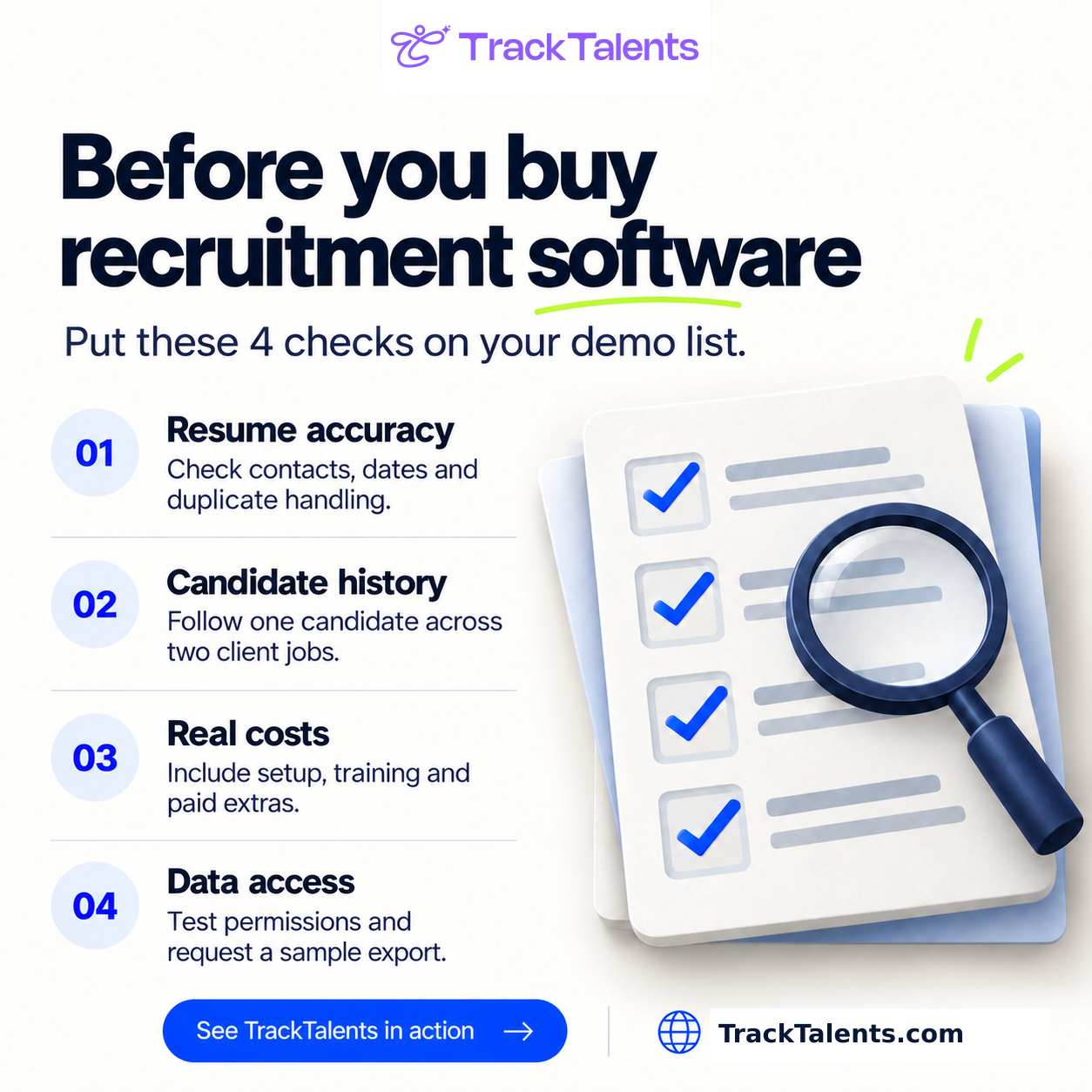
Buyers should still verify the precise workflow during a product demonstration. In particular, ask which job boards have approved connections, whether searches can run on a schedule, how job-board usage limits are enforced, how duplicates are resolved, and which privacy and retention controls apply. A job-board integration should not be assumed to provide unattended harvesting unless that capability and the source’s permission are both confirmed.
The most useful trial is based on the organization’s own sourcing conditions. Test a familiar vacancy, import a controlled group of resumes and measure relevance, parsing accuracy, duplicate handling, recruiter effort and record traceability. This shows whether the system improves the quality and control of candidate sourcing, not simply its speed.
Automated resume harvesting is valuable when it removes repetitive work while preserving evidence, permissions and recruiter judgment. If it produces a larger database but weaker searches, unclear sourcing or poorly governed candidate information, it has not improved recruitment. The right ATS workflow should help recruiters find relevant people sooner, understand from which source each profile came, and make hiring decisions that remain human, accountable, and defensible.