
An applicant tracking system (ATS) does not make recruitment effective by itself. It helps employers organize job openings, gather applications, review candidates, share decisions, and check hiring results.
An ATS works best when it matches a recruitment process that is already well planned. In that case, it can streamline routine tasks, prevent candidates from getting stuck between steps, and help hiring teams focus on what needs attention. Poorly set up workflows do the opposite: they speed up inconsistent practices and make problems bigger. If records are not updated quickly, reports, reminders, and automatic actions that depend on them become less useful.
Evaluating the benefits of an ATS is not just about looking at its features. Employers need to figure out where technology can truly improve the workflow, what needs to be set up to fit their processes, and which decisions still need human judgment. A quick look at each recruitment step can reveal possible gaps:
- Is the task repetitive and rules-based enough to automate, or does it require individual judgment?
- Can the platform perform the task as standard, or will it require configuration, integration, or a separate manual process?
- Who remains accountable for the decision or outcome?
- Does the system retain a usable record of the action, including who completed it and when?
- Could the step affect fairness, privacy, or regulatory compliance and therefore require direct human oversight?
This exercise turns a feature comparison into a practical assessment of the recruitment workflow. It shows where an ATS can remove friction, where better configuration is needed, and where the underlying process—not the software—needs to change.
What an Applicant Tracking System Actually Does
An ATS serves as the working record of the recruitment process. It collects applications and tracks each candidate from the initial submission through screening, interviews, offer decisions, and final closure. The range of functions varies by platform, subscription, and available integrations, but may include:
- Job requisition creation and approval
- Vacancy posting across career sites and job boards.
- Online application forms
- Resume parsing and candidate profile creation.
- Prescreening and eligibility questions
- Candidate searches, filters and matching
- Interview scheduling
- Recruiter and hiring manager evaluations
- Automated emails, alerts and reminders
- Offer preparation, approval and documentation.
- Recruitment dashboards and reports
- Connections with HR, assessment and onboarding systems
An ATS and an AI recruitment tool are not always the same. Many ATS features follow fixed rules set by the employer. For example, the system might mark an application as ineligible if a candidate says they do not have a required certification. The system follows a set rule; it does not judge the candidate’s overall fit on its own.
An AI-assisted matching tool works differently. It may compare a candidate’s experience, skills, qualifications, and other details with the job’s requirements, then suggest applicants who seem relevant—even if their job titles or descriptions don’t exactly match. That suggestion is still a prediction based on the data and how the model was built. It does not prove that one candidate is better than another.
Employers should determine which functions follow fixed rules and which generate predictions or suggestions. They also need to know what information each function uses, if its results can be checked or changed, and how much it affects the final hiring choice.
This distinction matters because storing an application, searching a candidate database and algorithmically ranking applicants are different activities with separate operational and regulatory implications.
Centralized Candidate Records Remove Everyday Recruitment Friction
Recruitment information often gets spread out across emails, spreadsheets, shared folders, calendars, and hiring managers’ personal notes. This makes it hard to know if an application has been looked at, who is responsible for the next step, or why a candidate was turned down.
An ATS creates a central record for each job opening and applicant. Authorized users can see the candidate’s resume, application answers, interview history, messages, evaluation notes, and current status without having to piece together information from different places.
This shared record can reduce several common problems:
- Recruiters contacting the same candidate without knowing that a colleague has already done so
- Interview feedback remaining in personal email accounts
- Applications being overlooked during staff leave.
- Hiring managers asking repeatedly for status updates
- Candidates remaining in the wrong stage after a decision
- Rejection reasons being recorded inconsistently or not at all.
Centralizing data does not mean every employee should have unlimited access. Candidate records may include salary details, ID documents, health info, demographic data, or background check results. So, controlling access by role, setting rules for keeping data, and tracking who views it are just as important as making access easy.
The quality of the database also depends on daily care. Duplicate profiles, outdated statuses, and missing rejection reasons make searches, reports, and future candidate contact less effective. To keep data quality high, organizations should regularly check candidate records to find and fix common problems. Giving someone the job of watching for incomplete or duplicate entries helps keep standards. Giving recruiters clear guidelines on record keeping and regular training supports good practices and keeps the ATS working well.
Workflow Automation Removes Routine Delays, Not Human Judgment
Recruitment often slows down due to unfinished tasks rather than difficult hiring decisions. Recruitment often slows down because tasks are left unfinished, not because hiring decisions are hard. A job request stays in an approver’s inbox, interview feedback comes late, or a good candidate waits days for scheduling options. None of these tasks is hard, but together they make candidates wait and keep jobs open longer than necessary. Publishing approved vacancies through selected channels.
- Confirming receipt of applications
- Assigning candidate reviews to recruiters
- Sending interview scheduling options
- Reminding interviewers to complete scorecards
- Alerting hiring managers when candidates reach specified stages
- Sending approved rejection or status-update messages
- Transferring accepted candidates into the onboarding workflow
These actions cut down on repetitive tasks and make it easier to see who is responsible for the next step. However, every automatic action is based on certain assumptions. A quick rejection is still a bad decision if it depends on an outdated, wrong, or too strict screening question.
Automated rules should be checked whenever job needs change and on a regular schedule. Recruiters and hiring managers can look at unexpected rejection trends, wrong messages, wrong stage changes, and cases where the process missed a good candidate. HR, legal, privacy, or accessibility experts may also need to review higher-risk steps.
Some parts of recruitment are straightforward to automate. An application confirmation or a reminder to complete an interview scorecard follows a clear rule and does not determine a candidate’s future. Ranking or rejecting an applicant is different: it may decide whether that person’s application is ever reviewed by a recruiter. A named member of the hiring team should therefore check the evidence, investigate results that do not make sense, and be able to explain how the decision was reached.
The standard workflow must also accommodate situations it was not designed to handle. A candidate may need an accommodation, use a different application method, or hold an equivalent qualification that a yes-or-no screening question misses. Recruiters need the authority to stop an automated action, reassess the application, and document why the workflow changed.
Resume Screening Becomes More Consistent, Not Automatically More Accurate
The claim that every ATS scans resumes for keywords and rejects applicants that do not use the right phrases is too simplistic. ATS platforms differ substantially.
Screening works differently from one ATS to another. Some platforms allow recruiters to store and search applications. Others use eligibility filters, prescreening questions, scoring rules, matching models, or AI-generated recommendations. Oracle Recruiting, for example, treats disqualification questions separately from scored prescreening questions. That distinction has a practical consequence: one response may remove a candidate from consideration, while another contributes to a score that recruiters can review. Employers therefore need to understand how their own platform handles each step, as no two ATSs share the same screening method.
Used carefully, screening tools can help recruiters organize large applicant volumes. They may identify candidates who meet clearly defined requirements such as work authorization, location, license status, language proficiency, or willingness to work specified hours.
Problems arise when preferences are treated as essential qualifications or when recruiters assume that a score represents overall suitability. A candidate may have relevant experience but describe it differently, possess an equivalent credential or come from an adjacent industry with transferable skills.
A defensible screening process should:
- Separate genuine minimum requirements from desirable attributes
- Use criteria directly connected to the work.
- Allow recognized equivalent qualifications or experience.
- Avoid broad filters that exclude potentially suitable applicants unnecessarily.
- Review samples of both selected and rejected applications.
- Provide a route for reasonable accommodations.
- Record the reason for each material selection decision.
- Reassess filters when a role repeatedly produces an unsuitable shortlist.
An ATS can apply criteria consistently. It cannot determine whether those criteria are fair, relevant, or well designed unless the recruitment team does that work first.
Candidate Experience Improves Only When the Application Journey’s Designed Well
An ATS can prevent candidates from disappearing into a communication gap. Application confirmations, interview instructions, reminders, and timely status updates can all be delivered by structured workflows.
Automated messages improve candidate communication only when they arrive at the right time and provide useful information. A generic email sent too early or too late can create more uncertainty than it resolves. Repeated templates are unhelpful if they do not tell candidates where they stand, whether they need to act, or when to expect the next update. The application itself likewise shapes candidate experience. Employers should test the process from a candidate’s perspective and examine:
- How long the application takes to complete
- Whether information already contained in a resume must be entered again.
- How well the form works on a mobile device
- Whether an applicant can save progress and return later
- Whether instructions and job requirements are clear
- Whether people using assistive technologies can complete each step
- How candidates request an accommodation or technical assistance
- Whether interview times account for different locations and time zones
- Whether rejection messages accurately reflect the candidate’s stage
Candidate communicatioCandidate communication should answer practical questions: Has the application been received? What happens next? Is further action needed? When should the candidate expect an update? delivery mechanism. Recruiters remain responsible for the usefulness, accuracy, and tenor of the message.
Shared Workflows Give Hiring Teams Clearer Ownership
Hiring decisions usually involve recruiters, hiring managers, interviewers, HR representatives and, in some organizations, finance or senior leadership. Without a shared workflow, each participant may use different criteria or assume someone else is responsible for the next step.
An ATS can display how many candidates are at each stage, which interviews are pending, and at which feedback is overdue. A visual pipeline, such as the one described in Greenhouse Recruiting’s product documentation, can help teams see both candidate progress and outstanding actions.
Structured scorecards and interview guides can also improve decision quality by directing interviewers towards agreed job-related criteria. They are most effective when interviewers record evidence rather than impressions.
Comments such as “not a good cultural fit” provide little useful information and may conceal inconsistent judgment. A stronger note would identify the competency assessed, the question asked, and the evidence in the candidate’s response.
To reduce group influence, interviewers can submit independent evaluations before a group discussion. Access controls should also prevent participants from viewing sensitive information that is unrelated to their role in the decision.
Recruitment Analytics Expose Bottlenecks—If the Data Is Reliable
ATS reporting can show where recruitment activity is slowing down and which sources are producing candidates who progress through the process. Useful measures may include:
- Time spent in each hiring stage
- Applications awaiting review
- Source-to-screen conversion
- Screen-to-interview conversion
- Interview-to-offer conversion
- Offer acceptance and decline rates.
- Candidate withdrawal points
- Interview feedback completion
- Recruiter workload
- Reasons for rejection or offer refusal
Time-to-fill and time-to-hire should not be treated as interchangeable. Definitions vary, but time-to-fill typically measures the period from opening or approving a vacancy to its filling. Time-to-hire focuses on the period from a candidate’s entry into the process to their acceptance of an offer. To ensure consistent measurement and meaningful comparisons, organizations should establish a formal process to define and document all key metrics before implementing an ATS or making process comparisons. This approach helps avoid misperceptions and provides a reliable basis for continuous assessment.
Speed should not be the only measure of success. A shorter process may reflect better scheduling, but it could also result from premature rejection or insufficient assessment. Recruitment data should be interpreted alongside quality indicators such as probation outcomes, hiring manager feedback, candidate withdrawal and early attrition—where these measures are appropriate and lawfully collected.
Recruitment reports do not correct poor data. When recruiters leave candidates in the wrong stage, skip rejection reasons, or select the wrong source, the figures begin to drift from reality. The dashboard may still appear complete, but measures such as time in stage, source performance, and rejection trends will be misleading.
What Changes When an ATS Connects With Other HR Tools
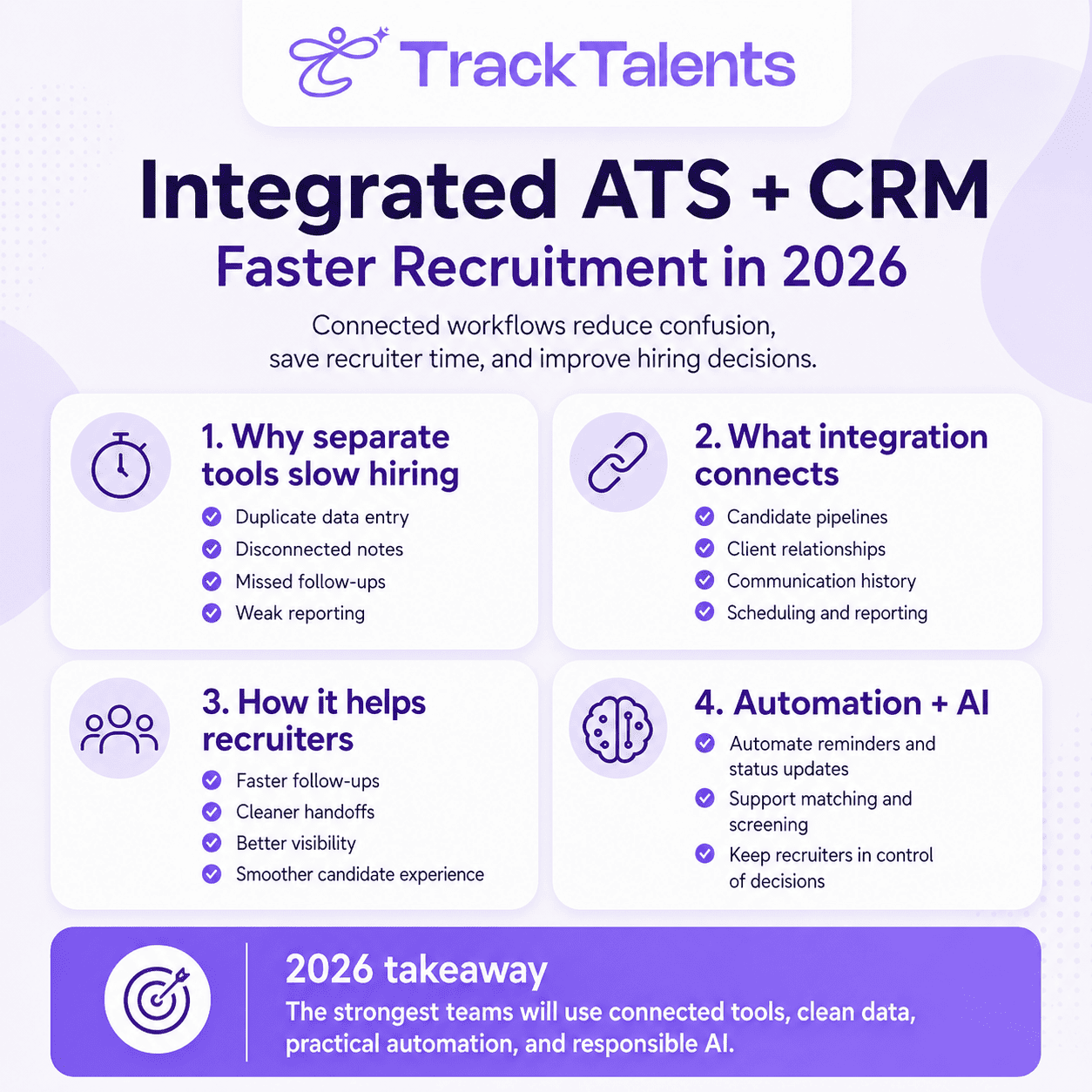
Recruiters often enter the same information more than once. A candidate applies through a job board, interview details are added to a calendar, assessment results arrive through another platform, and the successful applicant’s information is entered again during onboarding. Connecting these systems can remove much of this repeated work. Candidate records, interview bookings, results, and offer details can pass between the relevant tools instead of being copied manually at every stage.
A dashboard can report only what recruiters enter into the system. If a candidate has already reached the interview stage but the profile still shows “screening,” the time spent at each stage is immediately distorted. Missing rejection reasons and incorrectly labeled sourcing channels create similar gaps. The charts may look polished, but they no longer reflect how the hiring process actually unfolded.
For example, an accepted candidate’s approved details may move into an onboarding system instead of being copied manually from the application. Interview availability may be drawn from connected calendars, while assessment results may return to the candidate record.
These connections are useful only when the organization defines:
- Which system is the authoritative source for each data field
- What information should move between systems?
- Who can access the transferred information?
- How duplicate records will be handled?
- What happens when an integration fails
- How changes and deletions are synchronized
- How long transferred data will be retained
- Which vendor is responsible for correcting an error
- Whether the unification meets security and regional data requirements
An integration can accelerate a process but also expands the number of systems processing candidate information. Procurement teams should evaluate data flows and responsibilities rather than accept claims of “flawless integration” without technical and operational testing.
An ATS Creates Compliance Evidence; It Does Not Guarantee Compliance
An ATS can assist with record-keeping by preserving applications, stage changes, evaluation notes, communications, and reasons for decisions. Configured workflows may also help employers apply the same procedural steps across comparable candidates.
These functions can support accountability, but no ATS guarantees lawful or unbiased recruitment. A consistently applied selection rule may still be discriminatory, unnecessary or unrelated to the job.
In the United States, the Equal Employment Opportunity Commission has published guidance addressing adverse impact and disability-related concerns when employers use software, algorithms or AI in employment decisions. The agency’s guidance makes clear that existing employment protections remain relevant when automated tools make or inform selection decisions. Its current materials are available through the EEOC’s publications on AI and employment.
The UK Information Commissioner’s Office has similarly warned employers to assess the lawful basis, fairness, disclosure and data-minimization practices of AI recruitment tools. Its audits found examples of excessive data collection, indefinite retention, inferred demographic characteristics and filters that could exclude people based on protected characteristics. The ICO advises employers to establish responsibilities with providers, assess privacy risks, monitor for bias and explain how candidates can challenge automated decisions. The ICO’s procurement guidance sets out the questions organizations should ask before using such a tool.
Within the European Union, the EU Artificial Intelligence Act classifies certain AI systems used to examine or filter job applications and evaluate candidates as high-risk. The Act applies in stages, with most provisions applying from 2 August 2026. The exact duties depend on the system, its use, the organization’s role and applicable transitional rules.
These regulatory approaches are not interchangeable. Employers hiring in multiple countries should examine the rules that apply in each location, particularly when using automated scoring, profiling, biometric analysis, or fully automated decisions.
Functional governance should include:
- A documented purpose for every screening or scoring function
- Clear responsibility between the employer and technology provider
- Human review proportionate to the decision’s effect.
- Regular checks for inaccurate or unfair outcomes
- Candidate privacy notices written in understandable language
- Defined retention and deletion schedules
- Access controls for confidential information
- Procedures for correction, challenge and human review
- Evidence of system testing and workflow changes
Compliance depends on the organization’s decisions and practices, not simply on the presence of an audit trail.
Measure ATS Value Against Defined Hiring Problems
Claims that an ATS reduces cost or time should be tested against an organization’s baseline. Results vary depending on hiring volume, workflow complexity, existing systems, implementation quality, and team adoption.
Before introducing or replacing an ATS, recruitment leaders should document current conditions. Useful baseline measures include:
- Average administrative time spent on each vacancy
- Number of applications awaiting review beyond the agreed period
- Average candidate response time
- Time lost arranging interviews.
- Percentage of interview scorecards completed on schedule
- Frequency of duplicate or incomplete candidate records
- Time candidates remain inactive at each stage.
- Number of manual transfers into HR or onboarding systems
- Completeness of recruitment records during an audit
The team can then compare performance after implementation. Measures should be segmented by role type, location, and hiring volume because a high-volume entry-level campaign behaves differently from an executive or specialist search.
A system may create value even when overall time-to-fill does not fall. It might improve record completeness, reduce scheduling workload, or clarify candidate ownership. Conversely, a faster process is not necessarily better if candidate withdrawals rise or hiring managers receive weaker shortlists.
Choose an ATS by Workflow Fit, Controls and Adoption
The longest feature list rarely identifies the most suitable system. Employers should begin by identifying their recruitment problems and examining how well each platform handles the most common work.
Important evaluation criteria include:
- Ease of use for candidates, recruiters and occasional hiring managers
- Flexibility of requisition, approval and candidate-stage workflows
- Transparency of screening, matching and scoring functions
- Ability to review automated recommendations and exceptions
- Quality and configurability of reporting
- Integration alongside existing HR and business systems
- Mobile usability and usability accessibility
- Role-based permissions and security controls
- Data location, retention, export and deletion options
- Vendor support, implementation resources and documentation
- Migration requirements and data-cleaning effort
- Licensing terms and total operating cost
- Governance documentation for AI-supported functions
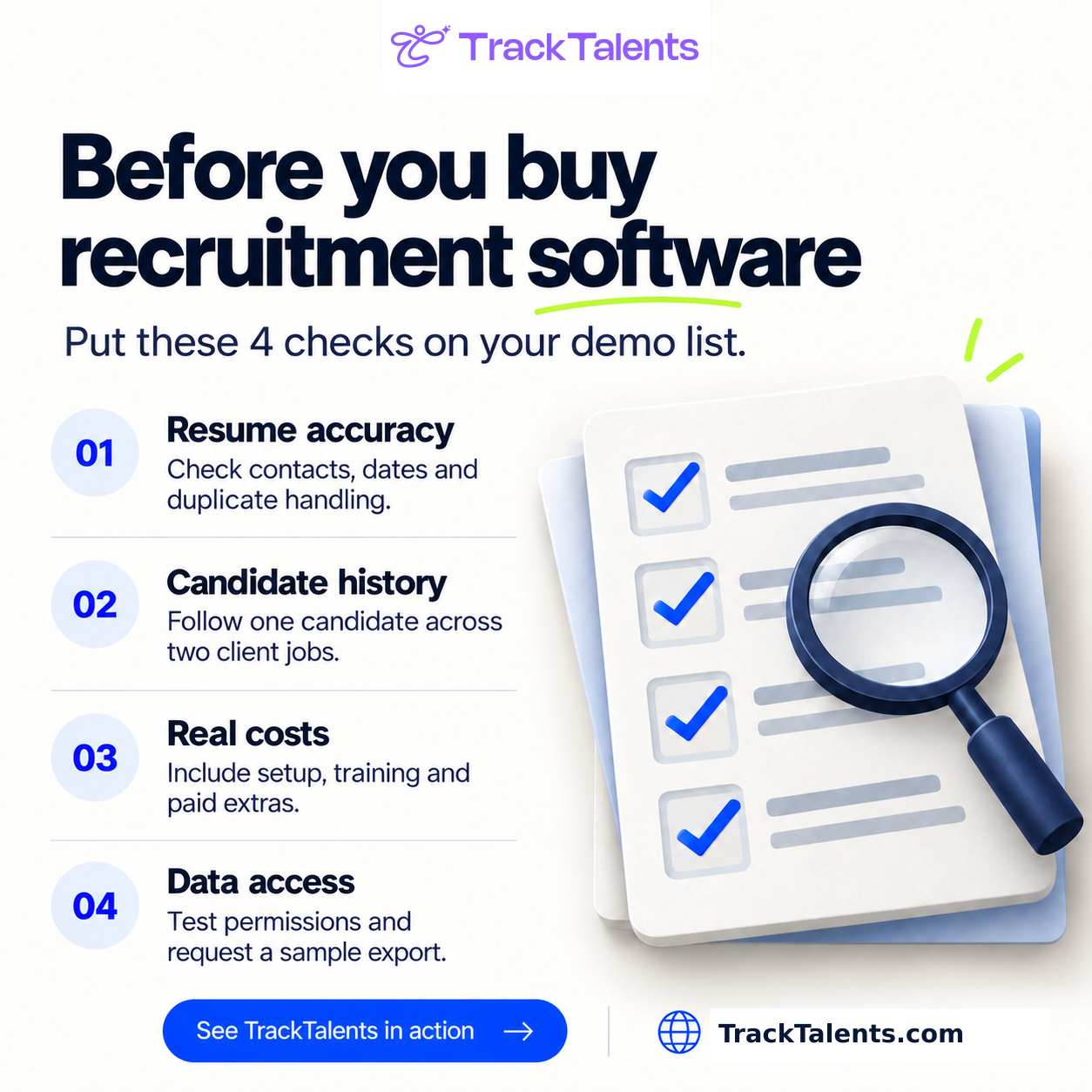
A demonstration using a polished sample workflow is not enough. Employers should test the platform with realistic vacancies, application volumes, user roles, and exceptions. This includes checking how the system handles duplicate candidates, incomplete applications, alternative qualifications, accommodations, rejected applicants, withdrawn offers, and integration failures.
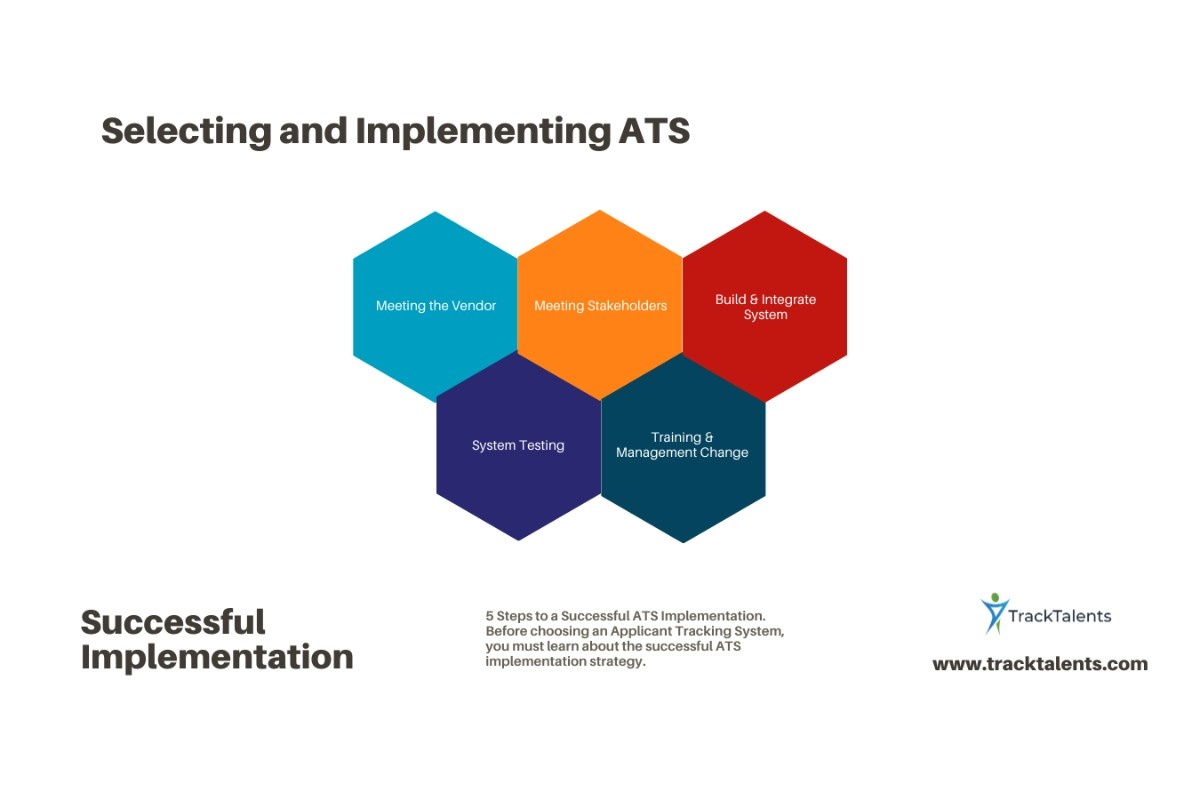
To pilot test an ATS effectively, HR teams can take several essential steps: select representative roles reflecting typical hiring scenarios, assemble a cross-functional team of recruiters, hiring managers, and system users, and specify clear success measures such as process completion times, error rates, user satisfaction, and candidate experience feedback. Track outcomes corresponding with identified hiring challenges and document problems encountered during the pilot, such as workflow hindrances or data quality issues. After the pilot, review findings with stakeholders and refine system configuration or training before full rollout.
Smaller organizations with occasional vacancies may not need a complex enterprise platform. A lightweight system with reliable candidate tracking, communication, and reporting may be more practical. Large or decentralized employers may require configurable approvals, multiple career sites, regional permissions, integrations and stronger reporting controls.
Start With the Process You Want the System to Enforce
Before purchasing or reconfiguring an applicant tracking system, map one complete hiring process from requisition approval to onboarding. Mark every handoff, delay, duplicated task, unclear decision, and point at which candidate information enters another system.
Use that map to identify which problems require automation, which need clearer ownership, and which arise from weak selection criteria or inconsistent recruiter behavior. Then pilot the proposed workflow on a representative vacancy and compare the results with the baseline.
An ATS delivers the greatest value when it supports a recruitment process that is already purposeful, job-related, and accountable. The technology can organize work, trigger action and expose patterns. Employers must still decide what good recruitment looks like—and ensure that the system consistently reflects it.