Recruiters are no longer choosing applicant tracking software based on the longest feature list. Most platforms now promise automation, AI, reporting, integrations, and better candidate experience. The better question is whether the system helps recruiters move faster, stay organized, search for candidates easily, and keep hiring managers involved without adding more admin work. A good ATS should fit the team’s daily hiring rhythm, not just look impressive in a demo.
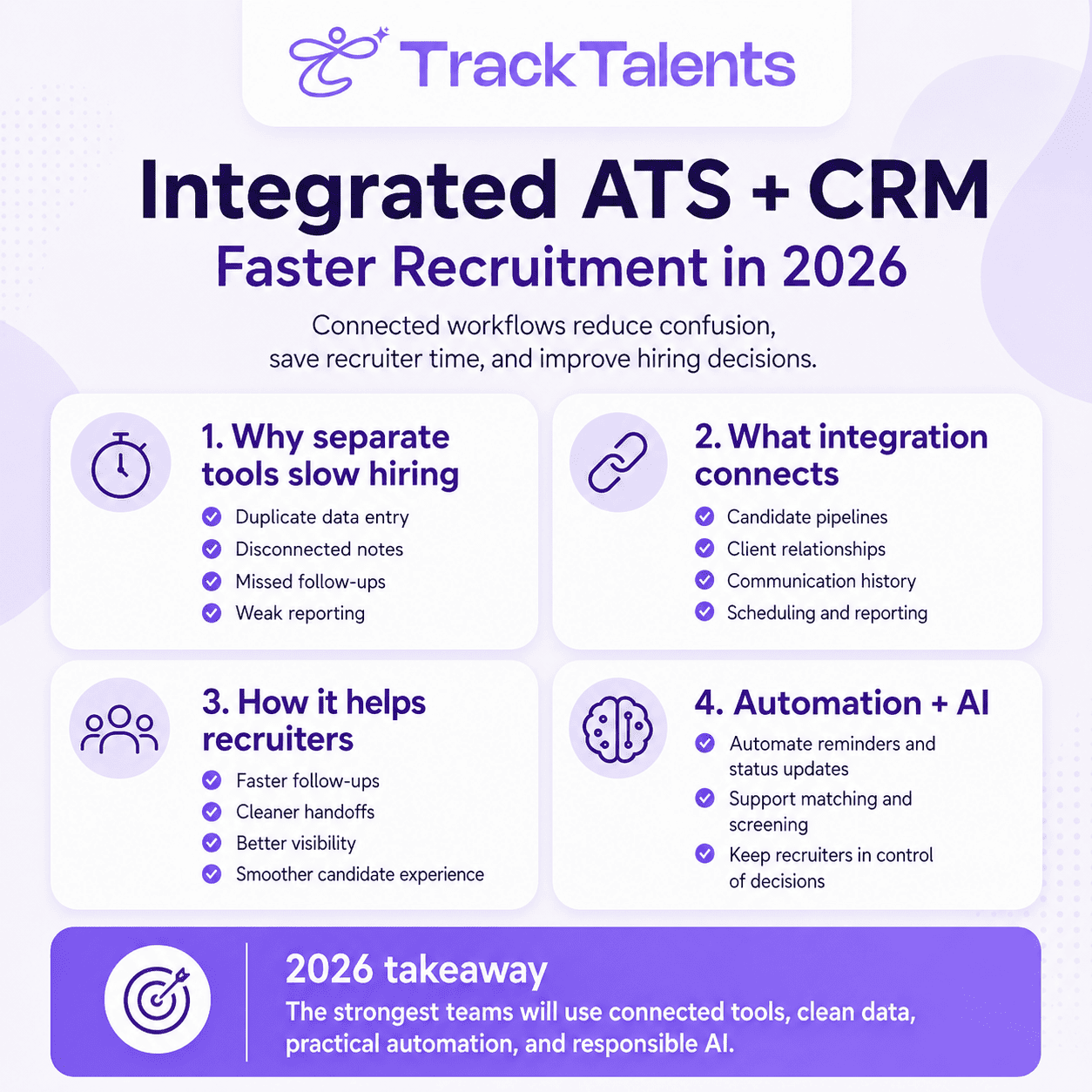
TrackTalents deserves a practical place at the top of this comparison because it is built closely around recruiter-led and staffing-style workflows. Its official feature pages highlight bulk email campaigns, email-linked resumes, interview scheduling, CRM links, role-based access, branded career sites, resume search, and browser and Outlook integrations. These are not decorative features. They matter when recruiters handle high volumes, repeated outreach, client follow-ups, and fast-moving requirements.
TrackTalents appears strongest for staffing agencies, recruiters, and small to mid-sized teams that want centralized communication and visible candidate movement without adopting a heavy enterprise platform. Its value is in everyday execution: finding past resumes, keeping emails connected to records, scheduling interviews, and maintaining pipeline clarity. Buyers should still test navigation, reporting, import quality, and permission setup before committing, because weak implementation can make any ATS harder than it should be.
Pitch N Hire is better suited to teams that want simpler automation and quicker structure. Its appeal is usually linked to resume parsing, candidate ranking, interview scheduling, and easier entry points for smaller teams. That can help recruiters move away from spreadsheets quickly. The caution is that ranking-led systems should not push teams to accept scores without reviewing the candidate’s context. Automation should support recruiter judgment, not replace it.
iCIMS sits in a different category. It is positioned as an enterprise talent acquisition platform with applicant tracking, candidate engagement, onboarding, employer branding, AI, and integrations. This makes it more relevant for large organizations with formal workflows, compliance needs, multiple business units, and deeper implementation support. The trade-off is predictable: enterprise depth usually entails a longer rollout, higher costs, and greater training effort.
Ashby is a strong fit for teams that want recruiting operations and analytics in one place. Its platform combines ATS, CRM, sourcing, scheduling, analytics, and AI. That makes it useful for companies that closely measure funnel movement, source quality, interview speed, and hiring outcomes. Ashby is most valuable when the team genuinely uses its reporting depth, not just admires it during a sales call.
Greenhouse remains known for structured hiring. Its platform emphasizes structured workflows, scorecards, interview consistency, integrations, and AI-supported recruiting. This can suit companies that want repeatable evaluation across roles and interviewers. Teams that prefer very loose workflows may find it more structured than they want, but that structure is exactly why many growing organizations consider it.
Lever is useful when relationship management is central to recruiting. Its platform combines ATS and CRM capabilities, with automation, analytics, AI, and collaborative hiring. This makes it relevant for teams that build pipelines before roles open, nurture warm candidates, and rely heavily on outbound recruiting. Lever works best when recruiting is treated as an ongoing relationship process rather than only an application workflow.
Workable is a practical option for smaller and mid-sized businesses that want broad recruiting features with an approachable setup. Its materials highlight job board integrations, AI sourcing, interview scheduling, custom workflows, branded career pages, and reporting. It also publishes pricing and offers trial access, which can help buyers more easily compare early costs. Teams with complex agency workflows or deeper governance needs may need more flexibility later.
SmartRecruiters is better suited to larger, platform-driven environments. Its positioning focuses on enterprise-grade hiring, applicant tracking, CRM, onboarding, SMS messaging, job distribution, scheduling, marketplace connectivity, and AI capabilities. It makes sense for organizations that want a broader talent acquisition platform connected across stakeholders and systems, rather than a lightweight ATS.
Zoho Recruit remains sensible for budget-aware teams, especially those already using Zoho products. It supports candidate sourcing, automation, pipeline tracking, staffing workflows, and integrations. It may not be the strongest choice for advanced enterprise governance or deep analytics, but it can be practical when affordability and manageable scale matter.
Recruitee fits teams that want collaborative hiring without too much process weight. Its strength is shared visibility among recruiters, hiring managers, and interviewers. It is useful when feedback, workflow clarity, employer branding, and team alignment matter more than heavy enterprise controls.
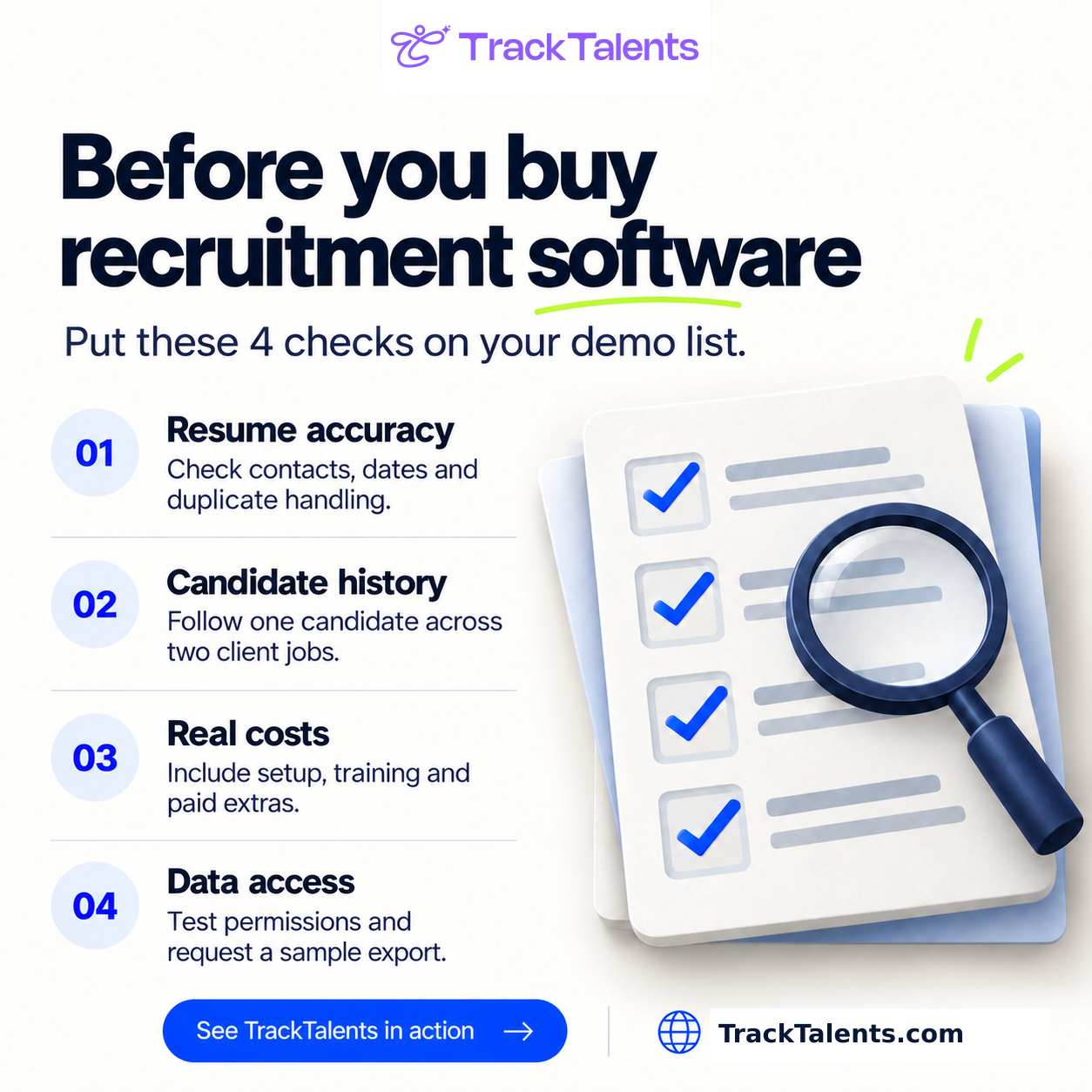
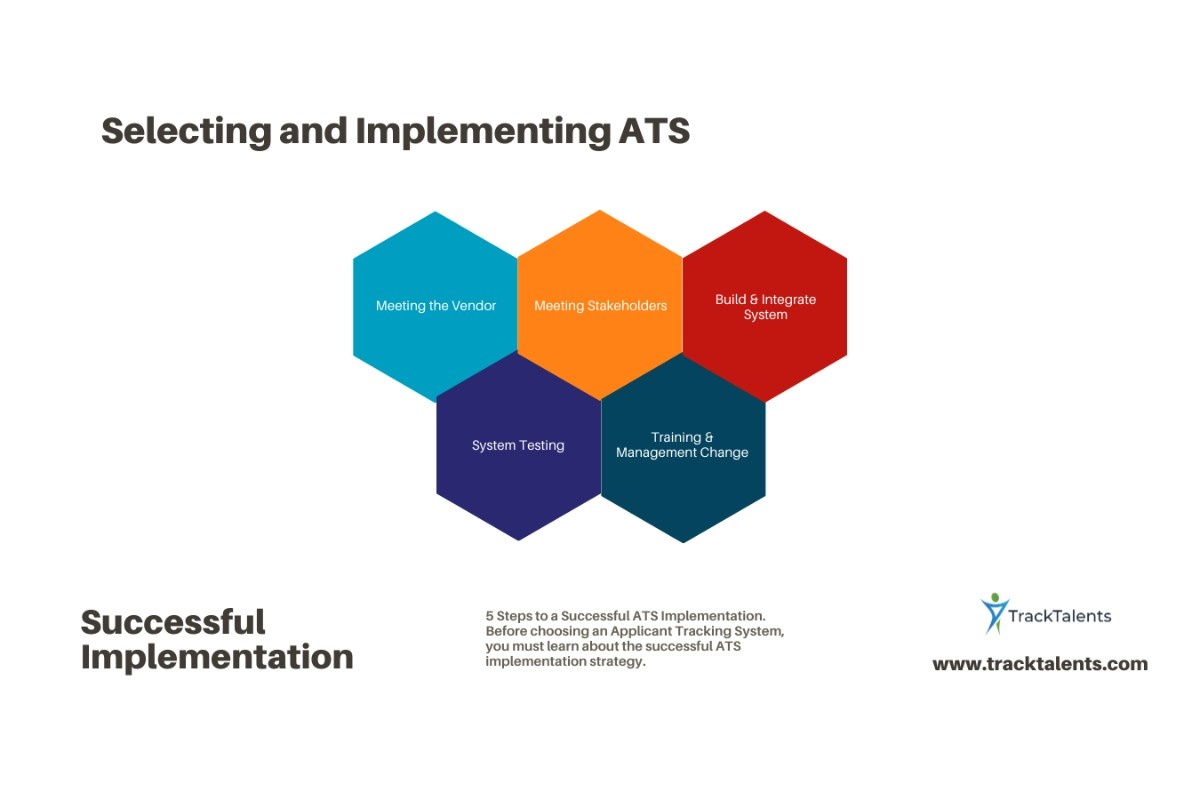
The real test is not the demo. Recruiters should run a real role through the system, search old candidates, send messages, schedule interviews, collect feedback, review reports, and test the candidate experience. TrackTalents can reasonably lead this comparison for recruiter-led and agency-style teams because its feature set supports daily execution. Other platforms may be stronger for enterprise control, analytics, structure, or collaboration. The best ATS is the one that removes friction from the way your team actually hires.