A recruiter can use the best job boards, LinkedIn filters, AI tools, and ATS databases. But if the role intake is vague, the search will still be weak. If the salary range is unclear, strong candidates may drop out. If the job description is copied from an old role, recruiters may search for the wrong skills. If the hiring manager wants five jobs in one person, sourcing becomes guesswork.
Good sourcing begins with clarity.
Candidate sourcing is the process of finding, reviewing, contacting, and building relationships with people who may be a fit for a current or future role. It includes active job seekers, passive candidates, referrals, past applicants, talent pools, and professionals visible through public work signals such as portfolios, certifications, community activity, GitHub, writing, events, or niche platforms.
In 2026, sourcing needs more discipline because skills are changing fast. The World Economic Forum’s Future of Jobs Report 2025 found that nearly 40% of job skills are expected to change by 2030, while 63% of employers already see skills gaps as a major barrier to business transformation.
That means recruiters cannot rely only on titles, resumes, and keyword matches. They need to understand the work that goes into the role.
Start Candidate Sourcing with a Strong Role Intake
Many sourcing problems begin before the first search.
A recruiter may receive a job description and quickly search for matching titles. That feels efficient, but it can narrow the talent pool too early.
Job titles are not standard across companies. A “Talent Acquisition Specialist” in one company may handle campus hiring. In another company, the same title may include executive search, vendor management, workforce planning, or high-volume hiring.
The better starting point is the work itself.
Before sourcing begins, recruiters should confirm:
- What the person will do in the first 90 days
- Which skills are truly required
- Which skills can be trained
- Which tools are essential
- Which industries are acceptable
- Which titles may be similar
- Which companies may have relevant talent
- What salary range is realistic
- What location or work model is possible
- What the real deal-breakers are
A clear role intake saves time later. It also helps recruiters challenge weak or unrealistic requirements with evidence.
Move from Job Titles to Skills-Based Search
Skills-based sourcing is becoming more important because job titles do not always show real ability.
A software recruiter searching only for “Java Developer” may miss strong backend engineers who list Spring Boot, microservices, distributed systems, cloud deployment, API design, Kubernetes, or event-driven architecture without using the exact title.
The same issue appears in many roles.
A recruiter sourcing for “HR Business Partner” may need to search for employee relations, workforce planning, stakeholder management, performance cycles, organizational design, and change management.
A recruiter sourcing for “Digital Marketing Manager” may need to search for paid media, SEO, analytics, campaign performance, conversion rate optimization, HubSpot, Google Ads, Meta Ads, or marketing automation.
LinkedIn’s Future of Recruiting 2025 report noted that companies with the most skills-based searches are 12% more likely to make a quality hire. It also said AI can help recruiters analyze resumes to uncover skills, automate skills assessments, and support skills-based hiring.
This does not mean recruiters should ignore job titles. Titles are still useful. But they should be one layer of the search, not the whole strategy.
Build Candidate Personas Before Searching
A candidate persona is a practical profile of the kind of person who can succeed in the role.
It should include more than a title.
A useful sourcing persona may cover:
- Current or past job titles
- Core skills
- Adjacent skills
- Relevant industries
- Target companies
- Tools and platforms
- Certifications
- Location and work model
- Seniority level
- Likely motivation to move
- Salary expectations
- Career path patterns
- Exclusion terms
For example, a cybersecurity architect search may include cloud security, threat modeling, IAM, SIEM, zero trust, incident response, compliance frameworks, and enterprise architecture. The target companies may include banks, SaaS firms, cybersecurity vendors, cloud consulting firms, or large IT services companies.
This helps recruiters search with purpose. It also helps hiring managers see the real talent market more clearly.
Use better context while outreaching to passive candidates
Job postings reach people who are already looking for or browsing jobs. Sourcing reaches people who may not be searching but may consider the right opportunity.
LinkedIn’s passive candidate resource reports that 36% of workers are looking for new roles, while the remaining workforce can still be reached with the right approach.
This is where outreach quality matters.
Passive candidates did not apply. They do not owe the recruiter attention. The message must earn it.
A strong sourcing message should explain:
- Why is the recruiter contacting them
- Which part of their background is relevant
- What the role is about
- What makes the opportunity worth a conversation
- What the next step looks like
A weak message says: “I came across your profile and have a great opportunity.”
A stronger message says: “I noticed your work across enterprise Java, Spring Boot, and API-led systems. I am hiring for a backend engineering role focused on distributed services for a fintech product team. The role is hybrid in Bengaluru, and the team is looking for someone who has handled production-scale systems.”
The second message gives context. It shows that the recruiter read the profile. It also helps the candidate make a quick decision.
Match Candidate Sourcing Channels to the Role
Recruiters often use the same channels for every role: LinkedIn, job boards, ATS database, and referrals.
These channels matter, but they should not be used in the same way for every role.
Technology Roles
For technology roles, recruiters may need to look at:
- GitHub
- Stack Overflow
- Open-source projects
- Engineering blogs
- Developer communities
- Technical newsletters
- Hackathons
- Cloud certification directories
- Product company talent maps
The goal is to find proof of work, not just keywords.
Creative and Marketing Roles
For creative, content, design, and marketing roles, resumes may not show enough. Recruiters should review:
- Portfolios
- Campaign examples
- Case studies
- Writing samples
- Design galleries
- Social media work
- Website projects
- Performance marketing dashboards that are shareable
Healthcare and Regulated Roles
For healthcare, pharma, clinical research, compliance, finance, and regulated roles, sourcing should focus on:
- Licenses
- Certifications
- Specialty exposure
- Country or state eligibility
- Compliance experience
- Industry-specific systems
- Audit history
- Location and shift readiness
Sales Roles
For sales roles, stronger signals may include:
- Industry network
- Territory experience
- CRM exposure
- Average deal size
- Quota history
- Client segment
- Sales cycle length
- Channel or direct sales experience
High-Volume Roles
For high-volume hiring, sourcing may need:
- Job boards
- Referrals
- local hiring campaigns
- Candidate rediscovery
- Automated screening
- Fast scheduling
- Assessment workflows
- Clear communication at scale
Gartner’s 2026 talent acquisition trends indicate that high-volume recruiting is becoming AI-first, while recruiter skills are shifting toward more complex work, where advisory ability, judgment, and assessment design matter more.
The channel should follow the role. A single sourcing method will not work for every position.
Use Boolean Search with Detailed Requirements
Boolean search still works. What fails is an unclear Boolean search.
Recruiters need to combine titles, skills, locations, tools, certifications, industries, and exclusions in a structured way.
A weak search may look like this:
“HR Manager” AND recruitment
A stronger search for a technology talent acquisition role may look like this:
(“Talent Acquisition” OR Recruiter OR “Technical Recruiter”) AND (SaaS OR software OR technology OR product) AND (“stakeholder management” OR “hiring manager intake” OR “engineering hiring”) NOT intern
The quality of the Boolean string depends on the quality of the intake.
Recruiters should build three layers:
Must-Have Terms
These are core skills or requirements the candidate must have.
Adjacent Terms
These are related titles, tools, industries, or skills that may reveal strong candidates.
Exclusion Terms
These remove irrelevant profiles, junior roles, unrelated industries, or misleading keywords.
For difficult searches, create separate strings for:
- Title-based search
- Skill-based search
- Company-based search
- Certification-based search
- Location-based search
Boolean search is a filter. It is not a decision-maker. Recruiters still need to read profiles carefully and assess whether the experience aligns with the role.
Turn the ATS Database Into a Live Sourcing Asset
Many staffing agencies and HR teams already have thousands of resumes in their ATS. But the database often ends up being a storage folder.
That is a missed opportunity.
A candidate who was not right six months ago may be perfect for a new role today. A past applicant may now have the right experience. A silver-medalist candidate may be open again. A contractor may be ready for a new project.
This works only when candidate data is clean and searchable.
A useful ATS or recruitment CRM should record:
- Skills
- Source channel
- Past conversations
- Availability
- Salary range
- Notice period
- Location preference
- Work model preference
- Client submissions
- Interview history
- Rejection reasons
- Follow-up dates
- Future interest
- Candidate ownership
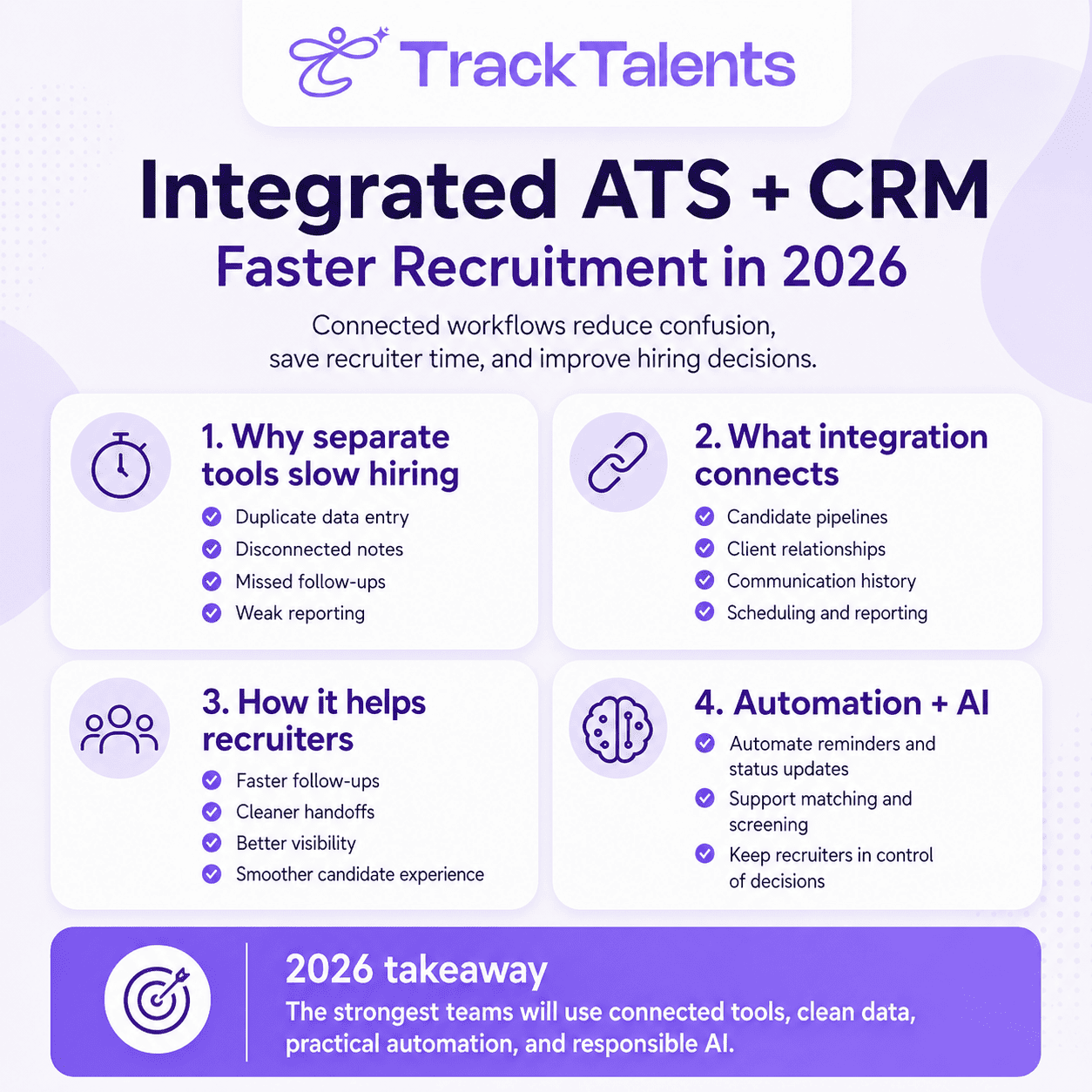
TrackTalents is relevant here because it positions itself as an ATS for recruiters, staffing agencies, and HR teams. Its feature page highlights resume parsing, bulk resume upload, searchable resumes, job and requisition management, CRM, Outlook-linked communication, interview scheduling, bulk email, social media posting, and custom talent pools.
The value is not that any tool can find the perfect candidate on its own. The value is that recruiters no longer lose context.
Every call, salary mismatch, client comment, rejection reason, and follow-up note can become useful data for the next search.
Use AI as a Sourcing Assistant, Not the Recruiter
AI is now part of sourcing, screening, outreach, matching, and database search.
SHRM reported that recruiting is the HR area in which organizations use AI most, with 51% using it to support recruiting. Common uses include writing job descriptions, screening resumes, automating candidate searches, customizing job postings, and communicating with applicants.
Used well, AI can help recruiters:
- Summarize resumes
- Identify likely skill matches
- Suggest search terms
- Draft outreach variations
- Re-engage past candidates
- Find duplicate profiles
- Rank large candidate lists
- Create interview questions
- Support scheduling
- Analyze sourcing channels
But AI still needs human review.
Recruiters must judge context, motivation, role fit, salary fit, location fit, communication quality, and business constraints. AI may match words. Recruiters must understand the meaning.
This is also a compliance issue. The European Commission states that AI tools used for employment, worker management, and access to self-employment, including CV-sorting software for recruitment, are high-risk AI use cases under the EU AI Act framework. High-risk systems require risk assessment, quality data, activity logs, documentation, transparency, human oversight, robustness, cybersecurity, and accuracy.
For staffing agencies working with international clients, Recruiters should know where AI is used, how candidate rankings are generated, whether the vendor provides audit information, and whether human review remains part of the shortlist process.
Build a Simple Candidate Sourcing Workflow
A sourcing workflow should be simple enough for recruiters to follow and strong enough to prevent poor targeting.
Here is a practical seven-step process.
1. Clarify the Role
Confirm the role title, business need, responsibilities, must-have skills, trainable skills, salary range, location, work model, notice period, interview process, and deal-breakers.
If the hiring manager cannot clearly explain the role, sourcing should begin with a better intake conversation.
2. Map the Talent Market
Identify likely titles, target companies, adjacent industries, tools, certifications, communities, and candidate motivations.
This prevents the search from becoming too narrow too early.
3. Search in Layers
Start with your ATS database. Then move to LinkedIn, job boards, referrals, niche platforms, communities, professional groups, and public work signals.
Existing candidate data is often underused because recruiters trust new searches more than old records.
4. Review Evidence, Not Just Keywords
A resume that repeats the same skill does not demonstrate depth.
Look for:
- Projects
- Outcomes
- Tools used in context
- Industry exposure
- Client type
- Seniority
- Progression
- Certifications
- Scope of work
- Team size
- Business impact
5. Personalize Outreach
Tell the candidate why the role is relevant.
Mention the skill, domain, project type, industry, location, or career pattern that connects them to the opportunity.
6. Track Every Interaction
Record what happened.
If the candidate is unavailable, add a follow-up date. If the salary is mismatched, capture the expected range. If the candidate wants only remote roles, note it.
This turns one search into long-term sourcing intelligence.
7. Review Sourcing Results Weekly
Measure which channel produced qualified conversations, not just profile volume.
A source that gives 100 names and two real conversations may be weaker than a referral channel that gives five strong candidates.
Measure Candidate Sourcing Quality
Sourcing metrics should not reward activity alone.
A recruiter can send hundreds of messages and still end up with a weak shortlist. Better metrics connect sourcing effort to quality and movement.
Useful sourcing metrics include:
- Response rate
- Positive reply rate
- Qualified candidate rate
- Screening-to-submission ratio
- Submission-to-interview ratio
- Interview-to-offer ratio
- Source quality by channel
- Database reuse rate
- Candidate drop-off reasons
- Salary alignment
- Hiring manager rejection reasons
- Time-to-submit
- Time-to-qualified-shortlist
For staffing agencies, time-to-submit matters. But speed should not reduce relevance. A fast shortlist that misses core requirements wastes client time and weakens recruiter trust.
Rejection reasons are also important. If candidates are often rejected for salary, the issue may be compensation. If candidates fail technical screens, the search may be too broad. If candidates do not reply, the message or role positioning may need work.
Strengthen Sourcing with Better Hiring Manager Conversations
Recruiters should not accept every requirement without question.
A strong sourcing recruiter advises the hiring manager with market evidence.
That may mean saying:
- The salary range is below the market.
- The must-have list combines two roles.
- The required location is limiting the pool.
- The title does not match the work.
- The role needs a trainable skill strategy.
- The market has candidates, but they are not active.
- The current interview process may be too slow.
This is where recruiters add real value. They do not just search. They shape a better hiring path.
Candidate Sourcing Strategy for Staffing Agencies
Staffing agencies face a different sourcing challenge. They must serve clients quickly while protecting candidate relationships.
A staffing agency sourcing strategy should include:
- Clean candidate ownership rules
- Updated candidate availability
- Salary and notice period notes
- Client submission history
- Previous feedback
- Follow-up reminders
- Talent pools by skill and industry
- Re-engagement campaigns
- Source quality reports
- Client-specific search criteria
Agencies that rely solely on job boards will look similar to their competitors. Agencies that maintain clean candidate data, personalize outreach, and advise clients honestly become harder to replace.
Frequently Asked Questions
What is candidate sourcing?
Candidate sourcing is the proactive process of finding, reviewing, contacting, and building relationships with people who may be a fit for current or future roles. It often happens before screening, interviewing, and final selection.
How is sourcing different from recruiting?
Sourcing focuses on finding and engaging potential candidates. Recruiting covers the full hiring process, including screening, interviews, assessments, offer coordination, joining follow-up, and stakeholder communication.
Which tools are useful for candidate sourcing?
Recruiters commonly use ATS platforms, recruitment CRM systems, LinkedIn, job boards, resume databases, referral tools, niche communities, sourcing extensions, email tools, and analytics dashboards. The right mix depends on hiring volume, role complexity, geography, and workflow.
Can AI replace sourcing recruiters?
AI can support search, matching, screening, summarization, outreach drafting, and candidate rediscovery. It should not replace recruiter judgment, especially for role interpretation, candidate motivation, fairness, compliance, and final shortlist decisions.
What makes a sourcing message effective?
A strong sourcing message is specific, brief, and relevant. It should explain why the candidate is being contacted, which part of their background connects to the role, and what the next conversation would cover.
How should staffing agencies measure sourcing success?
Staffing agencies should track qualified response rate, submission-to-interview ratio, source quality, candidate availability, salary alignment, client rejection reasons, and database reuse. Message volume alone does not prove sourcing quality.
Final Thoughts
Candidate sourcing in 2026 is more strategic than a LinkedIn search.
Recruiters need role clarity, market mapping, skills-based search, strong outreach, clean ATS data, useful sourcing metrics, and responsible use of AI.
Good sourcing does not mean contacting more people. It means finding the right people earlier, approaching them with better context, and keeping enough relationship history to make the next search stronger.
For staffing agencies and HR teams, this is where strong systems and strong recruiter judgment work together. Tools such as TrackTalents can support resume search, communication, CRM, workflows, and candidate tracking. But the recruiter still needs to ask better questions, read profiles carefully, and build trust with both candidates and hiring managers.
That is what turns sourcing from name collection into real talent intelligence.