Candidate screening is the point at which recruiters decide which applicants should continue in the hiring process. It may include resume reviews, screening calls, work samples, professional profile checks, eligibility verification, and automated recommendations. The purpose is not to eliminate people as quickly as possible. It is to identify credible evidence that a candidate can perform the role while applying consistent and job-related standards.
When the screening criteria are unclear, recruiters can spend hours speaking with candidates who do not meet essential requirements. At the same time, capable applicants may be overlooked because their resumes use unfamiliar job titles, lack polished wording, or omit the expected keywords.
A reliable candidate screening process reduces these avoidable errors. It gives recruiters a defensible way to explain why a person advanced, why another applicant did not, and what evidence still needs to be examined during the interview.
What Should Be Established After Candidate Screening
Screening should answer a limited set of practical questions:
- Does the candidate meet the essential conditions of the role?
- Is there credible evidence of the required skills?
- Do the candidate’s recent responsibilities match the level of the vacancy?
- Are the salary, location, schedule, notice period, and work authorization expectations compatible?
- What information needs to be tested or clarified at the next stage?
- Is there any job-related reason not to continue?
It should not attempt to make the entire hiring decision. A resume cannot prove technical depth, and a short phone call cannot establish long-term performance. Screening should gather sufficient evidence to determine whether a more detailed assessment is warranted.
Before Reviewing Applications, define and document roles
Many screening problems begin before the first application arrives. A job description may contain a long list of tools, qualifications, behaviors, and preferred experience without distinguishing what the employer genuinely needs.
Recruiters then make their own interpretations. One person may reject applicants who lack industry experience. Another may prioritize education. A hiring manager may focus on years of experience even when the work relies more heavily on a single specialized skill.
A role scorecard prevents these differences from turning into inconsistent shortlisting.
Separate Requirements into Three Categories
Essential requirements are conditions a candidate must meet to perform the role legally or effectively. These may include a professional license, work authorization, language proficiency, location, shift availability, security clearance, or a technical capability needed from the first day.
Trainable requirements are skills that can be developed within a reasonable onboarding period. A candidate may know a comparable software platform, have worked in an adjacent industry, or lack experience with an internal process that the company teaches new employees.
Preferences may strengthen an application but should not become automatic grounds for rejection. Examples include experience with a particular software brand, employment at a well-known company, an advanced degree that is not required for the work, or knowledge of an additional market.
This separation keeps recruiters from treating every line in a job description as equally important.
Build Evidence into the Scorecard
Each scorecard criterion should clearly state what the recruiter needs to confirm. For a required technical skill, look for recent project experience, direct task ownership, tools used, and measurable results. The skill can then be marked as confirmed, unclear, or missing.
When reviewing client management experience, consider the types of customers handled, account sizes, renewal responsibilities, and examples of how escalations were resolved. This helps determine whether the experience is strong, partial, or absent.
Leadership experience should be assessed through team size, decision-making authority, coaching responsibilities, and ownership of team performance. This makes it easier to identify whether the candidate has genuine leadership experience or only holds a managerial title.
For regulatory knowledge, verify relevant licenses, certifications, experience with regulated processes, and direct compliance responsibilities. Any information that cannot be confirmed should be marked for further checking.
Availability should cover the candidate’s notice period, location, shift preferences, and possible start date. These details will show whether the candidate’s availability matches the role requirements.
A scorecard should describe evidence, not impressions. “Communicates well” is open to interpretation. “Explains recent responsibilities clearly and answers follow-up questions with specific examples” is easier to apply consistently.
Skills-based screening can also broaden the pool beyond candidates with familiar job titles or educational credentials. LinkedIn’s 2025 recruiting report found that organizations conducting the highest level of skills-based searches were 12% more likely to make what the platform classified as a quality hire. The same report found that 93% of talent acquisition professionals considered accurate skills assessment important for improving hiring quality.
Resume Screening Should Verify the Candidate’s Skills and Experience
A polished resume can make evidence easier to find, but it does not prove that the candidate performed the work described. A poorly written resume can hide relevant experience without indicating weak job performance.
Recruiters should therefore distinguish between two questions:
- Does the resume clearly communicate the candidate’s experience?
- Does the underlying experience appear relevant to the vacancy?
Only the second question should determine whether someone deserves further consideration.
Assess Responsibilities Based on the Candidate’s Role and Work Environment
Job titles vary widely between companies. An “Account Executive” may manage existing clients in one organization and acquire new business in another. A “Project Manager” may own budgets and delivery within one company but primarily perform coordination work elsewhere.
Look beyond the title and examine:
- The work the candidate personally handled
- The type and scale of clients, systems, projects, or operations
- The tools used and the purpose for which they were used
- The level of decision-making authority
- The teams or stakeholders involved
- The output, result, or business consequence
- The recency and duration of the experience
For a backend developer, useful evidence may include API development, database design, cloud deployment, testing, production support, security controls, and system scale.
For an account manager, it may include customer segment, portfolio size, renewals, upselling, retention, escalations, procurement discussions, and CRM usage.
For a recruiter, evidence may include industries covered, requisition volume, sourcing channels, employment types, client coordination, offer management, and placement outcomes.
Treat Keyword Matches in the Resume as Leads and not as proof
Automated search can identify resumes containing a required skill, but the keyword alone says little about proficiency.
A candidate may list a tool that was used briefly. Another may have substantial experience with a comparable platform but use different terminology. Recruiters should examine where, when, and how a skill was applied before assigning a score.
When evidence is promising but incomplete, mark the criterion for clarification rather than rejecting the applicant immediately.
Structured Screening should be able to produce consistent shortlisting
Unstructured screening allows personal preference to influence the decision. One recruiter may value prestigious employers. Another may react negatively to career gaps. A third may rely heavily on how confident the candidate sounds.
Structured screening limits this variation by giving recruiters the same core criteria, evidence questions, and rating scale.
The US Office of Personnel Management notes that structured interviews improve interrater agreement by establishing rules for eliciting, observing, and evaluating responses. Although an initial screening call is shorter than a formal interview, the same principle applies: candidates for the same vacancy should be assessed against comparable questions and scoring standards.
A simple rating system may use:
- 0 — No evidence
- 1 — Limited or indirect evidence
- 2 — Adequate evidence for the role
- 3 — Strong, recent and relevant evidence
- N/A — Not assessed at this stage
The recruiter should add a brief note supporting each rating. A number without an explanation creates the appearance of structure without improving the decision.
Use the Screening Call to Learn What the Resume Does Not Reveal
A screening call should not be a spoken repetition of the application. It should investigate missing information, confirm essential requirements, and identify the areas that a manager or technical interviewer should examine.
A focused screening call normally covers:
Current Responsibilities
Ask what the candidate does in practice rather than requesting a broad career summary.
Useful prompts include:
- What are you directly responsible for in your current role?
- Which part of the process do you own?
- What type of clients, systems, or projects do you handle?
- Which decisions can you make independently?
- What is an example of a recent problem you resolved?
Role-Relevant Skills
Choose questions from the scorecard rather than asking about every item on the resume.
A technical candidate may be asked to explain a production issue, the investigation performed, the options considered, and the final resolution.
A salesperson may be asked to describe the sales cycle, target ownership, customer objections, decision-makers involved, and personal contribution to the outcome.
An operations candidate may be asked about process failures, shift coverage, vendor delays, reporting accuracy, or an urgent escalation.
Reason for Considering a Change
This question helps determine what the candidate expects from the next role. It should not be used to judge someone for leaving a difficult employer or seeking higher pay.
The response may reveal whether the person wants greater responsibility, a different work arrangement, a new industry, improved compensation, or a more stable position. Recruiters can then explain whether the vacancy is likely to meet that expectation.
Practical Conditions
Confirm important conditions early:
- Compensation range
- Notice period
- Work location
- Remote, hybrid, or onsite expectations
- Shift or travel requirements
- Employment type
- Work-authorization status where legally appropriate
- Planned availability
Discussing these points early prevents candidates and hiring managers from investing time in a process that cannot lead to an acceptable offer.
Candidate Questions
Allow time for the candidate to ask about the role, reporting line, team, hiring stages, compensation structure, and work environment.
A screening call is a two-way exchange. An applicant cannot make an informed decision when the recruiter collects extensive information but offers only a vague description of the opportunity.
Replace Generic Questions with Role-Specific Validation Questions
“Tell me about yourself” can open a conversation, but it rarely provides enough evidence for a shortlist decision.
Questions should reflect the work.
Technical Positions
Ask about:
- Recent projects and personal ownership
- Architecture, configuration, or coding decisions
- Production environments
- Debugging and incident response
- Security, testing, or deployment practices
- System scale and performance constraints
- Collaboration with product, quality, or operations teams
Sales, Account Management, and Customer Success
Ask about:
- Customer segment and territory
- Sales or renewal cycle
- Revenue, retention or target responsibility
- Objection handling
- Escalation management
- CRM usage
- Negotiation with business and technical stakeholders
- The candidate’s direct contribution to reported results
Operations and Coordination
Ask about:
- Process ownership
- Daily systems and reports
- Team, shift, or vendor coordination
- Compliance steps
- Service-level requirements
- Urgent operational failures
- Documentation and handover practices
Creative and Marketing Roles
Ask about:
- The brief and intended audience
- The candidate’s contribution to the final work
- Research and idea development
- Feedback and revision handling
- Brand requirements
- Campaign or content measurement
- Portfolio pieces that represent relevant work
Entry-Level Candidates
Past employment may offer limited evidence. Examine:
- Academic or personal projects
- Internships and volunteering
- Learning effort outside coursework
- Reliability and follow-through
- Response to feedback
- Understanding of the role
- Willingness to perform the actual work involved
The standard should remain job-related, but the evidence may come from a wider range of experiences.
Work Samples Should Resemble the Job
A useful assessment tests an important part of the role. It should not become unpaid project work or a generic exercise selected only because it is easy to administer.
The US Office of Personnel Management defines work samples as tasks that mirror activities performed on the job. That connection makes them more meaningful than tests with little relationship to the vacancy.
Examples include:
- Editing a short article from a supplied brief
- Debugging a contained piece of code
- Responding to a realistic customer complaint
- Prioritizing an operations scenario
- Reviewing a small dataset and explaining the findings
- Preparing a short account-development plan
- Assessing a sample recruitment requirement and proposing a sourcing approach
Before sending an assessment, tell the candidate:
- Why is the task being used
- What it is designed to measure
- The expected completion time
- The evaluation criteria
- Whether external resources or AI tools are allowed
- Who will review the work
- When feedback or a decision can be expected
- Whether the output will be used only for evaluation
There is no universal time limit suitable for every assessment. Early-stage tasks should remain proportionate to the opportunity. When an exercise requires substantial original work or could provide commercial value to the employer, a paid task or a later-stage assessment is more respectful.
Employers should also provide an accessible alternative or reasonable adjustment where required. The EEOC has warned that software-based tests and algorithmic tools can screen out people with disabilities even when they could perform the job with or without accommodation.
Limit Social Media Screening Only to Job-Relevant Information
Professional profiles can provide legitimate job-related evidence. LinkedIn may show employment history and professional activity. GitHub can demonstrate public code contributions. Behance and Dribbble can display design work. Academic profiles may confirm publications or research interests.
The problem begins when recruiters move from professional verification into personal investigation.
A recruiter may encounter information about age, health, disability, religion, political views, family circumstances, ethnicity, sexual orientation, or other characteristics that should not influence the decision. Once viewed, that information can affect the assessment, consciously or unconsciously.
A safer process is to:
- Check only sources relevant to the role
- Define the purpose before beginning
- Tell candidates when social-media vetting forms part of the process
- Record only job-related findings
- Avoid comments about lifestyle, beliefs, or personal relationships
- Separate the person conducting the check from the final decision, where practical
- Apply the same procedure to candidates at the same stage
The UK Information Commissioner’s Office advises employers to justify why social-media vetting is necessary, inform candidates that it will occur, and prevent irrelevant personal information from influencing the recruitment decision. It also recommends separating social-media research from decision-making where possible.
Complete Background Checks Before Making an Offer
Background screening is different from initial candidate screening. It verifies information or assesses a defined risk after the candidate has demonstrated sufficient suitability for the role.
The type of check should relate to the job. A position involving regulated financial responsibility may require different verification from a warehouse, marketing, software development, or customer service role.
Possible checks include:
- Identity
- Employment history
- Education or professional qualifications
- Criminal records where lawful and relevant
- Driving history for driving positions
- Professional licences
- References
- Credit information is limited and legally permitted in certain circumstances
Requirements vary between countries, states, industries, and job types. Employers should obtain legal advice for the jurisdictions in which they hire.
In the United States, when an employer obtains a background report from a consumer reporting company, the Fair Credit Reporting Act imposes disclosure, permission, pre-adverse action, and adverse action requirements. Candidates must also receive information that enables them to review and challenge inaccurate report data.
Checks should be:
- Disclosed in advance
- Conducted with the required permission
- Consistent across comparable candidates
- Limited to relevant information
- Reviewed for accuracy
- Assessed in context
- Stored securely
- Retained only as long as necessary
A background check should not replace interviews, skill evaluation, or reference to the role scorecard.
Use an ATS to organize the screening process
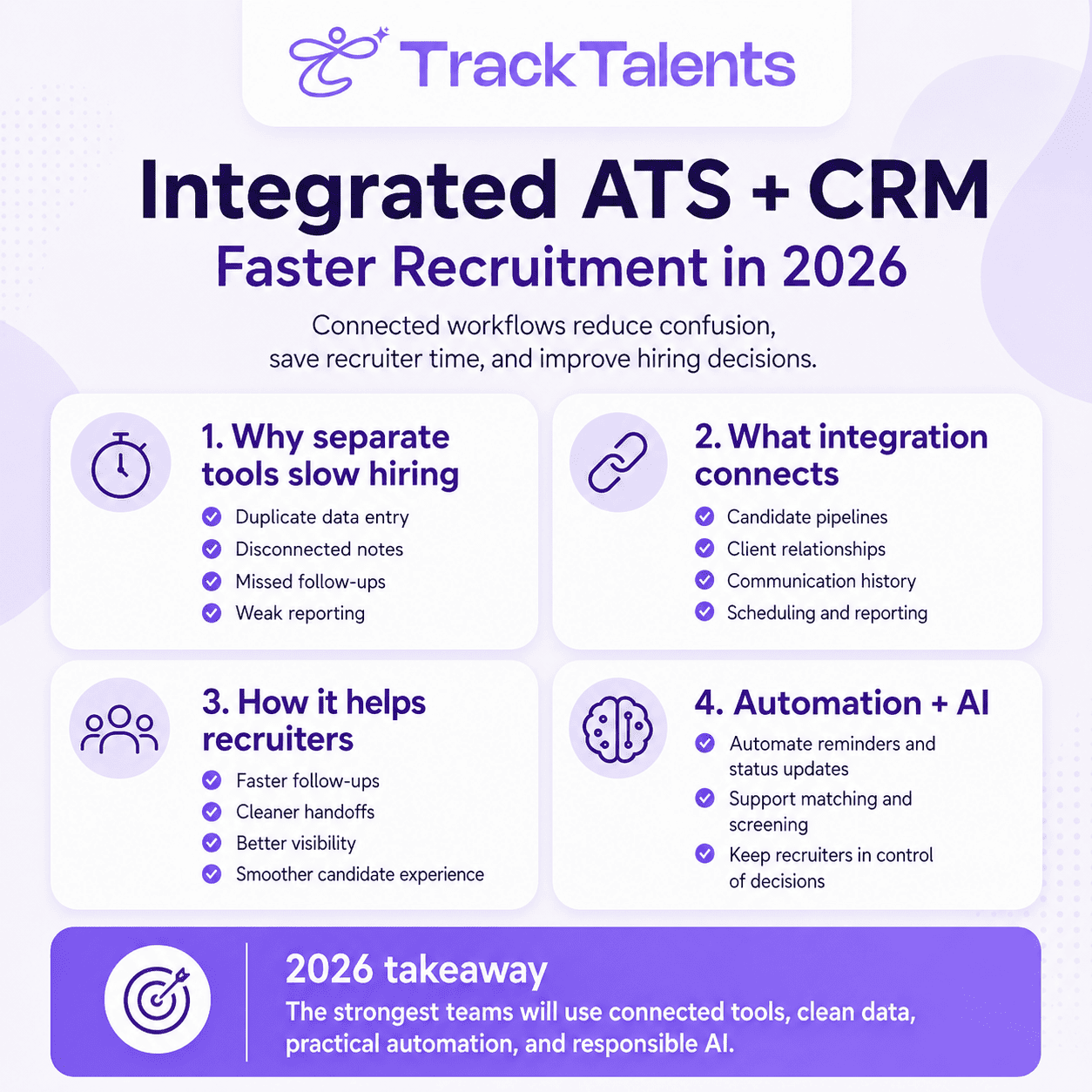
An applicant tracking system can help recruiters store applications, search for previous candidates, record screening evidence, schedule interviews, maintain communication histories, and track movement through each hiring stage.
The system becomes useful when it creates a reliable record of:
- The criteria used
- The information collected
- The person who made the recommendation
- The reason for the decision
- The next action
- Candidate communication
- Hiring manager feedback
TrackTalents is presented by its provider as a customizable ATS for recruiters, staffing agencies, and HR teams, with integrations intended to support recruitment workflows. In a structured screening process, a platform of this type can centralize candidate records, communication, stages, and evaluation notes. The tool can improve visibility, but the employer still needs to define the criteria and supervise the decisions made through the system.
Poor criteria do not become fair or accurate merely because they are stored in software. If recruiters use vague rejection labels, inconsistent scores, or unverified assumptions, the ATS will preserve those weaknesses rather than correct them.
AI Screening Requires Active Human Oversight
AI tools can assist with resume parsing, skill extraction, candidate matching, screening summaries, question generation, scheduling, and organizing large applicant pools.
The risk increases when a system ranks, excludes, or recommends candidates without sufficient understanding of:
- The data being used
- The weight assigned to each criterion
- The accuracy of extracted information
- The treatment of employment gaps or unconventional career paths
- The effect on different candidate groups
- The accessibility of the assessment
- The frequency of false negatives
- The process for human reconsideration
Candidate confidence is already fragile. A 2025 Gartner survey of 2,918 job candidates found that only 26% trusted AI to evaluate them fairly. 32% were concerned that AI could prevent their application from succeeding, and 25% said they trusted an employer less when AI was used to assess their information.
The Employer Remains Responsible
Using an external vendor does not transfer every legal and ethical responsibility to that vendor.
The EEOC has stated that US federal employment-discrimination law can apply when automated systems make or inform selection decisions. It has also warned that employers should consider the adverse impact and the possibility that software may disadvantage candidates with disabilities.
The UK ICO has similarly reported that AI recruitment tools are used for sourcing, CV summarisation, scoring, screening, and selection. Its audit work found that poorly governed tools can unfairly exclude applicants or compromise their privacy.
A Practical AI Screening Control List
Before using AI in candidate screening, recruitment leaders should document:
- Intended purpose: State exactly what the system will and will not do.
- Role criteria: Confirm that the ranking factors are derived from a current job analysis.
- Data sources: Ask the vendor what candidate information is collected, inferred, retained, and shared.
- Validation: Examine evidence that the system measures something related to job performance.
- Human review: Require a trained recruiter to review automated rejections and unusual rankings.
- Accommodation: Provide candidates with a clear way to request an alternative process.
- Candidate notice: Explain when automated assessment is being used, where required or appropriate.
- Outcome monitoring: Compare progression and rejection patterns across relevant groups.
- Error reporting: Create a way for recruiters and candidates to challenge inaccurate information.
- Change control: Reassess the tool when the job, model, data, vendor settings, or workflow changes.
- Retention: Define how long resumes, scores, recordings, and inferred data will be kept.
- Accountability: Name the person responsible for reviewing performance, fairness, privacy, and complaints.
The NIST AI Risk Management Framework supports this type of ongoing governance by treating risk management as an ongoing process that involves mapping, measuring, managing, and governing AI risks, rather than a one-time vendor review.
Screening Notes should clearly explain the decision
Labels such as “good candidate,” “poor fit,” or “not suitable” provide little value. They do not tell the hiring manager what the recruiter found, and they cannot support a future reconsideration.
A practical screening record should include:
- Candidate name
- Vacancy
- Application source
- Essential criteria met
- Essential criteria missing
- Relevant experience
- Skill evidence
- Compensation expectations
- Notice period or availability
- Location and work-model preference
- Points requiring clarification
- Recruiter recommendation
- Reason for the recommendation
- Next action
Screening Note Example
Candidate: Priya Menon
Role: Enterprise Account Manager
Source: Employee referral
Essential criteria: More than 4 years of B2B account management experience. Has managed enterprise SaaS customers and used Salesforce for three years.
Relevant evidence: Manages 15 enterprise accounts and participates in renewals, upselling, escalation resolution, and discussions with procurement and technical stakeholders. Reported a 95% retention rate and clearly explained her direct role in recovering a delayed implementation.
Compensation and availability: Expectations are within the approved range. Available after four weeks.
Work model: Open to hybrid or remote work.
Points requiring clarification: No direct experience in the EMEA market. The hiring manager should assess how quickly regional commercial knowledge can be developed.
Recommendation: Continue to the hiring manager interview.
Next action: Schedule an interview focused on enterprise renewal strategy and cross-functional account recovery.
The note gives the manager evidence to examine rather than a conclusion to accept blindly.
Role-Based Screening Framework
The screening process should reflect the type of role being filled. For software, data, DevOps, and technical support positions, recruiters should review recent projects, direct ownership, production exposure, architecture decisions, debugging, testing, and the scale of work handled. Resumes that rely heavily on keywords, give little detail about the candidate’s contribution, or show limited production experience may require further clarification. Suitable next steps could include a technical interview or a focused work sample.
For sales, account management, and customer success roles, screening should cover the customer segment, sales cycle length, targets, renewals, retention, CRM usage, and experience handling escalations. Recruiters should take a closer look at unverified results, unclear account ownership, and possible compensation mismatches. A manager interview, case discussion, or mock customer call can help confirm the candidate’s practical ability.
When screening candidates for operations, logistics, HR operations, or administrative roles, the focus should be on process ownership, reporting, systems knowledge, compliance, shift requirements, vendor coordination, and the ability to handle urgent issues. Weak documentation, unclear decision-making authority, or schedule limitations may need further discussion. An operations interview or scenario-based exercise can provide a clearer view of the candidate’s experience.
For content, design, SEO, and marketing roles, recruiters should examine the candidate’s portfolio, understanding of the target audience, ability to interpret briefs, individual contribution, revision process, tools used, and approach to measuring performance. Unclear ownership, copied work, overreliance on templates, or a limited understanding of the results should be explored before moving forward. A portfolio review or a small paid assignment may be appropriate.
Interns, graduates, and career transitions should be assessed differently from experienced professionals. Recruiters can review academic projects, internships, learning efforts, understanding of the role, reliability, and response to feedback. Limited awareness of the job, concerns about availability, or unrealistic expectations may require clarification. A structured junior-level interview or a basic task can help assess their potential.
The framework should always be adapted to the role. A single generic checklist may overlook important details in one profession while overemphasizing information that is less relevant in another.
Make Candidate Communication Part of the Screening Process
Screening is often the candidate’s first direct experience with the employer or staffing agency. Long periods of silence create uncertainty and increase the chance that capable candidates will accept another opportunity.
Communication points should be planned before applications are reviewed:
- Application received
- Selected for screening
- Assessment requested
- Interview arranged
- Decision delayed
- Application placed on hold
- Not progressing
- Final outcome
Messages do not need to be lengthy. They need to tell the candidate what has happened and, where possible, what will happen next.
Application Received
“Thank you for applying for the Marketing Manager position. We have received your application and will review it against the role requirements. We will contact shortlisted candidates regarding the next stage.”
Selected for a Screening Call
“We would like to arrange a short screening call to discuss your recent experience and the requirements of the Marketing Manager role. Please share your availability for the following time slots.”
Assessment Request
“As the next stage, we invite you to complete a role-related assessment. The task is expected to take approximately [time], and we will evaluate it against the criteria included in the instructions. Please let us know if you require an adjustment or alternative format.”
Application Not Progressing
“Thank you for the time you invested in your application. We have decided not to progress your application for this vacancy because the position requires direct experience in [specific requirement]. We appreciate your interest and wish you well in your search.”
Where company policy allows, a specific job-related reason is more useful than a vague rejection. Recruiters should avoid language that creates legal risk, reveals confidential comparisons, or makes assumptions about the candidate.
Decide Rejection Criteria Before screening
Without agreed-upon rejection points, candidates remain in the system because recruiters are unsure whether a shortfall is acceptable.
Common reasons may include:
- Missing a legally required license
- Lack of required work authorization
- Incompatibility with an essential shift or location
- Compensation expectations outside the approved range
- No evidence of a skill required from the first day
- Failure to complete a necessary assessment
- Inability to meet a client-specific compliance condition
- Material inconsistencies that remain unexplained
Each rejection reason should connect to the role.
“Does not feel suitable” cannot be tested or defended. “Has managed only consumer accounts; the vacancy requires direct ownership of enterprise renewals” gives a clear explanation and may allow the person to be considered for another position.
Recruiters should also distinguish between a rejection and a hold. A strong applicant may be unsuitable for the current vacancy but relevant to another client, location, seniority level, or employment type.
Measure Screening Quality
The number of resumes reviewed and the speed of screening show workload and efficiency. They do not show whether recruiters are advancing the right people.
More useful measures include:
- Percentage of screened candidates accepted by the hiring manager
- Screen-to-interview conversion
- Interview-to-offer conversion
- Offer acceptance
- Candidate withdrawal stage
- Assessment completion
- Rejection reasons
- Source performance by role
- Hiring manager feedback on shortlist quality
- Percentage of candidates reconsidered after an initial rejection
- Automated recommendations overturned by recruiters
- Time candidates remain without an update
Metrics should be interpreted rather than celebrated in isolation.
If many recruiter-approved candidates are rejected by managers, the scorecard may not reflect the managers’ actual requirements. The alternative explanation is that the manager has introduced criteria that were never agreed upon. Both possibilities require investigation.
If candidates withdraw after compensation is disclosed, recruiters should discuss the range earlier.
If assessment completion is low, the task may be too long, unclear, inaccessible, or introduced too early.
If automated screening rejects candidates who later perform well after manual review, the filters or model settings require attention.
A Consistent Candidate Screening Workflow
A practical screening process can follow these stages:
- Analyze the job and confirm essential outcomes.
- Separate essential, trainable, and preferred criteria.
- Build a scorecard with observable evidence.
- Configure ATS fields and filters around the approved criteria.
- Review resumes for role evidence rather than presentation quality.
- Conduct a structured screening call.
- Use a job-related assessment only when it adds evidence.
- Record the recommendation and supporting reasons.
- Communicate the decision or next step promptly.
- Review shortlist outcomes with the hiring manager.
- Audit rejection patterns and automated recommendations.
- Update the scorecard when evidence shows that it is inaccurate.
The process should be consistent without becoming inflexible. Recruiters need room to investigate unusual career histories, transferable skills, and evidence that does not follow a familiar pattern.
Frequently Asked Questions
What is candidate screening?
Candidate screening is the process of reviewing applicants or sourced professionals to decide who should continue in the hiring process. It may involve resume review, screening calls, job-related assessments, professional-profile checks, and eligibility or background verification at the appropriate stage.
What are the main candidate screening methods?
Common methods include structured resume review, telephone or video screening, scorecards, work samples, skill tests, professional-profile checks, reference verification, and legally compliant background checks.
What should a recruiter ask during a screening call?
The recruiter should ask about current responsibilities, evidence of essential skills, recent job-related examples, expectations for the next role, compensation, notice period, availability, location, work model, and other practical conditions relevant to the vacancy.
How can candidate screening become fairer?
Use criteria based on the work, ask comparable core questions, score evidence consistently, document decisions, provide reasonable adjustments, restrict personal social-media checks, and examine rejection patterns. Automated recommendations should be reviewed rather than accepted without question.
Can AI be used for candidate screening?
AI can support resume parsing, skill identification, summaries, matching, scheduling, and workflow organization. Employers should understand the criteria used, monitor outcomes, provide accommodation and review options, protect candidate data, and retain human accountability for employment decisions.
How does an ATS support candidate screening?
An ATS can centralize applications, scorecards, communication, interview stages, assessment records, rejection reasons, and hiring-manager feedback. Its value depends on the quality of the process configured within it. Clear criteria and disciplined recordkeeping remain necessary.
Should recruiters reject a candidate because of a poorly written resume?
Resume quality may be relevant for positions where written communication is an essential responsibility. For other roles, recruiters should separate presentation weaknesses from evidence of job capability. Unclear but potentially relevant experience can be examined during a short screening call.
How long should a candidate assessment take?
The task should be proportionate to the role, hiring stage, and value of the opportunity. Early assessments should be limited and focused. Employers requesting substantial original work should consider either offering a paid exercise or moving the task to a later stage.
Candidate Screening Should Produce Explainable Decisions
A strong screening process does not depend on one recruiter’s instinct, a collection of resume keywords, or an unexplained software score.
It begins with a clear definition of the work. It seeks evidence, applies comparable standards, records the rationale for each recommendation, and provides candidates with enough information to participate fairly. Technology can make the process easier to manage, but it cannot decide which criteria are valid or accept responsibility for the outcome.
The most useful screening process is not the one with the highest rejection rate or the shortest review time. It is the one that repeatedly sends credible candidates to the next stage while giving recruiters, hiring managers, and applicants a clear account of how each decision was reached.