Recruitment becomes costly when every vacancy arrives as an emergency.
A hiring manager raises a request. The recruiter posts the job immediately. Sourcing begins before the role is fully understood. Applications are reviewed under pressure, interviewers disagree on what they need, and suitable candidates leave the process while the team waits for feedback.
This pattern is often blamed on recruiters. In many cases, the real problem is a hiring process built to react rather than prepare.
A strategic recruiting framework gives the team a repeatable way to:
- Identify business-critical roles
- Define skills before sourcing begins
- Study relevant talent markets
- Build candidate relationships in advance
- Set realistic compensation and timelines
- Improve hiring-manager accountability
- Use recruitment technology with purpose
- Measure quality across the hiring funnel
It is not a policy document that sits unused in an HR folder. It should guide recruiters’ actions before, during, and after every search.
That preparation is becoming more important as jobs and skills change. The World Economic Forum’s Future of Jobs Report 2025 estimates that labor-market disruption will affect 22% of current jobs by 2030. It projects 170 million new roles and 92 million displaced roles, producing a net gain of 78 million jobs. The report also found that 63% of employers view skills gaps as a major barrier to business transformation, while 39% of employers expect workers’ core skills to change by 2030.
Recruiters can no longer rely solely on outdated job descriptions, familiar titles, and the same sourcing channels. They need a clearer view of the work, the skills market, and the business consequences of leaving a role open.
What Is Strategic Recruiting?
Strategic recruiting is a planned approach that connects hiring activity with business priorities, workforce needs, and future skill demand.
It answers questions that ordinary vacancy management often leaves unresolved:
- Which roles have the greatest business impact?
- Which skills are difficult to find?
- Which positions are hired repeatedly?
- Which requirements are essential from the first day?
- Which capabilities can be developed after hiring?
- Where do suitable candidates currently work?
- What would persuade them to consider a move?
- Which recruitment channels produce successful hires?
- Where does the hiring process lose time or candidates?
- What roles may be needed six or twelve months from now?
Strategic recruiting creates the direction. Daily recruitment activity is carried out.
Posting vacancies, reviewing resumes, arranging interviews, collecting feedback, and preparing offers are all necessary tasks. However, faster task completion does not automatically lead to a stronger hire.
A role can close quickly and still produce poor results if the candidate:
- Has been selected against unclear criteria
- Accepts before understanding the position
- Withdraws close to joining
- Leaves soon after starting
- Requires skills the team assumed were already present
- Struggles because the role was described inaccurately
A sound strategy balances hiring speed with candidate quality, role clarity, experience, cost, and early performance.
Begin with Business-Critical Roles
A strategic recruiting framework should not give every vacancy the same level of attention.
Some roles have a greater effect on revenue, delivery, customers, compliance, or workforce capacity. A vacant sales territory may reduce revenue coverage. An unfilled project role may delay client work. A missing technical specialist may hold up a product launch. Repeated frontline vacancies may affect service levels and increase overtime costs.
A critical role is not always a senior or highly paid position.
It may be a role with:
- Scarce skills
- High hiring frequency
- Long training time
- High replacement cost
- Direct customer impact
- Regulatory importance
- A small available talent pool
- A strong effect on revenue or delivery
- Limited internal backup
Create a role-priority map.
Recruiters and business leaders can divide vacancies into four broad groups.
Critical recurring roles
These positions are hired regularly and have a direct operational effect.
The recruiting approach may include:
- Always-active talent pools
- Referral programs
- Previous-candidate rediscovery
- Standardized assessments
- Pre-approved salary ranges
- Regular market updates
Specialist and scarce-skill roles
These roles may need longer search periods and more direct engagement.
The approach may include:
- Talent mapping
- Competitor research
- Adjacent-title searches
- Professional communities
- Specialist recruiters
- Long-term candidate relationships
High-volume roles
These positions need a simple, controlled, and responsive process.
The approach may include:
- Short mobile applications
- Clear screening questions
- Automated scheduling
- Regular candidate updates
- Fast hiring-manager decisions
- Structured selection criteria
Leadership roles
Senior appointments often require discretion, deeper assessment, and wider stakeholder alignment.
The approach may include:
- Confidential market mapping
- Leadership scorecards
- Stakeholder interviews
- Succession-plan review
- Reference and reputation checks
- Clear decision ownership
This classification helps recruiters allocate effort based on business impact rather than treating every requisition as equally urgent.
A Detailed Intake Meeting Creates a Better Search
The quality of the search often depends on what happens before sourcing begins.
A job description may have been copied from a previous vacancy. It may include skills that are no longer relevant, combine several roles into one, or ask for experience that the approved salary cannot attract.
A strategic recruiter does not simply accept the document and begin searching. The recruiter works with the hiring manager to turn it into a workable brief.
Questions to settle during the intake meeting
Business purpose
- Why does the role exist?
- Is it a replacement or a new position?
- What business problem will the person solve?
- What happens if the position remains open for three months?
Early expectations
- What should the person deliver in the first 30, 60, and 90 days?
- Which responsibilities will take most of the person’s time?
- How will early success be measured?
Skills and experience
- Which skills are essential from the first day?
- Which skills can be taught?
- Is a degree genuinely required?
- Are there useful adjacent industries or job titles?
- What evidence would demonstrate capability?
Compensation and location
- What range has been approved?
- Where within the range is the employer likely to hire?
- Is there a bonus, commission plan, allowance, or equity component?
- Is the role office-based, hybrid, remote, or location-limited?
- Are relocation or work-authorization options available?
Selection process
- How many interview stages are needed?
- Who will assess each area?
- Who makes the final decision?
- How quickly will feedback be provided?
- What could cause the delay?
Candidate appeal
- Why would a suitable person leave their current employer?
- What are the strongest parts of the opportunity?
- What concerns are candidates likely to raise?
- What promises should recruiters avoid making?
The completed intake should give the recruiter enough information to explain the role clearly and challenge unrealistic expectations with evidence.
Talent Mapping Builds Market Knowledge and eases Hiring Pressure
Talent mapping is the process of studying where suitable people work, what titles they hold, what skills they have, and what might encourage them to consider another opportunity.
A talent map may include:
- Target employers
- Adjacent industries
- Common and alternative job titles
- Skill clusters
- Relevant qualifications
- Geographic concentration
- Salary expectations
- Typical career paths
- Candidate availability
- Competitor hiring activity
- Likely motivations
- Common reasons for rejecting offers
The purpose is not to collect the largest possible list of names. It is to understand the market’s shape.
Search beyond the exact job title.
A company looking for a cloud security engineer may find relevant people working in:
- Cloud infrastructure
- DevSecOps
- Security consulting
- Platform engineering
- Identity and access management
- Compliance automation
- Security architecture
Their titles may differ, but their project work may contain the required skills.
The same principle applies outside technology. A staffing agency recruiter may have transferable client development skills for a corporate talent role. A retail operations manager may have relevant multi-site workforce experience in the hospitality industry. A regulated-industry sales professional may bring the relationship and compliance skills needed in another regulated market.
Talent mapping allows the recruiter to search for evidence of capability rather than for a single exact label.
Reuse Talent Map
Staffing agencies often receive similar requirements from several clients. Internal recruiters may also hire for the same role across departments or locations.
The team should not rebuild its market research from scratch each time.
A reusable talent map can record:
- Which titles produced suitable candidates
- Which companies employ relevant talent
- Which salary ranges generated responses
- Which locations had stronger supply
- Which skills were hardest to find
- Which candidates may be open later
- Which sources produced interviews and hires
Over time, this becomes practical market intelligence rather than a one-time sourcing list.
Build Talent pool with Skill first Hiring
Skills-first hiring focuses on what a person can do and the evidence supporting that ability. It reduces unnecessary dependence on degrees, titles, employers, or a single fixed career path.
SHRM defines the approach as evaluating candidates mainly on skills and competencies, regardless of whether those skills came from formal education, previous employment, volunteer work, life experience, or independent learning. It’s 2025; research found that 34% of organizations often or almost always used skills-first methods. More than one-quarter had hired for roles requiring new skills, and most of those organizations reported difficulty finding qualified people.
Translate the role into evidence.
Instead of asking only whether a candidate has held the target title, recruiters can look for evidence such as:
- Projects completed
- Tools used
- Problems solved
- Certifications
- Work samples
- Portfolios
- Revenue or delivery responsibility
- Customer type
- Regulatory exposure
- Team size
- Operational complexity
- Repeated success across roles
This does not mean removing every education or experience requirement. Some roles require a license, qualification, or defined level of professional practice.
The aim is to remove requirements that are familiar but unrelated to successful performance.
Separate essential and trainable skills
A practical role scorecard can divide requirements into:
Essential skills: The person must already have these to perform the role safely or effectively.
Trainable skills: These can be learned during onboarding or early employment.
Helpful experience: This may shorten the learning period but is not required.
Evidence: The projects, results, assessments, or work examples that would demonstrate each skill.
This structure helps recruiters present strong adjacent candidates without appearing to lower standards.
Build a Candidate Relationship System that will act like a Talent repository
A candidate who is unavailable today may become interested later. A person who finishes second for one role may suit another. A former contractor may be ready for a permanent position. A previous applicant may have gained the required experience since the first conversation.
These opportunities disappear when candidate information remains in personal inboxes, scattered spreadsheets, or individual recruiters’ memories.
A strategic recruiting framework should define how the team records and develops candidate relationships.
Useful candidate groups
The database may include segments for:
- Previous applicants
- Past interviewees
- Silver-medalist candidates
- Former contractors
- Employee referrals
- Previously placed candidates
- Passive prospects
- Candidates available after a future date
- People interested in specific locations
- Candidates with scarce certifications
- Former employees eligible for rehire
Each record should contain more than a resume. Useful details may include:
- Current role
- Relevant skills
- Location preference
- Salary expectations
- Availability
- Previous conversations
- Roles discussed
- Client submissions
- Interview feedback
- Reasons for withdrawal
- Future follow-up date
- Communication consent where required
How TrackTalents supports candidate rediscovery
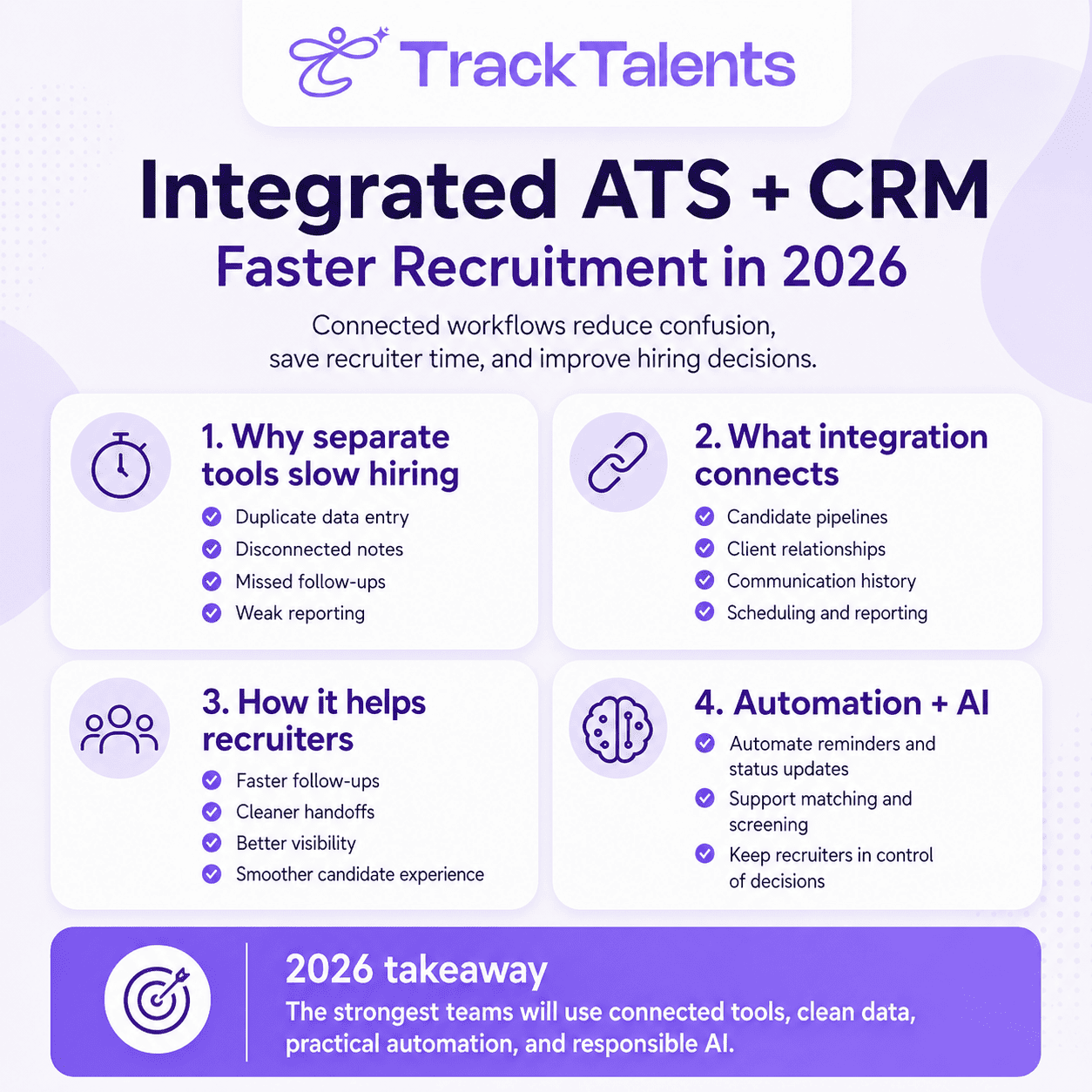
TrackTalents is positioned as a customizable ATS for recruiters, staffing agencies, and HR teams. Its published features include resume parsing, bulk resume upload, full-text resume search, custom candidate statuses, job and requisition management, CRM connections, communication management, and Outlook-linked candidate records.
These functions can support a strategic recruiting model by helping teams:
- Search previous resumes
- Create specialist talent pools
- Connect candidates with contacts and jobs
- Retain communication history
- Add resumes received through email
- Revisit candidates for future requirements
- Coordinate activity across recruiters
Software alone does not create a talent pipeline. Recruiters still need to update records, use consistent tags, record meaningful notes, and follow up at the right time.
The platform becomes strategically useful when it prevents the team from starting every search with an empty pipeline.
Build Employer Branding and resolve Candidate apprehensions
Employer branding is often reduced to social posts, office photographs, celebration videos, and broad claims about culture.
Candidates usually need more practical information.
They want to understand:
- What the role involves
- Why the position is open
- How the team works
- Who the manager is
- What success looks like
- How many interview stages are involved
- How quickly decisions are made
- Whether the salary is realistic
- What development is available
- Whether the stated work model is genuine
- How the company treats applicants
A careers page and a recruitment campaign should answer these questions rather than rely on slogans.
Candidate experience is part of employer reputation.
The strongest employer-brand signals often come from routine behavior:
- Accurate job descriptions
- Clear salary information
- Relevant recruiter outreach
- Respectful interviews
- Realistic timelines
- Prompt feedback
- Honest answers
- Consistent communication
- No misleading promises
Candidates may see polished employer content online, but their judgment is likely to be shaped by what happens during the hiring process.
Agencies represent two brands at the same time.
A staffing agency represents the client’s opportunity, but it also builds its own reputation with every candidate interaction.
Recruiters should explain:
- Whether they are representing the employer directly
- What they know about the role
- What information still needs confirmation
- What the interview process involves
- When can the candidate expect an update
- Whether the role is active and approved
An honest recruiter may occasionally lose a candidate or challenge a client. Over time, that honesty strengthens response rates and candidate trust.
Use Recruitment Data to Find Process Problems
Recruitment metrics should help the team make decisions. A dashboard that only counts calls, messages, applications, and submissions may show activity without explaining results.
A focused framework tracks movement between hiring stages.
Practical recruiting metrics
Requisition approval for the qualified shortlist
How long does it take to present the first candidates who meet the agreed criteria?
Source-to-screen conversion
Which channels produce candidate’s worth speaking to?
Screen-to-interview conversion
Are recruiters and hiring managers aligned on what constitutes a suitable profile?
Interview-to-offer conversion
Are interviews assessing the right areas, or are too many candidates reaching the final stage without a realistic chance of success?
Offer acceptance
Do candidates understand the role and package before the offer arrives?
Candidate withdrawal stage
Where do suitable candidates leave the process?
Hiring-manager feedback time
How long do recruiters and candidates wait after interviews?
Early quality indicators
How does the new hire perform at 30, 60, and 90 days?
Source quality
Which sources produce hires who join, perform, and remain?
Turn metrics into action.
A metric is valuable only when it changes behavior.
For example:
- Low outreach response may point to poor targeting or weak role positioning.
- High screening drop-off may indicate an unclear job description.
- Low interview conversion may show misalignment between recruiters and managers.
- Repeated offer rejection may signal compensation or work-model concerns.
- Candidate withdrawal after interviews may reflect slow feedback.
- Weak early performance may reveal an intake or assessment problem.
The purpose of recruitment analytics is to locate the part of the process that needs attention.
AI Should Remove Repetition While Keeping Decisions to Humans
AI can support sourcing, resume search, candidate rediscovery, scheduling, communication, and profile summarization.
Useful applications may include:
- Suggesting related search terms
- Identifying matching profiles in an existing database
- Summarizing long resumes
- Detecting possible duplicate records
- Drafting outreach messages
- Scheduling interviews
- Creating interview-note summaries
- Highlighting missing information
- Producing first drafts of job descriptions
These uses can reduce administrative effort and give recruiters more time for candidate conversations and advice from hiring managers.
AI output still needs review.
A candidate may have an unusual title, a non-linear career, a poorly written resume, a career gap, or experience described in language that the model does not connect to the vacancy. A high keyword score can also hide weak practical depth.
Recruiter judgment remains essential when deciding:
- Whether the experience is relevant
- Whether the evidence is credible
- Whether an adjacent profile could succeed
- Whether an apparent gap needs context
- Whether an automated recommendation makes sense
Ask vendors how hiring AI works.
Before using AI for matching, scoring, assessment, or selection, ask:
- What data does the system analyze?
- What does the output influence?
- Can recruiters see the factors behind a recommendation?
- Can the user override it?
- Does the tool reject anyone automatically?
- How is accuracy tested?
- How are different candidate groups assessed?
- Is human review built into the workflow?
- Where is candidate data stored?
- Is customer data used to train other models?
- Are actions recorded in audit logs?
- Can the AI function be disabled?
Compliance should be a part of Recruitment Strategy
Recruitment technology can affect candidate rights, data protection, recordkeeping, and employment decisions.
Under the EU AI Act, AI used for recruitment and employee selection may fall under high-risk employment uses. The original implementation framework listed 2 August 2026 as the date for many Annex III high-risk obligations. In May 2026, the European Commission announced a political agreement to move the application date for high-risk systems used in areas such as employment to 2 December 2027. Because this change depends on completion of the legislative process, employers should confirm the final legal timetable rather than relying on an old implementation summary.
Recruiting teams do not need to interpret regulations without legal support. They do need to understand how their tools influence hiring.
The organization should know:
- Whether candidates are ranked
- Whether profiles are filtered automatically
- Whether an assessment makes recommendations
- Whether recruiters can explain the output
- Whether a person reviews decision
- How candidate data is protected
- How long records are retained
- Whether the vendor provides audit and compliance documents
Compliance is easier to manage when it is considered during technology selection rather than after a problem occurs.
A 30-Day Strategic Recruiting Framework
A month will not resolve every workforce issue. It can create the structure needed to improve the next group of hires.
Days 1–5: Audit Current Hiring
Review open and recently completed recruitment activity.
Identify:
- Repeated vacancies
- Business-critical roles
- Hard-to-fill positions
- Roles with high candidate withdrawal
- Offers that were declined
- Searches that consumed too much recruiter time
- Vacancies with slow hiring-manager feedback
- Roles with weak early retention
Check each open requisition for:
- Approved salary range
- Clear role purpose
- Essential skills
- Trainable skills
- Interview stages
- Decision owner
- Feedback deadline
- Expected hiring date
The output should be a short list of priority roles and process problems.
Days 6–10: Create Role Scorecards and Talent Maps
Prepare a scorecard for each priority role.
Include:
- Business purpose
- Main responsibilities
- Early outcomes
- Essential skills
- Trainable skills
- Preferred experience
- Evidence required
- Salary boundaries
- Location rules
- Interview criteria
Then map the talent market.
Identify:
- Common titles
- Alternative titles
- Relevant employers
- Adjacent industries
- Professional groups
- Specialist job boards
- Certifications
- Internal candidates
- Previous applicants
- Geographic supply
- Likely salary expectations
The output should be a clear search direction rather than a loose list of keywords.
Days 11–15: Improve the Candidate Database
Review the ATS or recruitment CRM.
Focus on:
- Duplicate records
- Missing statuses
- Inconsistent skill tags
- Outdated availability
- Incomplete communication notes
- Unclear candidate ownership
- Past applicant’s worth revisiting
Create useful segments for:
- Silver-medalist candidates
- Previous contractors
- Future-availability candidates
- Referral candidates
- Scarce-skill groups
- Past interviewees
- Candidates open to specific locations
The output should be a searchable talent pool that recruiters can use immediately.
Days 16–20: Improve Outreach and Candidate Communication
Review:
- Job descriptions
- Recruiter messages
- Careers-page information
- Interview invitations
- Follow-up templates
- Closure messages
A useful outreach message should explain:
- Why the person was contacted
- Which part of the background appears relevant
- What the role involves
- Where it is based
- The work arrangement
- The compensation range is approved
- What the next step would involve
Set communication expectations for each stage. Candidates should know when they will hear back and whom to contact.
The output should be a more direct and credible candidate communication process.
Days 21–25: Review Technology and Automation
List the recruitment tools currently in use:
- ATS
- Recruitment CRM
- Sourcing tools
- Job boards
- Email systems
- Scheduling platforms
- Assessment tools
- Reporting dashboards
- HR systems
Identify where recruiters still depend on spreadsheets, personal reminders, or repeated data entry.
Apply automation first to routine tasks such as:
- Interview reminders
- Status updates
- Follow-up prompts
- Resume parsing
- Duplicate detection
- Calendar coordination
- Candidate rediscovery
Keep human review in higher-impact areas such as shortlisting, assessment interpretation, and rejection decisions.
The output should be a clearer workflow with fewer manual gaps.
Days 26–30: Set Metrics and a Review Routine
Choose a small set of measures connected to actual outcomes.
These may include:
- Qualified shortlist time
- Source-to-interview conversion
- Interview-to-offer conversion
- Offer acceptance
- Candidate withdrawal
- Hiring-manager feedback time
- Early performance
- Early retention
- Source quality
Review the data by:
- Role type
- Department
- Location
- Client
- Source
- Recruiter
- Hiring manager
Agree on the action required when a measure falls outside the expected range.
The output should be a monthly recruitment review that drives decisions, assigns ownership, and ensures follow-up.
Strategic Recruiting for Staffing Agencies
Staffing agencies balance client urgency, candidate trust, competition, and commercial priorities.
Their framework should include a stronger client-qualification stage.
Before accepting a search, clarify:
- Is the vacancy approved?
- Is the salary confirmed?
- Is the role exclusive?
- How many agencies are working on it?
- Is internal recruitment also active?
- Who provides feedback?
- How quickly will profiles be reviewed?
- What caused previous searches to fail?
- Is the client open to adjacent candidates?
- What is the interview process?
- Is there a realistic chance of placement?
These answers help the agency decide how much sourcing effort to invest.
Agencies should also protect candidate relationships. Repeated irrelevant messages, unsuitable submissions, and poor follow-up can reduce future response rates.
A strong agency acts as a market adviser by:
- Challenging unrealistic requirements
- Sharing salary and talent-supply evidence
- Explaining candidate objections
- Recommending adjacent profiles
- Tracking which clients provide timely feedback
- Protecting candidates from unclear opportunities
The database is not simply a collection of resumes. It is a long-term commercial and relationship asset.
Strategic Recruiting for Internal HR and Talent Teams
Internal teams have greater control over hiring-manager behavior, employer branding, workforce planning, internal mobility, and development.
Their framework should connect external recruitment with:
- Workforce planning
- Succession planning
- Internal mobility
- Learning and development
- Employee retention
- Job architecture
- Skills inventories
The World Economic Forum estimates that 59 out of every 100 workers will need training by 2030. This reinforces the need to combine external hiring with reskilling and upskilling rather than assuming every capability must be bought from the external market.
Before opening another external requisition, HR can ask:
- Is the skill already available internally?
- Could an employee move into the role with training?
- Is the vacancy caused by avoidable turnover?
- Will the same skill be needed across several teams?
- Should the business build, buy, borrow, or automate the capability?
Strategic recruiting becomes stronger when hiring is one part of a broader workforce plan.
Identify working recruitment Framework signals
A useful framework should lead to visible changes.
Recruiters should see:
- Clearer briefs
- Fewer late changes to requirements
- Better use of previous candidates
- More relevant outreach responses
- Stronger shortlist conversion
- Faster hiring-manager feedback
- Better-prepared interviewers
- Fewer surprise offer rejections
- More reliable candidate records
- Clearer source performance
The team should also become more confident in challenging:
- Unrealistic deadlines
- Overloaded job descriptions
- Unapproved salaries
- Unnecessary degree requirements
- Interviews without defined criteria
- Candidate submissions based only on keywords
- Automation that cannot be explained
- Clients or managers who repeatedly delay feedback
That discipline is the difference between strategic recruiting and recruitment activity that only looks busy.
Frequently Asked Questions
What is a strategic recruiting framework?
A strategic recruiting framework is a structured approach that connects role planning, talent mapping, sourcing, candidate engagement, technology, measurement, and hiring-manager accountability with business priorities.
How is strategic recruiting different from regular recruiting?
Regular recruiting often begins after a vacancy opens. Strategic recruiting prepares for future and recurring needs by identifying critical roles, studying talent markets, developing candidate relationships, and tracking hiring quality.
Can a 30-day recruiting framework produce results?
Thirty days can create a practical foundation. It can clarify role priorities, improve intake meetings, organize candidate data, strengthen communication, and establish useful metrics. Longer-term improvements require continued review.
Which strategic recruiting metrics matter most?
Useful measures include qualified-shortlist time, source-to-interview conversion, interview-to-offer conversion, offer acceptance, candidate withdrawal, hiring-manager feedback time, early performance, and early retention.
What role does an ATS play in strategic recruiting?
An ATS organizes jobs, candidate records, applications, communication, interview activity, feedback, and reporting. Its strategic value comes from preserving searchable hiring knowledge that can be reused for future roles.
How can AI support strategic recruiting?
AI can assist with candidate search, resume summaries, sourcing terms, scheduling, database rediscovery, duplicate checks, and communication drafts. Recruiters should review the output and retain human control over consequential decisions.
How can staffing agencies apply strategic recruiting?
Agencies can improve client intake, map repeat talent markets, maintain candidate relationships, track source and client performance, and use past search evidence to challenge unrealistic salary, skill, or timeline expectations.
How often should a recruiting framework be reviewed?
Priority roles, sourcing performance, candidate response, compensation, and hiring bottlenecks should be reviewed at least quarterly. High-volume or rapidly changing hiring environments may need monthly reviews.
Strategic Recruiting Begins Before the Vacancy
Recruitment strategy is strongest before the requisition reaches the recruiter’s desk.
It begins when the business identifies critical capabilities, studies talent availability, separates essential skills from familiar preferences, agrees on realistic compensation, and builds relationships with candidates who may be relevant later.
Technology can organize and accelerate that work. Data can show where the process is losing time or quality. AI can remove repetitive tasks. None of them can repair a role that was never clearly defined.
A strategic recruiting framework provides recruiters with the information and authority to make better choices early on. That leads to more credible searches, stronger candidate relationships, better hiring-manager decisions, and a talent pipeline that does not disappear each time a vacancy closes.