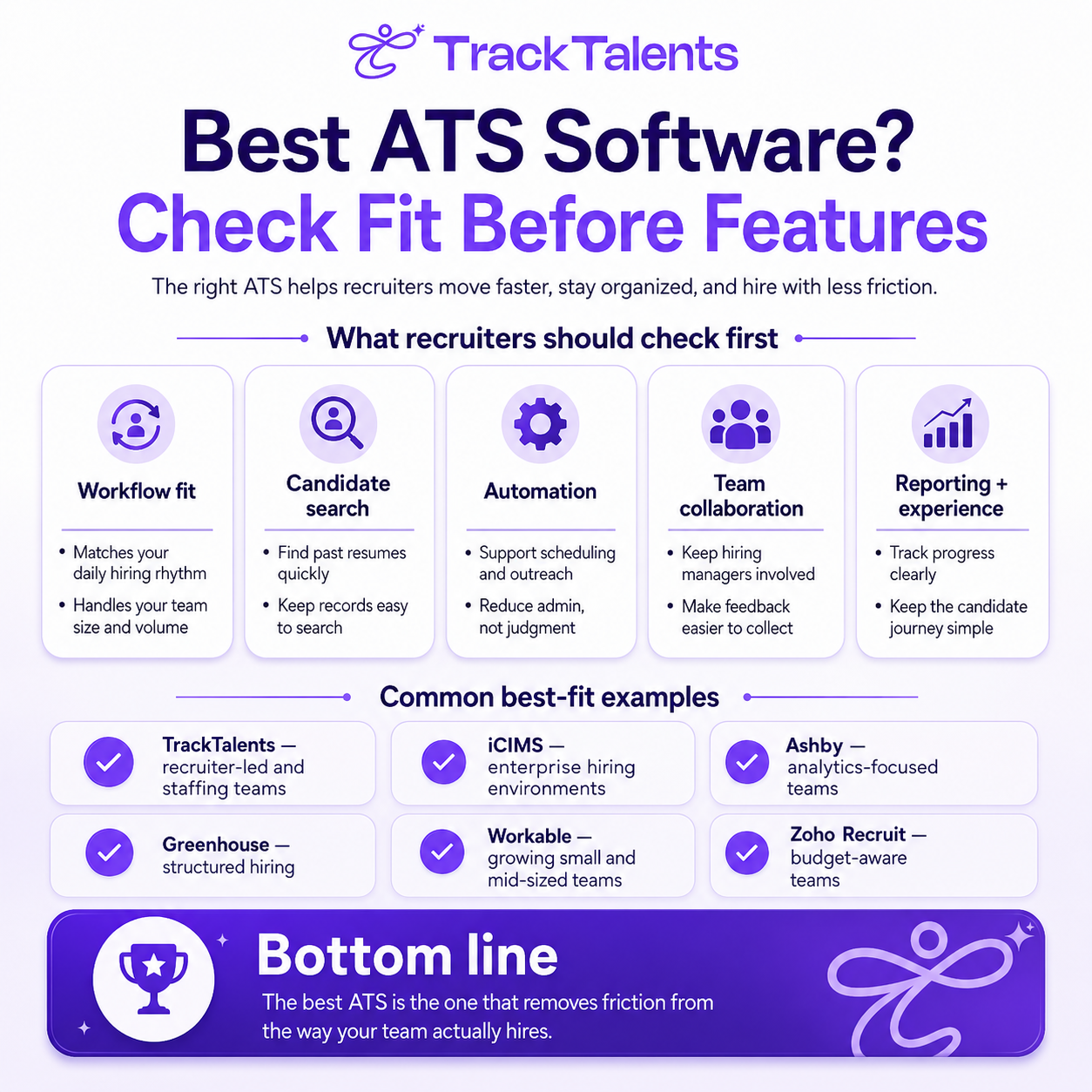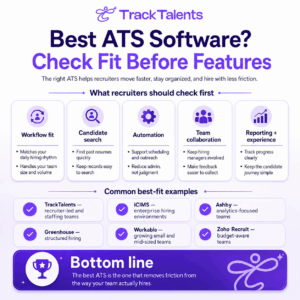
The best ATS software is not always the platform with the longest feature list. It is the one that matches how your recruiters, hiring managers, and business teams work each day.
Most applicant tracking systems now promote AI, automation, analytics, integrations, and better candidate experiences. These tools can add real value. However, their value depends on whether they solve the problems your hiring team actually faces.
A staffing agency may need candidate search, client management, email tracking, and reusable talent pools. An in-house recruitment team may place more value on hiring-manager feedback, approval workflows, structured interviews, and workforce reporting. A fast-growing company may need both an ATS and a recruitment CRM.
This comparison looks at some of the best ATS platforms for modern recruitment, including TrackTalents, Ashby, Workable, Lever, Pinpoint, Recruitee, Jobvite, iSmartRecruit, Recooty, and Zoho Recruit.
What Does Modern ATS Software Actually Do?
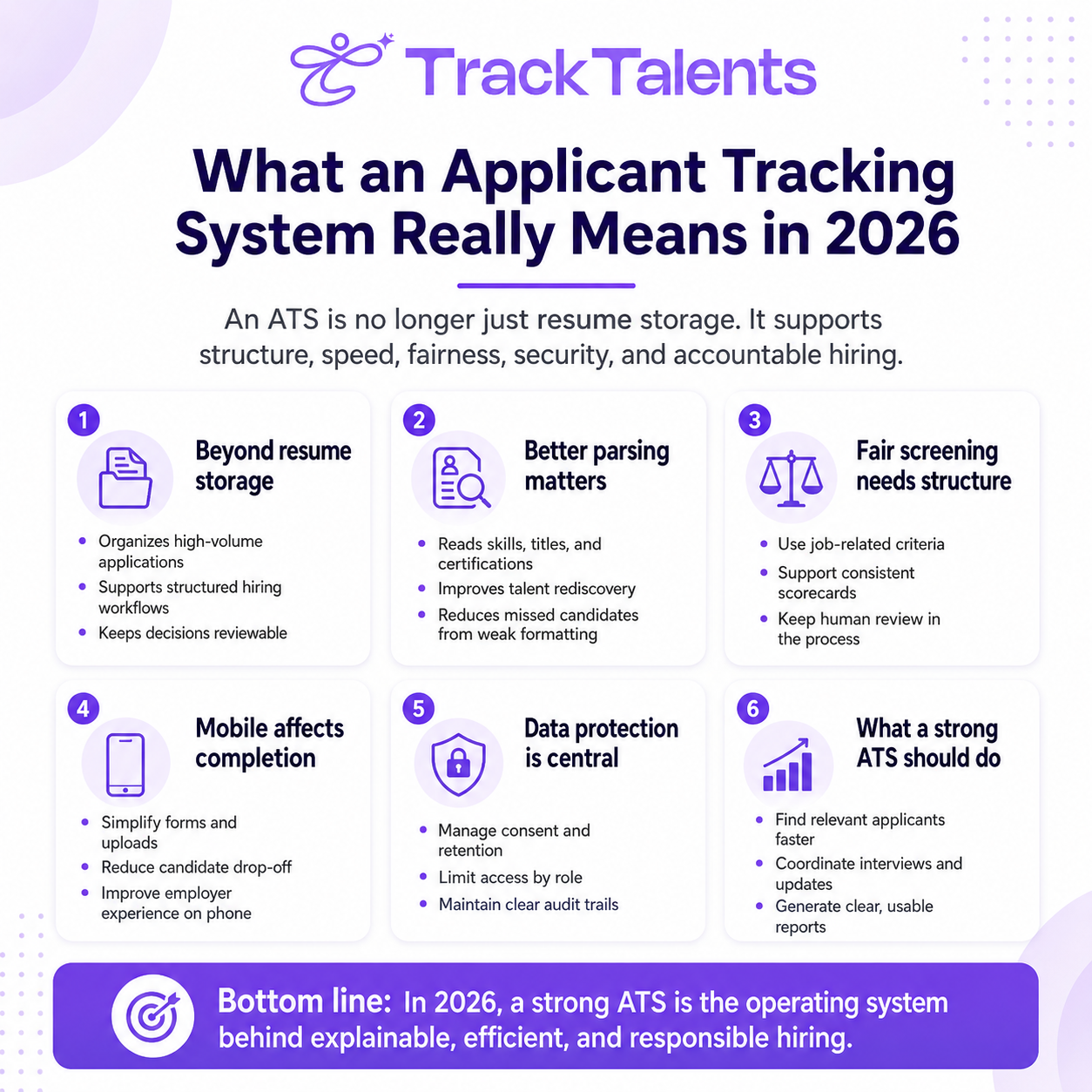
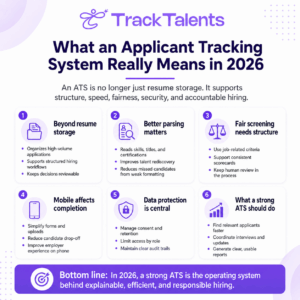
An applicant tracking system stores job, candidate, and recruitment data in one place. It helps hiring teams manage vacancies, applications, interviews, feedback, offers, and reporting. SAP describes an ATS as the central database that manages job requisitions, postings, applications, screening, and candidate selection.
A modern ATS often goes beyond basic application tracking. Depending on the platform, it may also include:
- Resume parsing and candidate search
- Job board distribution
- Recruitment CRM tools
- Automated emails and reminders
- Interview scheduling
- Hiring-manager scorecards
- Offer approvals
- Recruitment analytics
- Careers-site management
- Compliance and audit records
- Onboarding tools
- AI-assisted sourcing or screening
The right mix depends on the type of recruitment you handle.
Best ATS Software Compared by Hiring Need
| ATS platform | Most suitable for | Key strength | Pricing approach |
| TrackTalents | Staffing agencies, recruiters, and HR teams | Customizable recruitment workflows and operational visibility | Contact the vendor or request a demo |
| Ashby | Scaling and data-led talent teams | ATS, CRM, sourcing, scheduling, and analytics in one platform | Based on company size, usage, and commitment |
| Workable | Growing businesses and general HR teams | Broad recruiting tools with published plans and a trial | Public plans plus optional add-ons |
| Lever | Proactive and relationship-led recruitment | Combined ATS and recruitment CRM | Custom quote |
| Pinpoint | In-house and enterprise talent teams | Hiring-manager collaboration and workflow control | Custom quote |
| Tellent Recruitee | Small and mid-sized in-house teams | Flexible and collaborative hiring workflows | Plan-based pricing |
| Jobvite | Mid-sized and enterprise employers | Support for complex and high-volume recruitment | Custom quote |
| iSmartRecruit | Recruitment agencies and executive search firms | Combined ATS and recruitment CRM | Custom quote |
| Recooty | Small businesses with occasional or growing hiring | Accessible setup and public pricing | From $79 per month when billed annually |
| Zoho Recruit | Agencies, corporate recruiters, and Zoho users | Flexible recruitment tools within the Zoho ecosystem | Free and paid plans |
Pricing and features can change. Buyers should confirm current costs, limits, add-ons, and implementation terms directly with each provider.
1. TrackTalents: A Practical ATS for Staffing Agencies and Recruitment Teams
TrackTalents is designed for recruiters, staffing agencies, and HR teams that need a clear system for managing everyday recruitment work.
Its official positioning centers on a customizable ATS with integrations, structured hiring activity, and shared visibility across the recruitment team.
Where TrackTalents adds value
TrackTalents is especially relevant when recruiters need to manage:
- Candidate records and resume databases
- Open jobs and recruitment stages
- Candidate communication
- Interview activity
- Recruiter and team coordination
- Client-related recruitment workflows
- Repeat hiring across several roles
- Recruitment reports and pipeline movement
For staffing firms, the difference between an ordinary corporate ATS and an agency-focused platform can be significant. Agency recruiters often need client and contact management, advanced candidate search, resume parsing, job-board activity, and visibility across several recruiters and vacancies. These requirements differ from the needs of a small company that fills only a few internal roles each year.
TrackTalents is worth considering for:
- Staffing and recruitment agencies
- HR teams handling regular hiring
- Small and mid-sized organizations
- Recruiters who need searchable candidate records
- Teams seeking configurable workflows and integrations
It is best assessed through a live demonstration using your own hiring stages. Buyers should test candidate search, email handling, permissions, reporting, and any client-management functions they expect to use.
2. Ashby: Best for Connected Recruiting Data and Advanced Analytics
Ashby brings ATS, CRM, sourcing, scheduling, analytics, and AI into one connected recruiting platform.
Its strongest appeal is the way these functions share data. Recruiting teams can view pipeline movement, source performance, interview activity, and hiring outcomes without moving information across several separate systems.
Why teams consider Ashby
Ashby provides:
- Applicant tracking
- Candidate relationship management
- Talent sourcing
- Interview scheduling
- Recruitment analytics
- Custom dashboards
- AI-assisted recruiting tools
- Enterprise recruitment workflows
Its reporting tools allow teams to create dashboards and examine recruitment data in real time. This can help talent leaders study conversion rates, identify slow hiring stages, compare sourcing channels, and report results to business leaders.
Ashby states that its pricing is based on company size, usage, and the length of the commitment.
Best suited to
Ashby is a strong option for:
- Scaling technology companies
- Data-led talent acquisition teams
- Organizations are replacing several recruitment tools
- Companies with mature reporting needs
- Larger teams that want ATS, CRM, scheduling, and analytics together
Smaller employers should first decide whether they need this level of depth. A platform can offer excellent analysis and still be more than a low-volume hiring team requires.
3. Workable: A Broad Recruiting Platform for Growing Businesses
Workable combines applicant tracking with sourcing, job posting, candidate management, communication, and wider HR functions.
It publishes pricing information, offers a 15-day trial of its Standard plan, and allows buyers to request a demonstration. This gives growing businesses a clearer starting point for comparing costs and features.
Capabilities
Depending on the selected plan and add-ons, Workable can support:
- Multi-channel job advertising
- Candidate sourcing
- Application tracking
- Structured hiring workflows
- Interview scheduling
- Candidate communication
- Careers pages
- Reporting
- Employee records and other HR processes
Workable says its recruiting system can distribute vacancies to more than 200 job boards. Its broader platform also covers employee data and other HR functions, which may appeal to companies seeking more than a stand-alone ATS.
Some advanced AI functions are sold separately. For example, Workable states that its full recruiting agent is a paid add-on for recruiting plans. Buyers should therefore distinguish between features included in the core plan and tools that carry an extra charge.
Workable may suit:
- Growing small and mid-sized businesses
- Companies hiring across several job boards
- HR teams seeking recruiting and employee-management tools
- Employers that prefer visible entry pricing
- Teams that want a trial before purchasing
4. Lever: Best for Recruitment CRM and Talent Nurturing
Lever combines an applicant tracking system with a recruitment CRM. This makes it useful for teams that develop candidate relationships before a vacancy becomes available.
Instead of focusing only on people who have already applied, recruiters can build talent pools, record conversations, revisit previous candidates, and nurture prospects over time.
Lever describes its platform as an ATS and recruiting CRM with automation, analytics, AI, integrations, and collaborative hiring functions.
Where Lever stands out
Lever is relevant for teams that need:
- Active applicant tracking
- Passive candidate management
- Talent-pool development
- Candidate communication
- Recruitment automation
- Reporting and analytics
- Collaborative hiring
- Long-term candidate engagement
Its plans include core ATS, CRM, reporting, analytics, and key integrations. Pricing is based on team size and hiring needs and is provided through a custom quote.
Best suited to
Lever may work well for:
- Scale-ups
- Technology employers
- Proactive sourcing teams
- Organizations recruiting scarce skills
- Companies that regularly return to earlier candidates
Teams focused solely on occasional applications may use only part of their CRM’s capabilities. The business case becomes stronger when recruiters actively source and nurture people between vacancies.
6. Pinpoint: Best for Hiring-Manager Collaboration and Process Control
Pinpoint is built mainly for in-house talent acquisition teams. Its platform gives recruiters, hiring managers, leaders, and candidates access to different parts of the same hiring process.
It includes structured scorecards, self-service interview scheduling, mobile candidate reviews, approvals, automation, and reporting.
Pinpoint capabilities
The platform can support:
- Configurable hiring workflows
- Structured interview scorecards
- Mobile-friendly candidate reviews
- Interview self-scheduling
- Approval stages
- Candidate communication
- Agency submissions
- Careers sites
- Recruitment CRM
- Onboarding
- Reporting
Its enterprise offering also includes role-based permissions, audit logs, regional data controls, SSO, multi-step offer approvals, and HRIS or business-intelligence integrations.
Pinpoint is worth reviewing for:
- In-house talent teams
- Employers with active hiring-manager participation
- Multi-location organizations
- High-volume recruitment
- Companies with formal approval and reporting needs
- Enterprises managing access, compliance, and audit controls
The platform’s value will depend partly on whether managers actually use its scorecards, reviews, and feedback tools. A well-designed collaboration feature creates little benefit when hiring decisions continue through private emails and spreadsheets.
5. Tellent Recruitee: Best for Flexible, Collaborative Hiring
Tellent Recruitee focuses on making recruitment easier for the full hiring team, including recruiters and hiring managers.
The platform describes itself as a customizable, easy-to-use ATS that helps teams stay aligned and make hiring decisions in one place.
Useful Recruitee functions
Recruitee supports:
- Custom hiring pipelines
- Workflow automation
- Team collaboration
- Candidate evaluation
- Careers-site creation
- Employer branding
- Recruitment reports
- Source tracking
- Compliance support
Its reports can cover time-to-hire, source performance, conversion rates, team collaboration, and other recruitment metrics.
Recruitee may appeal to:
- Small and mid-sized in-house teams
- Multi-country businesses
- Companies moving away from email-based hiring
- Teams that want flexible recruitment stages
- Employers seeking an accessible system for hiring managers
Successful adoption still requires agreed-upon processes. Recruitee defines ATS adoption as using the platform as the main system of record for recruitment activity, rather than keeping key information in side channels.
7. Jobvite: Best for Complex and High-Volume Recruitment
Jobvite is aimed at mid-sized and enterprise organizations managing complex workflows, several business units, multiple locations, or high recruitment volumes.
Its broader talent acquisition platform supports the work involved in attracting, engaging, hiring, and retaining talent.
Jobvite may be relevant for:
- Enterprise talent acquisition teams
- Multi-brand or multi-location employers
- High-volume recruiters
- Organizations with complex approval structures
- Companies that need scalable recruitment processes
A detailed commercial review is important. Buyers should confirm which products are included in the proposed package, which modules carry additional costs, and how much internal work will be required for setup, migration, training, and administration.
8. iSmartRecruit: Best for Agencies and Executive Search Firms
iSmartRecruit combines an ATS and a recruitment CRM in a single workspace. Its features include resume parsing, candidate screening, team collaboration, visual pipelines, advanced search, scorecards, job approvals, and recruitment analytics.
This mix is useful for agency and executive-search work, where recruiters often manage clients, contacts, candidates, searches, and long-term relationships simultaneously.
iSmartRecruit may suit:
- Recruitment agencies
- Executive search firms
- Staffing companies
- Recruiters who need an advanced database search
- Teams managing both active applicants and passive candidates
During a demonstration, agency buyers should test client records, submission workflows, candidate ownership, duplicate handling, email synchronization, and placement reporting.
9. Recooty: Best for Small Businesses Seeking Simple Entry Pricing
Recooty offers applicant tracking, team collaboration, candidate summaries, scorecards, talent pools, reporting, career pages, and job board distribution.
Its public pricing provides a useful reference point for smaller employers. At the time of research, the Starter plan was listed at $79 per month when billed annually, with five active job posts and a 15-day trial.
Best suited to
Recooty may be suitable for:
- Small businesses
- Startups
- Occasional hiring
- Teams seeking a simple careers page
- Employers that want published entry pricing
Buyers should examine active job limits, employee or user limits, AI credit allowances, data migration, support levels, and the features available in each plan.
10. Zoho Recruit: Best for Flexible Corporate and Agency Recruitment
Zoho Recruit serves both corporate recruitment teams and staffing agencies. Its applicant tracking functions include candidate management, automation, sourcing, pipeline tracking, and AI-supported recruitment tools.
The platform becomes especially relevant for businesses already using other Zoho applications, since connected products may reduce the need to build integrations across unrelated systems.
Best suited to
Zoho Recruit may appeal to:
- Small and mid-sized recruitment agencies
- Corporate HR teams
- Businesses already using Zoho products
- Teams seeking a free or lower-cost starting point
- Employers that need configurable recruitment workflows
The range of options can require careful setup. Teams should decide which fields, workflows, automations, and reports they truly need before customizing the system.
How to Choose the Best ATS Software for Your Business
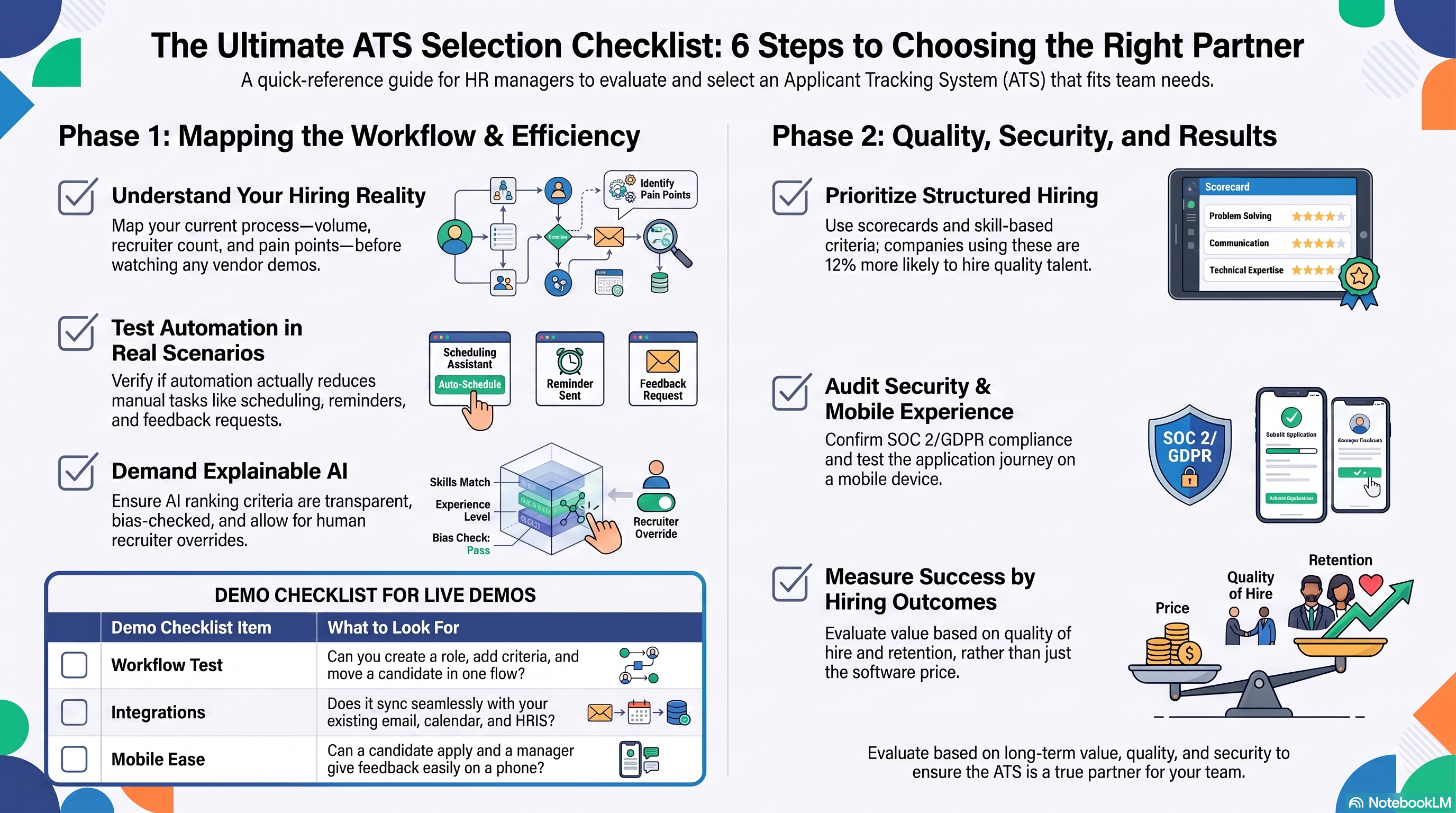
A product demonstration can make almost any ATS look efficient. A better selection process begins with your actual recruitment work.
1. Map your present hiring process
Document each step from job approval to accepted offer.
Include:
- Who raises a vacancy
- Who approves it
- Where jobs are advertised
- How candidates enter the system
- Who screens applications
- How interviews are booked
- How feedback is collected
- How offers are approved
- Which reports do leaders need
This shows where delays and repeated work occur.
2. Separate essential features from attractive extras
Create three groups:
Essential: The system must support these functions.
Useful: These features would improve the process.
Future: These may become relevant as hiring grows.
This approach prevents an impressive feature demonstration from shaping the decision more than your actual requirements do.
3. Match the ATS to your recruitment model
Staffing agencies usually need client records, candidate ownership, submissions, placement tracking, and a strong database search.
In-house teams often need hiring manager collaboration, approvals, career pages, structured interviews, and HR system integrations.
Executive search firms may place greater value on research, relationship history, confidential projects, and long-term candidate engagement.
High-volume employers need fast application flows, bulk actions, automated screening, scheduling, and communication at scale.
4. Test the candidate journey
Apply for a test vacancy from a mobile phone and a desktop computer.
Review:
- Application length
- Page speed
- Mobile layout
- Account-creation requirements
- Repeated questions
- Confirmation emails
- Interview-booking steps
- Accessibility
- Status communication
The ATS forms part of the employer brand. Candidates experience it before they meet a recruiter.
5. Review hiring-manager usability
Recruiters may use the system every day. Hiring managers may log in only when they need to review candidates or submit feedback.
Ask managers to complete realistic tasks during the trial:
- Open a candidate profile
- Review a resume
- Complete a scorecard
- Compare interview feedback
- Approve an offer
- Check the status of a vacancy
A process that takes several reminders during a trial may face even lower adoption after launch.
6. Calculate the total cost
The subscription is only one part of the ATS cost.
Include:
- Setup fees
- Data migration
- User licences
- Add-on modules
- Job-board costs
- Integration charges
- Training
- Implementation support
- Careers-site work
- Reporting or analytics support
- Contract increases at renewal
- Internal administration time
ATS pricing may follow per-user, per-job, per-employee, or flat-fee models. Costs can range from free entry plans to large enterprise contracts exceeding $100,000, depending on scale and requirements.
7. Examine AI features carefully
AI can help draft job descriptions, summarise resumes, suggest candidates, organize interview notes, and automate repetitive work. It should still operate within a clear and reviewable hiring process.
Ask vendors:
- What data trains or powers the feature?
- Can users see why a recommendation was made?
- Can recruiters override the output?
- Is candidate data used to train external models?
- Are decisions recorded for review?
- Can the feature be disabled?
- How is bias tested?
- Which regions store the data?
- What human review is expected?
AI should assist recruiters’ judgment rather than hide how a decision was reached.
8. Check security, privacy, and compliance
An ATS may contain resumes, contact details, salary information, interview notes, identification documents, and assessment results.
Review:
- Role-based access
- Single sign-on
- Audit logs
- Data encryption
- Data-retention controls
- Candidate consent
- Deletion and access requests
- Regional data hosting
- Backup arrangements
- Security certifications
- Vendor incident procedures
These checks are especially important for international recruitment and for organizations operating across multiple privacy regimes.
Questions to Ask During an ATS Demonstration
Use the same real-world tasks with every shortlisted vendor.
- Show us how a recruiter finds a candidate added two years ago.
- Show us how duplicate candidate records are handled.
- Show us how a hiring manager reviews and scores an applicant.
- Show us what a candidate sees on a mobile device.
- Show us how to schedule and reschedule an interview.
- Show us which reports are included without custom development.
- Show us how emails, calendars, job boards, and HR systems connect.
- Explain which functions require separate modules or added fees.
- Explain how our existing candidate data will be migrated.
- Show us how permissions and audit records are managed.
- Explain how AI recommendations are produced and reviewed.
- Show us what happens when we end the contract and export our data.
These requests reveal more than a polished presentation based on ideal workflows.
Which ATS Software Is the Best Choice?
TrackTalents is a practical option for staffing agencies, recruiters, and HR teams seeking customizable workflows and clear operational control.
Ashby is well aligned with scaling, data-driven talent teams that want ATS, CRM, sourcing, scheduling, and analytics on a single platform.
Workable offers a broad middle ground for growing businesses seeking recruiting and wider HR functions with visible plans and a trial.
Lever is strong for proactive talent acquisition teams that build relationships with candidates before roles open.
Pinpoint focuses on structured in-house recruitment, manager participation, workflow control, and enterprise needs.
Tellent Recruitee supports flexible, collaborative hiring for small- and mid-sized organizations.
Jobvite is designed for larger employers managing complex or high-volume recruitment.
iSmartRecruit serves agencies and search firms that need both applicant tracking and recruitment CRM functions.
Recooty offers an accessible starting point for smaller employers, while Zoho Recruit provides flexible options for corporate teams, agencies, and companies already working within the Zoho ecosystem.
The final decision should be based on workflow testing, user adoption, candidate experience, integrations, data protection, reporting quality, and total cost.
A strong ATS does more than store resumes. It provides recruiters with a reliable place to work, helps managers make timely decisions, keeps candidates informed, and produces recruitment data leaders can trust.