Candidate experience is not created by a careers page alone. It is formed by every step where a job seeker decides whether a recruiter, staffing agency, or employer is clear, fair, and serious about the role.
A candidate may accept a long hiring process when updates are honest. They may stay interested in a demanding interview process when expectations are explained early. For example, after receiving an application, a recruiter can send a short email describing the next steps and a rough timeline. This could include when to expect the first screening call, how many interview rounds are planned, and when decisions are usually made. By sharing this information at the start, candidates know what to expect and are less likely to feel lost or frustrated. They may continue with a role once the salary, work model, and interview steps are discussed, so they don’t invest too much time.
Trust grows when the process feels clear.
Candidate experience covers the full journey: job discovery, application, recruiter calls, screening, interviews, assessments, feedback, offer handling, rejection, pre-boarding, and onboarding. A strong process does not mean every candidate gets selected. It means every candidate understands where they stand.
For recruiters and staffing agencies, candidate experience is now a business issue. It affects application completion, response rates, referrals, offer acceptance, employer reputation, and future talent pipelines.
Candidates Judge the Process Before the First Call
The first impression often happens before a recruiter speaks to the candidate.
A job seeker may see the role on LinkedIn, a job board, a staffing agency website, a careers page, or a social post. If the job title is vague, the salary is missing, the duties are unclear, or the application form is too long, the experience has already started weakly.
SHRM’s 2025 Talent Trends research found that HR professionals viewed easier application processes and voluntary pay range disclosure as highly effective recruiting strategies. In that research, 49% selected streamlining applications as effective, while 48% selected including pay ranges in job postings.
A useful job post should answer the questions candidates already have:
- What is the real role?
- Where is the job based?
- Is it remote, hybrid, or on-site?
- What is the pay range?
- Which skills are required from day one?
- Which skills are preferred?
- How many interview rounds are expected?
- Is the role active, approved, and funded?
The more basic details are hidden, the more doubt the process creates.
Detailed and Relevant Job Descriptions Increase Candidate Confidence
Many job descriptions try to look detailed but end up sounding confusing. They combine two or three roles, list too many tools, and use broad phrases that do not explain the actual work.
Candidates observe this.
A good job description should separate:
- Daily responsibilities
- Required skills
- Preferred skills
- Certifications or licenses
- Shift, travel, or location requirements
- Reporting structure
- Interview and assessment steps
“Must-have” skills should not be mixed with skills that can be learned after joining. If a certification, shift, language skill, license, or work model is fixed, it should be stated clearly. If a skill can be trained, it should not become an early rejection filter.
A simple phrasing template a recruiter can use is: “The following skills are required on day one: [list must-have skills]. The following skills are nice to have but can be developed after joining: [list trainable skills]. For example: “Excel skills and a valid driver’s license are required. Experience with Salesforce is preferred, but can be learned after hire. This approach gives candidates a clear sense of what is essential versus what is trainable.
For staffing agencies, this matters even more. Candidates may not know the client company at the first stage. If the agency cannot explain the role properly, the candidate may assume the recruiter is only forwarding resumes without understanding the job.
Salary Transparency Creates Early Trust
Not every employer is legally required to publish salary ranges. Some roles also have flexibility dependent on experience. Still, hiding compensation until late in the process creates avoidable friction.
Candidates may complete calls, assessments, and interviews only to learn that the range does not correspond to their expectations. This wastes time for the candidate, recruiter, hiring manager, and client.
Pay transparency is also becoming a compliance issue in more places. SHRM reported that new pay transparency laws took effect or were scheduled to take effect in Illinois, Minnesota, New Jersey, Vermont, and Massachusetts in 2025.
Recruiters do not need to oversell pay. They need to be clear.
If the range is fixed, say so.
If there is flexibility, explain what affects it.
If the client has not approved a range, the recruiter should get approval before sourcing heavily.
Salary clarity may reduce unqualified conversations, but it improves serious conversations.
Recruiter Communication Is the Heart of Candidate Experience
Most candidate experience issues are communication issues.
Candidates lose trust when they face silence after applying, unclear following steps, repeated requests for the same information, late feedback, or sudden changes in the process. Even a short update is better than no update.
To help recruiters build trust and create a consistent experience, here are sample update messages they can use at common stages:
Application received: “Thank you for applying for the [Job Title] position. We have received your application and will review your details. You should hear back from us within [timeframe].”
Shortlisted for screening: “We have reviewed your application for [Job Title] and would like to continue with a brief screening call. Please inform us of your availability this week.”
Not selected after application: “Thank you for your interest in [Company/Client Name] and the [Job Title] role. After assessing your application, we will not be moving forward at this time. We thank you for your interest and urge you to apply for future opportunities.”
Interview scheduled: “Your interview for [Job Title] is scheduled for [date] at [time] with [interviewer name or panel]. We look forward to speaking with you.”
Feedback pending: “Thank you for completing your interview for the [Job Title] role. We are currently gathering feedback and expect to update you by [date].
Role on hold: “We wanted to let you know that the [Job Title] hiring process is temporarily on hold. We will update you as soon as there is progress. Thank you for your tolerance.”
Offer stage: “Congratulations. We are preparing your offer for the [Job Title] role and will share details with you by [date]. Please let us know if you have any immediate questions.”
Process closed: “Thank you for your effort and interest throughout the process for the [Job Title] position. The process has now been closed, but we hope to reconnect in the future regarding other opportunities.”
Using clear, timely messages helps candidates feel respected and minimizes uncertainty at every stage.
Greenhouse’s 2025 Workforce & Hiring Report found that 72% of candidates said the job they applied for turned out to be different from what was offered. The report also pointed to role uncertainty and opaque interview practices as major sources of candidate frustration.
Recruiters should set communication checkpoints for each stage:
- Application received
- Shortlisted for screening
- Not selected
- Interview scheduled
- Feedback pending
- Role on hold
- Offer stage
- Process closed
- Onboarding started
These updates do not need to be long. They need to be timely, specific, and consistent. As a general guide, recruiters should aim to update candidates at least once per week, even if there is no significant progress to share. At key decision points—such as after screening, interviews, or when timelines change—updates should be sent as soon as possible. By setting this expectation, recruiters minimize uncertainty and build trust throughout the process.
For staffing agencies, communication is also a brand asset. A candidate may forget the job ID, but they will remember whether the recruiter followed up after promising to do so.
A Better Application Process Reduces Drop-Off
A serious candidate should not have to upload a resume and then manually retype the same information into several fields.
Long forms, forced account creation, broken mobile pages, unclear error messages, and repeated questions create drop-offs before recruiters even review the applicant.
Appcast reports that around two-thirds of job applications are submitted on mobile devices. It also noted that mobile app behavior varies by job function, with very high mobile use in gig work, hospitality, transportation, real estate, warehousing, and logistics.
This means application design must work well on smaller screens.
An early application form should usually collect only:
- Resume
- Name and contact details
- Location
- Work authorization, where relevant
- Notice period, where relevant
- Salary expectation, where appropriate
- A few role-specific screening questions
More detailed information can be collected later if the candidate moves forward.
A shorter application is not a weaker application. When designed well, it reduces friction while still helping recruiters identify serious candidates.
Structured screening calls should result in timely output
Candidates can sense when a screening call is improvised.
A recruiter who repeats what is already on the resume, asks scattered questions, or cannot explain the role makes the process seem weak. A structured screening call should confirm role fit. It should not become a full interview.
A strong screening call covers:
- Current role and responsibilities
- Relevant experience
- Reason for change
- Salary expectation
- Notice period
- Location or work model preference
- Must-have skill match
- Work authorization, where required
- Candidate questions
The recruiter should also explain the role clearly enough for the candidate to decide whether they want to continue.
The best screening calls are two-way. Recruiters evaluate candidates, but candidates also evaluate recruiters, agencies, and employers.
A candidate’s time should be respected at Interviews
A strong interview process has a reason for every step.
Candidates may be invited to multiple rounds for senior, technical, or specialist roles. But they expect to know why each round exists and what it will assess.
Before interviews begin, candidates should know:
- Who will they meet
- What each round will cover
- Whether there will be an assessment
- How long may the process take
- What the employer is trying to evaluate
- When can they expect feedback
Interviewers also need internal alignment. If each interviewer looks for something different, candidates receive mixed signals and the hiring team struggles to compare feedback.
Standardized interviews help create consistency. They also reduce the chance that candidates are judged mainly on personal impressions rather than role-relevant evidence.
For staffing agencies, this is especially important because recruiters often need to explain interview feedback to candidates after the client conversation.
Feedback Should Be Clear, Careful, and Job-Related
Not every rejected candidate can receive a detailed coaching report. But silence after an interview damages trust.
If a candidate has invested time in calls, interviews, or assessments, they deserve closure.
Feedback should be accurate and linked to the role. For example:
“The role requires direct enterprise account ownership, while your recent experience is mainly with inbound SMB accounts.”
That is more useful and professional than vague feedback such as:
“The client did not feel it was the right match.”
Recruiters must avoid making personal remarks, references to protected characteristics, or vague judgments about personality. Feedback must be brief, respectful, and tied to job requirements.
Good feedback also helps future hiring. A candidate rejected for one role may be right for another. If the ATS record includes clear notes, the next recruiter does not have to start from zero.
AI Can Support Hiring When Candidates Comprehend Its Role
AI is now used in sourcing, resume screening, matching, scheduling, assessments, interview preparation, and candidate communication. Used well, it can reduce manual work and improve response time. Used poorly, it can make candidates feel judged by a system they do not understand. To prevent confusion and address concerns, recruiters should proactively communicate the role of AI in their process.
Gartner reported in 2025 that only 26% of job candidates trusted AI to fairly evaluate them, while 52% believed AI was screening their application information. Gartner also found that 25% of candidates trusted employers less when AI was used to evaluate their information.
This does not mean recruiters should avoid AI. It means they should use it with care. Summarizing AI’s role up front reassures candidates and creates trust.
A simple disclosure statement can set expectations, for example: “We use AI-based tools to screen resumes and schedule interviews, but all final decisions are reviewed by a human recruiter. Your information will be handled confidentially throughout the process. If you have questions about where AI is used, please ask.”
Recruiters should explain:
- Where AI is used· Whether humans review the final decision
- How candidate data is dealt with· What kind of AI use is allowed for candidates
- Whether AI interviews or assessments are part of the process
For candidate experience, AI should boost clarity and speed. It should not remove human accountability.
Candidate Experience Improves with ATS Discipline
Candidate experience becomes harder to manage when recruiters depend on scattered emails, spreadsheets, personal reminders, and memory.
Once multiple roles, clients, recruiters, and hiring stages are involved, communication lapses become likely.
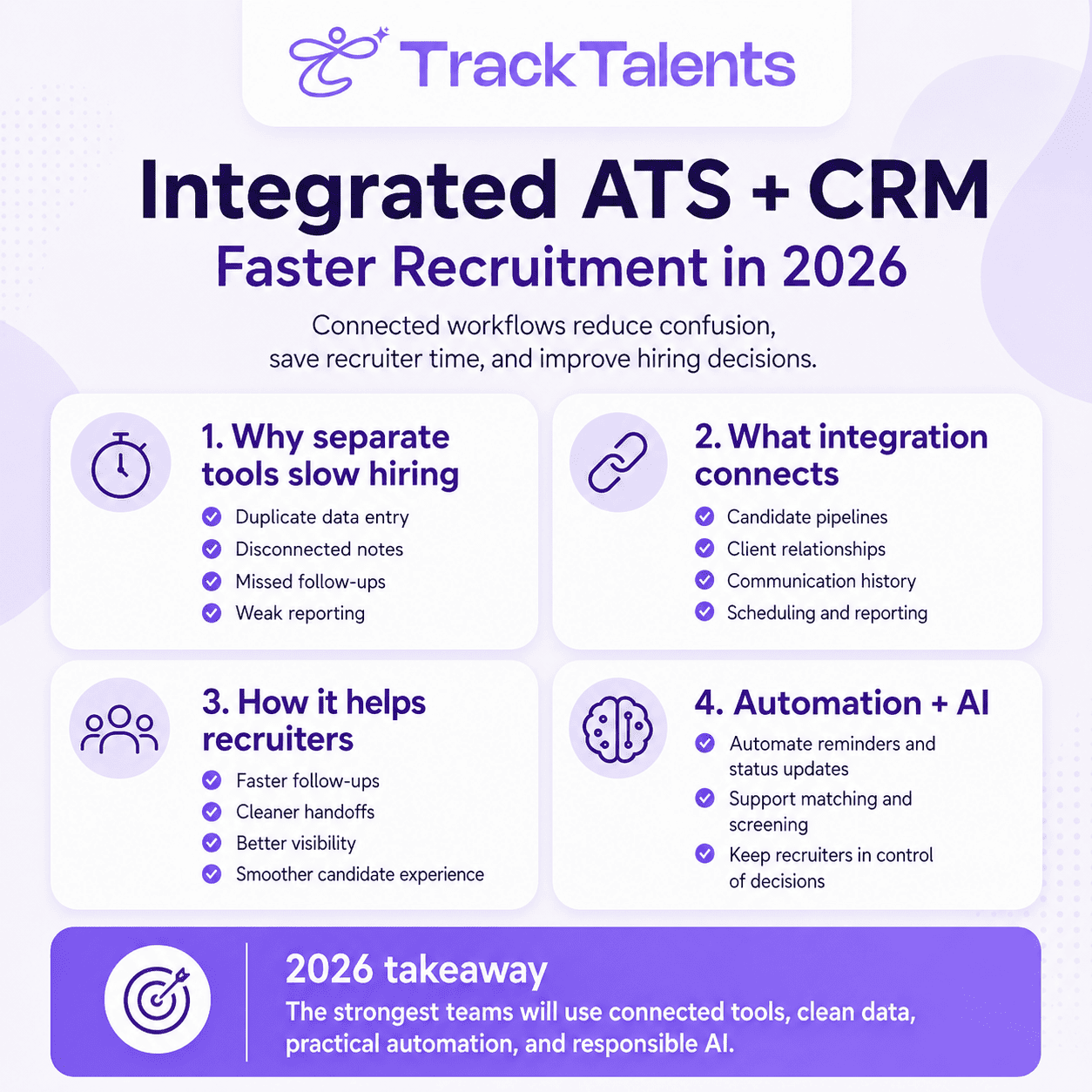
An applicant tracking system can support candidate experience by keeping resumes, notes, communication history, interview stages, feedback, and follow-up tasks in one place.
TrackTalents, for example, acts as a customizable ATS for recruiters, staffing agencies, and HR teams. Its official site lists features such as bulk mailing, job postings, job board integration, branded career site support, Outlook, Office 365, and Chrome plugin integration, CRM, resume management, recruiter activity logs, job pipeline, customizable workflows, integrated calendar, HR module, mail merge, and vendor management.
For recruitment teams, a system like this is useful for keeping clear records and guaranteeing follow-up discipline. The software alone will not create a better candidate experience. Recruiters still need process ownership. But without a central system, even good recruiters can miss updates, lose feedback, or forget strong candidates who were not selected the first time.
Staffing Agencies Handle Two Experiences at Once
A staffing agency has a more complex candidate experience challenge than an in-house HR team.
The agency represents itself and the client employer. If the client delays feedback, changes requirements, hides salary, or adds interview rounds, the candidate often blames the agency first.
That is why agencies should set client expectations before sourcing begins.
They should confirm:
- Job title and role scope
- Salary range
- Work model
- Must-have skills
- Interview steps
- Decision timeline
- Feedback process
- Candidate ownership
- Communication responsibilities
Agencies should also avoid overpromising. Saying “the client is very interested” before real feedback exists creates false hope.
A more business update would be:
“I have shared your profile and will update you by Friday, even if final feedback is still pending.”
That is easier to honor and more credible.
Onboarding Plays a Major Role in Candidate Experience
Candidate experience does not end when the offer is accepted.
The time between offer acceptance and joining is important. Candidates may receive counteroffers, rethink the move, worry about documents, or feel ignored after signing.
Recruiters ought to maintain active communication during this stage.
They should confirm:
- Joining date
- Documents required
- Reporting manager
- Work location
- First-day schedule
- Laptop or access details
- Background verification steps
- Payroll or contract requirements
- Shift information, where relevant
For contract staffing, onboarding clarity is even more important because payroll, timesheets, compliance documents, client-site access, and shift expectations may all be involved.
A candidate who feels prepared is more likely to join with confidence.
Candidate Experience Surveys Should Focus on Specific Moments
A candidate experience survey is useful only when it provides clear points for improvement. A broad question like “How was your experience?” may not reveal where the process fell short.
Better survey questions include:
- Was the job description clear before you applied?
- Was salary or compensation explained at the right stage?
- Did the recruiter explain the hiring process clearly?
- Were you updated within the expected timeline?
- Did the interviewers appear prepared?
- Was the assessment relevant to the role?
- Were you treated respectfully after being selected or rejected?
- Would you consider another role through this recruiter or company?
The 2025 Global CandE Benchmark Research Report reviewed the candidate experience journey of more than 66,000 candidates worldwide, from pre-application to onboarding. This reinforces the point that candidate experience should be measured across the full journey, not only after an offer is accepted.
Recruiters should track Candidate Experience Metrics
Candidate experience should not be judged only by complaints. Recruiters and staffing agencies should track signals that show where applicants are being lost.
Useful metrics comprise:
- Application completion rate
- Response time after application
- Screening-to-interview conversion
- Interview scheduling time
- Candidate drop-off stage
- Assessment completion rate
- Offer acceptance rate
- Rejection communication rate
- Candidate satisfaction score
- Time from interview to feedback
- Pre-joining drop-off rate
Each metric should lead to action. For example, if you notice a low application completion rate, consider simplifying your application form by removing unnecessary fields or enabling resume upload via mobile. If offer acceptance rates are low, review whether your pay ranges are competitive and ensure you discuss total compensation early in the process. By responding directly to what you measure, you turn metrics into meaningful process changes.
A high drop-off rate after screening may indicate a salary mismatch or an unclear role explanation. Low assessment completion may mean the task is too long or poorly introduced. Slow interview scheduling may show hiring manager availability issues. Poor offer acceptance may reveal compensation gaps, employer reputation issues, or process fatigue.
Reporting alone does not improve candidate experience. Process changes do.
Candidate trust improves with professional communication habits
Candidate experience improves when recruiters consistently follow simple habits.
Before publishing a role, confirm the title, work model, salary range, must-have skills, interview process, and application requirements.
Before screening, prepare role-specific questions and decide what must be confirmed.
Before interviews, tell candidates who they will meet, what will be discussed, and how long the process may take.
After interviews, update candidates even if final feedback is pending.
After rejection, provide polite closure and useful feedback where possible.
After the offer is accepted, stay in touch until joining.
After onboarding, ask for feedback and use it to improve the next hiring cycle.
This is not complicated. But it requires ownership.
Better Candidate Experience Comes from Operational Discipline
Candidate experience is not about making every candidate happy.
Some candidates will be rejected. Some roles will be paused. Some salary expectations will not match. Some hiring decisions will take longer than planned.
The real test is whether the process stays honest, respectful, and clear even when the answer is not positive.
For recruiters and staffing agencies, candidate experience is built through daily execution: accurate job information, punctual updates, structured screening, prepared interviews, relevant assessments, careful use of AI, clean ATS records, and respectful closure.
These are not small improvements. They decide whether candidates continue the conversation, refer others, apply again, or avoid the recruiter entirely.
A hiring process does not need to be perfect. It needs to be clear enough for candidates to trust it.
Frequently Asked Questions
What is candidate experience?
Candidate experience is the full journey a job seeker has with the hiring process. It includes job discovery, application, recruiter communication, screening, interviews, assessments, feedback, offer handling, rejection, pre-boarding, and onboarding.
Why is candidate experience important for recruiters?
Candidate experience affects application completion, candidate response, employer reputation, referrals, offer acceptance, and future hiring pipelines. Clear communication keeps candidates engaged even when the process takes time.
How can staffing agencies improve candidate experience?
Staffing agencies can improve the candidate experience by clearly explaining roles, discussing salary expectations early, updating candidates regularly, preparing them for client interviews, giving closure after rejection, and preserving accurate ATS records.
What is the most important part of candidate experience?
Communication is the most important part. Candidates can accept delays more easily when they receive honest updates. Silence after application, screening, or interview creates frustration and reduces trust.
Should salary be included in job descriptions?
Where possible, yes. Salary transparency saves time, reduces mismatch, and creates trust. In some locations, pay range disclosure is also becoming a legal requirement.
How does AI affect candidate experience?
AI can speed up screening, matching, scheduling, and communication. But candidates may distrust AI-based evaluation when the process is unclear. Recruiters should explain where AI is used and keep human monitoring in hiring decisions.
How does an ATS support candidate experience?
An ATS helps recruiters track applications, candidate communication, interview stages, feedback, follow-up reminders, and hiring history. This reduces missed updates and helps recruiters maintain a clearer candidate record.
When does candidate experience end?
Candidate experience continues after offer acceptance. Pre-boarding, document collection, joining updates, first-day instructions, and onboarding all shape how confident the candidate feels about the employer or staffing agency.