Free resume search sounds useful to every recruiter. It can help when hiring budgets are tight, roles are urgent, or job postings are not bringing enough qualified candidates. A searchable resume database can help recruiters find local candidates, remote workers, startup talent, senior professionals, active job seekers, and people who may not apply through a fresh job ad.
But a free resume search works well only when recruiters use it with care.
A resume is not a hire. It is only a lead.
The candidate still needs to be reachable, interested, qualified, available, aligned on salary, and ready to continue the conversation. That is why recruiters should not ask only, “Which site has the most resumes?”
The better question is:
Which resume source provides the most relevant, up-to-date, and reachable candidates for this role?
What Free Resume Search Really Means
“Free” can mean different things on different platforms.
Some sites allow free resume searches but charge to contact candidates. Some offer a free trial. Some allow free job postings but limit access to the resume database. Some let recruiters search profiles but hide phone numbers or email addresses. Others allow limited views or platform-only messaging.
So, before using any resume database, recruiters should check:
- Can I search resumes for free?
- Can I contact candidates for free?
- Are contact details visible?
- Is access limited by a trial period?
- Are there daily view limits?
- Can I save candidates?
- Can I export or move profiles into my ATS?
- Are resumes recent?
- Is the database strong in my target location?
- Does the platform fit this role type?
Free access is useful only when it helps the recruiter move from search to conversation.
Free Resume Search Is a Sourcing Channel, Not a Hiring Process
Free resume databases can widen the top of the funnel. They can help recruiters discover people outside their own network or job posting reach.
But they do not replace the basics of recruiting.
Recruiters still need:
- A clear role brief
- Strong search terms
- Good Boolean strings
- Fresh candidate filters
- Personalized outreach
- Screening questions
- Salary alignment
- Interview coordination
- Follow-up discipline
- ATS tracking
A recruiter can search 500 resumes and still produce no shortlist if the role intake is vague. A smaller database can perform better than a large one if the profiles are fresher and the candidates are easier to contact.
Best Free and Limited-Access Resume Search Platforms for Recruiters
The platforms below can help recruiters source candidates, but they are not equal. Some are closer to free resume databases. Some are free trials. Some are paid platforms with resume search features. Some work best only for specific roles.
1. Indeed Smart Sourcing
Indeed Smart Sourcing is one of the most visible resume search options for employers. Indeed says Smart Sourcing helps employers access resumes, receive AI-powered candidate matches, create customizable messages, and collaborate with team members and hiring managers.
Indeed can be useful for common job categories such as:
- Sales
- Customer service
- Administration
- Operations
- Retail
- Healthcare support
- Entry-level roles
- Local hiring
- Mid-level hiring
The strength is reach. The caution is competition. Many recruiters may be contacting the same candidates.
How Recruiters Should Use Indeed
Use tight filters. Search by job title, skills, location, recent activity, experience, and must-have criteria.
A broad title search may return too many results. A skills-based search can help recruiters find better matches.
2. MightyRecruiter
MightyRecruiter is better described as a free-trial platform than a permanently free resume database. Its pricing page states that users receive a 7-day free trial to create and post jobs, search its proprietary database of 10 million-plus resumes, manage candidates, and message candidates.
This can be useful for small teams that want to test job posting, resume search, and candidate management together.
How Recruiters Should Use MightyRecruiter
Use the trial with a plan.
Before starting, prepare:
- Target roles
- Search strings
- Locations
- Must-have skills
- Candidate filters
- Outreach templates
- Follow-up steps
A trial has value only when recruiters test real hiring work during the access period.
3. Well-found
Well-found is useful for startup and technology hiring. Its site says employers can reach a community of 10 million-plus startup-ready candidates, and its recruiter page positions the platform as a platform for startup-minded talent.
Well-found is not a general-purpose resume database like traditional resume sites. Its value is stronger for candidates interested in startup or high-growth company environments.
Best-Fit Roles for Well-found
Well-found can be useful for:
- Software engineering
- Product management
- Design
- Growth roles
- Marketing
- Operations
- Startup leadership roles
- Early-stage company hiring
How Recruiters Should Use Wellfound
Use Wellfound when the role has a startup angle. It may not be the first choice for local frontline hiring, traditional corporate roles, or high-volume hourly recruitment.
4. Jobvertise
Jobvertise directly positions itself as a free jobs and resume database. Its homepage says employers can search resumes and post jobs for free, while its resume search page shows free resume searches and the latest resume counts.
This makes Jobvertise one of the more direct options for recruiters looking for a free resume search.
How Recruiters Should Use Jobvertise
Use it for broad sourcing, but review quality carefully.
Check:
- Resume freshness
- Candidate location
- Contact availability
- Role relevance
- Duplicate profiles
- Completeness of information
Free databases can contain useful leads, but they can also contain outdated or incomplete profiles. Recruiters should screen before investing too much time.
5. PostJobFree
PostJobFree allows recruiters to post jobs and search resumes. Its homepage includes resume search and job posting options, and it shows recent job and resume counts.
PostJobFree can be useful for recruiters who are comfortable refining searches manually.
How Recruiters Should Use PostJobFree
Use specific keywords and exclusion terms.
For example, a recruiter hiring a payroll specialist may search for payroll, statutory compliance, and reconciliation while excluding unrelated HR generalist terms.
This helps reduce noisy results.
6. JobSpider
JobSpider positions itself as a 100% free job board for employers. It says it provides free job posting and free resume hosting with no hidden fees. It also notes that employers can search its resume database, which focuses on the United States and Canada.
JobSpider may be useful for recruiters hiring in the U.S. and Canada, especially when an extra free channel can add reach.
How Recruiters Should Use JobSpider
Use it as an additional source, not the only source. It may help with local or general hiring, but recruiters should still verify candidate freshness and fit.
7. ZipRecruiter
ZipRecruiter’s resume database page says recruiters can search by keywords, skills, job titles, location, experience, and education. It also states that the ZipRecruiter Resume Database includes 56 million resumes.
ZipRecruiter is better described as a paid platform with free-entry options rather than a fully free resume database. Recruiters should check current plan rules before assuming full access.
How Recruiters Should Use ZipRecruiter
Use ZipRecruiter when you need job distribution, matching, candidate management, and resume search in one place.
Before depending on it for urgent roles, confirm:
- Contact access
- Resume view limits
- Trial terms
- Messaging options
- Candidate freshness
- Pricing after trial
Searching without contact access may be useful for market research, but it may not solve urgent sourcing needs.
8. Monster
Monster is a major resume search and job posting platform for employers. Its employer page promotes resume search and job advertising, while its resume search page describes a large resume database and directs employers to pricing.
Monster should not be placed in the same category as fully free resume search sites. It is better suited as a paid resume database for recruiters to evaluate when the budget is available.
How Recruiters Should Use Monster
Use Monster when you need broader candidate reach and are ready to compare paid access options.
Check:
- Resume database size
- Contact access
- Pricing
- Industry strength
- Profile freshness
- Candidate quality
- Integration options
9. FlexJobs
FlexJobs is known for remote, hybrid, freelance, and flexible work. Its website positions it as a job site for legitimate work-from-home jobs, flexible hours, hybrid roles, and remote opportunities.
This makes FlexJobs useful for role-specific sourcing, especially when remote or flexible work is a key part of the offer.
Best-Fit Roles for FlexJobs
FlexJobs may be useful for:
- Remote roles
- Hybrid roles
- Freelance roles
- Flexible-schedule jobs
- Part-time professional roles
- Work-from-home roles
How Recruiters Should Use FlexJobs
Use it when the role clearly supports remote or flexible work. It may not be the best first choice for fully on-site, local, or shift-based roles.
Recruiters should also verify current employer access and pricing before assuming a resume search is free.
10. Ladders
Ladders is positioned around high-paying professional and executive jobs. Its official site promotes careers and executive roles with salaries exceeding $100K.
This makes Ladders more relevant for senior professionals, managers, executives, and higher-salary roles.
Best-Fit Roles for Ladders
Ladders may be useful for:
- Senior managers
- Executives
- Directors
- High-salary professionals
- Specialized leadership roles
- $100K-plus positions
How Recruiters Should Use Ladders
Use it selectively. It is not suitable for every hiring need.
It may be the wrong source for entry-level, hourly, frontline, blue-collar, or local volume hiring.
11. Craigslist
Craigslist can still help in some local markets. It may be useful for small businesses, trades, hourly work, local services, and community-based hiring.
But recruiters should use it carefully.
Craigslist is less structured than a recruitment platform. Candidate details may be incomplete. Posts may be outdated. Quality can vary by city and category.
How Recruiters Should Use Craigslist
Use it as a side channel for local hiring.
Verify every candidate carefully before moving them forward. A Craigslist profile or resume should be treated as a lead, not proof of fit.
Free Resume Search Platform Comparison
| Platform | Best Use Case | Access Type to Check | Recruiter Caution |
| Indeed Smart Sourcing | Broad hiring, local roles, mainstream jobs | Resume search and sourcing tools with plan-based access | High competition for candidates |
| MightyRecruiter | Small teams testing resume search and candidate management | 7-day free trial | Trial must be used with a plan |
| Wellfound | Startup and tech hiring | Employer tools for startup talent | Stronger for startup roles than general hiring |
| Jobvertise | Direct free resume search | Free resume search and job posting | Check freshness and profile quality |
| PostJobFree | Manual resume search and free job posting | Free resume search and job posting options | Search results may need heavy filtering |
| JobSpider | U.S. and Canada hiring | Free job posting and resume hosting | Best as an added channel |
| ZipRecruiter | Broad hiring with resume database and matching | Plan-based access and free-entry options | Confirm contact access |
| Monster | Paid resume search and job posting | Pricing-based resume search | Not a fully free database |
| FlexJobs | Remote, hybrid, freelance, flexible roles | Employer access should be verified | Role-specific value |
| Ladders | Senior and $100K-plus roles | Employer access should be verified | Not suitable for volume hiring |
| Craigslist | Local and hourly hiring | Local posting/search options vary | Needs careful verification |
What Recruiters Should Check Before Using Any Resume Database
A resume database should be tested before recruiters spend hours searching it.
Candidate Freshness
A recently updated resume is usually more useful than a resume uploaded years ago.
Use “last updated” filters when available.
Contact Access
Some platforms allow free search but charge for contact details. That may help market research, but it may not help urgent hiring.
Geography
Some platforms are stronger in the U.S. and Canada. Others are better for remote roles, startup jobs, or specific categories.
Candidate Quality
A large database does not always mean a strong shortlist. Recruiters should measure how many profiles turn into real conversations.
Workflow Support
Can recruiters save notes, tag candidates, track outreach, and move profiles into an ATS? If not, the work becomes harder to reuse.
Boolean Search Makes Free Resume Databases More Useful
Free resume databases often produce broad results. Boolean search helps recruiters reduce noise.
The goal is not to create the longest search string. The goal is to combine titles, skills, exclusions, and locations in a clear way.
Java Backend Developer Search
(“Java Developer” OR “Backend Developer”) AND Spring AND REST AND SQL NOT intern
Healthcare Recruiter Search
(“Healthcare Recruiter” OR “Medical Recruiter”) AND staffing AND nurses AND “candidate sourcing”
Accountant Search
Accountant AND (“accounts payable” OR “accounts receivable”) AND reconciliation AND Excel
Recruiters should also search for adjacent titles. A candidate may not use the exact job title but may still have the required skills.
Free Resume Search Works Better With an ATS
The biggest waste in resume search happens after the candidate is found.
Recruiters may save resumes in folders, copy names into spreadsheets, forget who was contacted, or lose follow-up notes. One candidate may be contacted twice, while another strong candidate is missed.
An ATS protects sourcing work from getting lost.
A good ATS record should include:
- Source
- Resume version
- Skills
- Location
- Salary expectation
- Notice period
- Contact status
- Role submitted for
- Recruiter notes
- Follow-up date
- Future-fit tags
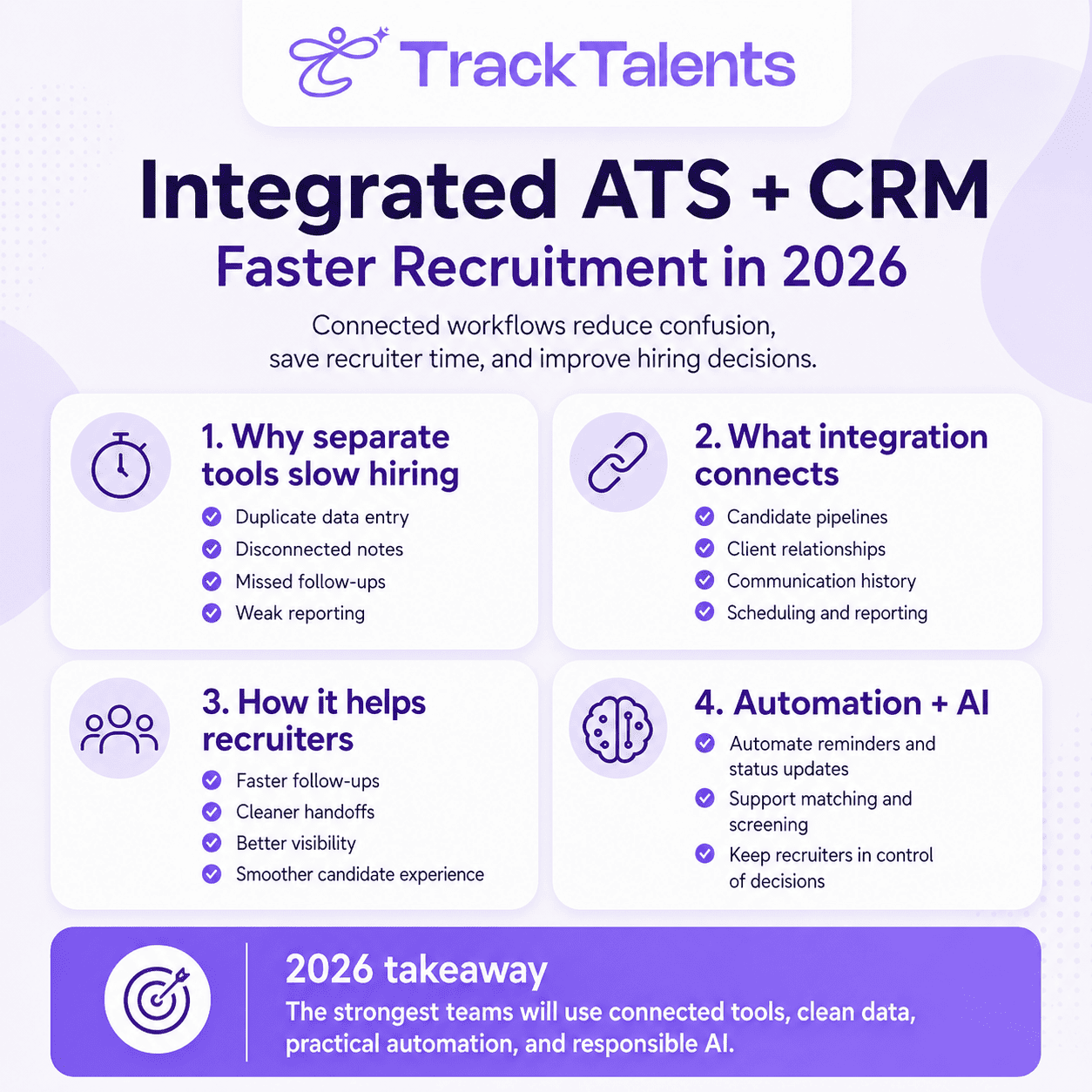
TrackTalents positions itself as a customizable ATS for recruiters, staffing agencies, and HR teams. Its official site highlights resume management, integrations, candidate tracking, job activity, and recruitment workflow support.
For recruiters using free resume databases, an ATS such as TrackTalents can help move scattered search results into a structured hiring pipeline.
The ATS does not replace sourcing. It protects the work recruiters have already done.
Screen Every Resume Before Shortlisting
A resume search result is only a lead. It is not proof of candidate quality.
Recruiters still need to check:
- Actual experience
- Role fit
- Motivation
- Salary alignment
- Notice period
- Availability
- Location or remote preference
- Communication quality
- Skill depth
- Accuracy of claims
This is even more important as recruiters see more AI-assisted resumes. AI can help candidates write clearer resumes, but it can also make weak profiles look polished.
Recruiters should ask candidates to explain:
- What work they actually handled
- Which tools did they use
- What results did they deliver
- What decisions they made
- Which projects are recent
- Which skills are hands-on
- What they want next
Free resume search can fill the top of the funnel. Screening protects the shortlist.
Candidate Privacy and Consent Still Matter
Recruiters should use resume databases in accordance with platform rules and applicable privacy laws.
A searchable resume does not mean recruiters should scrape, store, redistribute, or mass-message candidates without care.
Good recruiter practice includes:
- Contacting candidates professionally
- Explaining the role clearly
- Storing candidate data in approved systems
- Keeping records accurate
- Avoiding unnecessary personal data
- Updating or removing old data when required
- Respecting platform terms
- Avoiding spam-style outreach
For staffing agencies working across countries, privacy expectations can differ. The safer rule is simple: collect only what is needed, protect the data, and keep candidate communication respectful.
Build a Resume Search Strategy by Role Type
No recruiter should rely on a single free resume database.
Different roles need different channels.
Local Hourly Hiring
Use JobSpider, Craigslist, Jobvertise, PostJobFree, referrals, and local job boards.
Startup and Tech Hiring
Use Wellfound, LinkedIn, GitHub, niche communities, referrals, and your ATS database.
Remote and Flexible Roles
Use FlexJobs, remote job boards, LinkedIn, professional communities, and past remote candidates.
Senior Professional Roles
Use Ladders, Monster, LinkedIn, referrals, alumni networks, and targeted outreach.
Broad Mainstream Hiring
Use Indeed, ZipRecruiter, job boards, past applicants, and structured ATS search.
The strongest candidate may already be in the recruiter’s own database. External resume search should support internal rediscovery, not replace it.
Common Resume Search Mistakes Recruiters Can Fix
Searching Too Broadly
A vague search returns too many weak profiles. Use must-have skills, location, and exclusion terms.
Ignoring Your Own ATS
Past applicants, silver-medalist candidates, previous contractors, and old leads may respond faster than cold candidates.
Skipping Freshness Checks
An old resume may no longer reflect the candidate’s current role, salary, location, or availability.
Sending Generic Messages
A candidate found through a free database still expects relevant outreach.
Failing to Track Outcomes
Recruiters should know which database produced replies, interviews, submissions, offers, and joins.
Using Resume Search Without Role Clarity
If the job requirement is unclear, no database can strengthen the search.
Practical Workflow for Recruiters Using Free Resume Search
Follow this simple process:
- Build a role scorecard with must-have skills, preferred skills, salary range, location, work model, and exclusions.
- Search your own ATS first for past applicants, contractors, silver-medalist candidates, and future-fit profiles.
- Select external databases based on the role type.
- Build three searches: title-based, skill-based, and adjacent-background search.
- Filter by freshness, location, and must-have criteria.
- Review resumes for evidence, not keywords alone.
- Move suitable candidates into the ATS immediately.
- Send personalized outreach with role context and next step.
- Track responses, screening results, and source quality.
- Review which database produced qualified conversations, not just profile views.
This keeps free resume search practical, measurable, and reusable.
Frequently Asked Questions
What is a free resume search platform?
A free resume search platform allows recruiters to search resumes or candidate profiles without paying upfront. Some platforms are fully free, while others offer limited free access, free trials, or free search with paid contact access.
Are free resume databases reliable?
They can be useful, but quality varies. Recruiters should check resume freshness, candidate relevance, contact access, location fit, and platform quality before relying on any database.
Which free resume database is best for recruiters?
There is no single best option for every role. Indeed may help with broad hiring; Wellfound for startup roles; Jobvertise and PostJobFree for free search; JobSpider for U.S. and Canada hiring; and FlexJobs for remote or flexible roles.
Can recruiters contact candidates for free?
Sometimes. Some platforms allow free messaging or contact forms. Others allow resume search but require payment to unlock contact details. Recruiters should verify current platform rules before sourcing heavily.
How can recruiters search resumes more effectively?
Recruiters should use Boolean search, role-specific keywords, exclusion terms, location filters, recent-update filters, and skills-based search terms. They should also search their own ATS before using external databases.
Should staffing agencies use free resume search sites?
Yes, but only as part of a wider sourcing strategy. Staffing agencies should combine free databases with ATS rediscovery, referrals, LinkedIn sourcing, niche platforms, and structured candidate follow-up.
How does an ATS help with a free resume search?
An ATS helps recruiters store candidate records, track sources, manage outreach, avoid duplicate contacts, record screening notes, and reuse profiles for future roles.
Final Thoughts
Free resume search can help recruiters widen their reach, especially when budgets are limited. But free access does not guarantee candidate quality, response rates, or hiring success.
A recruiter still needs clear role requirements, sharp search terms, careful platform selection, structured screening, timely communication, and clean ATS records.
The best recruiters do not collect every free resume site and hope for results. They know which source fits which role. They filter quickly. They contact candidates professionally. They preserve useful profiles inside the ATS for future hiring.